



 Chat with AI
Exam 6: Terrestrial Worlds in the Inner Solar System

Exam 1: Our Place in the Universe71 Questions
Exam 2: Patterns in the Skymotions of Earth92 Questions
Exam 3: Laws of Motion70 Questions
Exam 4: Light and Telescopes71 Questions
Exam 5: The Formation of Stars and Planets79 Questions
Exam 6: Terrestrial Worlds in the Inner Solar System91 Questions
Exam 7: Atmospheres of Venus, Earth, and Mars69 Questions
Exam 8: The Giant Planets79 Questions
Exam 9: Small Bodies of the Solar System75 Questions
Exam 10: Measuring the Stars75 Questions
Exam 11: Our Star: The Sun71 Questions
Exam 12: Evolution of Low-Mass Stars73 Questions
Exam 13: Evolution of High-Mass Stars71 Questions
Exam 14: The Expansion of Space71 Questions
Exam 15: The Realm of the Galaxies71 Questions
Exam 16: Our Galaxy: The Milky Way80 Questions
Exam 17: Modern Cosmology and the Origin of Structure100 Questions
Exam 18: Life in the Universe41 Questions
Select questions type


The largest volcanic mountains in the Solar System are found on:
(Multiple Choice)
4.8/5  (76)
(76) If the Himalaya mountain range is presently 8,000 m in height and is rising at a rate of 0.5 m per century because of the convergence of two continental plates,how long did it take to create this mountain range?
(Multiple Choice)
4.8/5 (85)
(85) Studies of the amount of cratering at different locations on the Moon indicate that:
(Multiple Choice)
4.9/5 (85)
(85) The image below is of a crater on Mars.What evidence does it show about Mars?
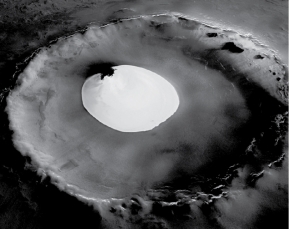
(Short Answer)
4.9/5 (83)
(83) Convection cannot take place in the Earth's mantle because it is not molten.
(True/False)
4.8/5 (75)
(75) Suppose an earthquake occurs on an imaginary planet.Scientists on the other side of the planet detect primary waves but not secondary waves after the quake occurs.This suggests that:
(Multiple Choice)
4.9/5 (69)
(69) All the terrestrial planets show evidence of disruptions due to tectonics.
(True/False)
4.8/5 (85)
(85) Which planet would you expect to have a larger molten core,a planet of Earth's size or a planet that had half the radius of Earth? Explain why.
(Essay)
5.0/5 (82)
(82) The interior of the Earth is hot mainly because of the pressure induced by the weight of the material above it.
(True/False)
4.7/5 (80)
(80) The fact that Earth's interior is differentiated suggests that:
(Multiple Choice)
4.8/5 (77)
(77) Based on the age of the light- and dark-colored regions of the Moon and the number of craters observed in these regions,we know that impacts in the inner Solar System:
(Multiple Choice)
4.9/5 (86)
(86) What is the surface temperature of a star that has a peak wavelength of 290 nm?
(Multiple Choice)
4.8/5 (82)
(82) Primary waves are seismic longitudinal waves whose paths are deflected when they travel through the Earth's liquid core.
(True/False)
4.8/5 (74)
(74) What would you study in order to determine the timescale on which the Earth's magnetic field reverses direction?
(Multiple Choice)
5.0/5 (76)
(76) The age of the Solar System can be determined most accurately by:
(Multiple Choice)
4.8/5 (82)
(82) Suppose you had samples of the same kind of rock from two planets that were completely identical except that the interior of one was chemically differentiated and the interior of the other was not.How would you expect the samples to differ from each other?
(Essay)
4.9/5 (68)
(68) A hotter star will radiate more blue photons than a cooler star.
(True/False)
4.8/5 (74)
(74) The Moon's tidal forces on Earth result in it pulling the near side of Earth toward it and pushing the far side of Earth away from it.
(True/False)
4.8/5 (73)
(73) 
Filters
- Essay(0)
- Multiple Choice(0)
- Short Answer(0)
- True False(0)
- Matching(0)