



 Chat with AI
Exam 12: Evolution of Low-Mass Stars

Exam 1: Our Place in the Universe71 Questions
Exam 2: Patterns in the Skymotions of Earth92 Questions
Exam 3: Laws of Motion70 Questions
Exam 4: Light and Telescopes71 Questions
Exam 5: The Formation of Stars and Planets79 Questions
Exam 6: Terrestrial Worlds in the Inner Solar System91 Questions
Exam 7: Atmospheres of Venus, Earth, and Mars69 Questions
Exam 8: The Giant Planets79 Questions
Exam 9: Small Bodies of the Solar System75 Questions
Exam 10: Measuring the Stars75 Questions
Exam 11: Our Star: The Sun71 Questions
Exam 12: Evolution of Low-Mass Stars73 Questions
Exam 13: Evolution of High-Mass Stars71 Questions
Exam 14: The Expansion of Space71 Questions
Exam 15: The Realm of the Galaxies71 Questions
Exam 16: Our Galaxy: The Milky Way80 Questions
Exam 17: Modern Cosmology and the Origin of Structure100 Questions
Exam 18: Life in the Universe41 Questions
Select questions type


Asymptotic giant branch (AGB)stars have high-mass loss rates because:
(Multiple Choice)
4.8/5  (84)
(84) Pressure from degenerate electrons keeps the core of a red giant star from collapsing.
(True/False)
4.9/5 (86)
(86) Suppose you measured H-R diagrams for the two star clusters pictured below. 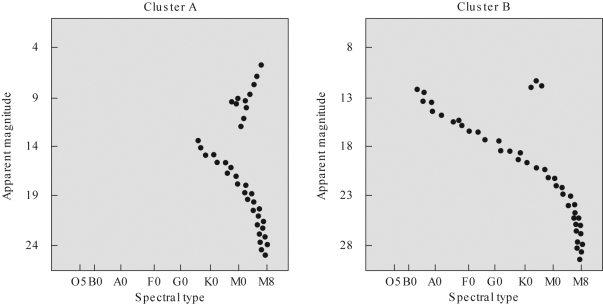 Which of the following statements is TRUE?
 (Multiple Choice)
4.7/5 (80)
(80) Why does helium burning in the core of a giant star not cause the star to become more luminous?
(Essay)
4.9/5 (69)
(69) As a main-sequence star burns its core supply of hydrogen,what happens?
(Multiple Choice)
4.7/5 (93)
(93) What ionizes the gas in a planetary nebula (see the image below)and makes it visible? 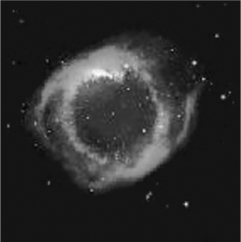
(Multiple Choice)
4.7/5 (85)
(85) A star like the Sun will eventually become an electron degenerate white dwarf star.
(True/False)
4.9/5 (94)
(94) Suppose you observe three star clusters.Cluster 1 has a main-sequence turnoff point at spectral type G,Cluster 2 has a turnoff point at spectral type A,and Cluster 3 has a turnoff point at spectral type B.Which cluster is youngest and which is oldest? Explain why.What is the approximate age of the oldest cluster?
(Essay)
4.8/5 (83)
(83) The figure below plots the chemical composition of the Sun as a function of radius for three different times.Which graph represents the correct chemical composition just prior to the Sun becoming a red giant? 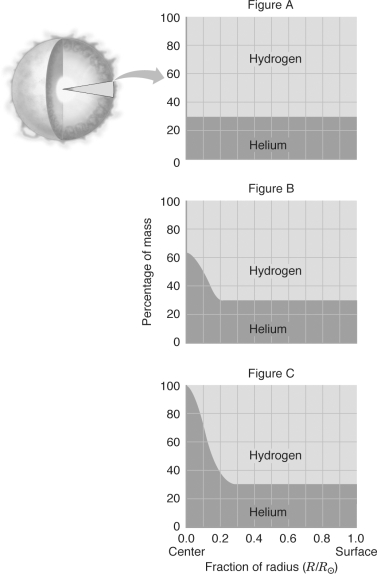
(Multiple Choice)
4.8/5 (74)
(74) A low-mass star that burns helium in its core and hydrogen in a shell is more luminous than a similar star that burns only hydrogen in a shell around a dead core.
(True/False)
4.9/5 (74)
(74) In what two ways does temperature affect the rate of nuclear reactions?
(Essay)
4.9/5 (91)
(91) A star like the Sun will lose about __________ of its mass before it evolves to become a white dwarf.
(Multiple Choice)
4.9/5 (81)
(81) Once the core of a low-mass main-sequence star runs out of hydrogen,fusion in the star stops until the core temperature is high enough for helium fusion to begin.
(True/False)
4.9/5 (83)
(83) A Type Ia supernova occurs when a white dwarf exceeds a mass of __________.
(Multiple Choice)
4.7/5 (77)
(77) 
Filters
- Essay(0)
- Multiple Choice(0)
- Short Answer(0)
- True False(0)
- Matching(0)