



 Chat with AI
Exam 13: The Costs of Production

Exam 1: Ten Lessons From Economics149 Questions
Exam 2: Thinking Like an Economist147 Questions
Exam 3: Interdependence and the Gains From Trade153 Questions
Exam 4: The Market Forces of Supply and Demand222 Questions
Exam 5: Elasticity and Its Application181 Questions
Exam 6: Supply, Demand and Government Policies148 Questions
Exam 7: Consumers, Producers and the Efficiency of Markets177 Questions
Exam 8: Application: The Costs of Taxation141 Questions
Exam 9: Application: International Trade161 Questions
Exam 10: Externalities199 Questions
Exam 11: Public Goods and Common Resources182 Questions
Exam 12: The Design of the Tax System154 Questions
Exam 13: The Costs of Production191 Questions
Exam 14: Firms in Competitive Markets200 Questions
Exam 15: Monopoly214 Questions
Exam 16: Business Strategy184 Questions
Exam 17: Competition Policy104 Questions
Exam 18: Monopolistic Competition214 Questions
Exam 19: The Markets for the Factors of Production215 Questions
Exam 20: Earnings, Unions and Discrimination206 Questions
Exam 21: Income Inequity and Poverty111 Questions
Exam 22: The Theory of Consumer Choice161 Questions
Exam 23: Frontiers of Microeconomics120 Questions
Exam 24: Measuring a Nations Income51 Questions
Exam 25: Measuring the Cost of Living52 Questions
Exam 26: Production and Growth62 Questions
Exam 27: Saving, Investment and the Financial System62 Questions
Exam 28: The Natural Rate of Unemployment59 Questions
Exam 29: The Monetary System66 Questions
Exam 30: Inflation: Its Causes and Costs74 Questions
Exam 31: Open-Economy Macroeconomics: Basic Concepts68 Questions
Exam 32: A Macroeconomic Theory of the Open Economy64 Questions
Exam 33: Aggregate Demand and Aggregate Supply82 Questions
Exam 34: The Influence of Monetary and Fiscal Policy on Aggregate Demand73 Questions
Exam 35: The Short-Run Trade-Off Between Inflation and Unemployment58 Questions
Exam 36: Five Debates Over Macroeconomic Policy38 Questions
Select questions type


If the total cost curve becomes steeper as output increases, then this reveals diminishing marginal product.
(True/False)
4.8/5  (81)
(81) An example of an implicit cost of production for a forestry company would be:
(Multiple Choice)
4.8/5 (72)
(72) Table 13-1
Measures of Cost for Splashy Cardboard Kayak Factory.
 -Refer to Table 13-1. The average variable cost of producing 3 kayaks is:
 (Multiple Choice)
4.8/5 (78)
(78) Economists and accountants agree on the inclusion of implicit costs into the cost analysis of a firm.
(True/False)
4.8/5 (89)
(89) Graph 13-3
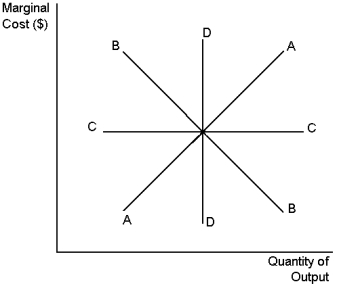 -Refer to Graph 13-3. If marginal cost is rising, then:
 (Multiple Choice)
4.8/5 (77)
(77) Graph 13-6
 This graph depicts average total cost functions for a firm that produces automobiles. Use the graph to answer the following question(s).
-Refer to Graph 13-6. This firm experiences economies of scale at which output levels?
This graph depicts average total cost functions for a firm that produces automobiles. Use the graph to answer the following question(s).
-Refer to Graph 13-6. This firm experiences economies of scale at which output levels? (Multiple Choice)
4.8/5 (83)
(83) What are opportunity costs? How do explicit and implicit costs relate to opportunity costs?
(Essay)
4.9/5 (90)
(90) Which of the following costs do not vary with the amount of output a firm produces?
(Multiple Choice)
4.9/5 (73)
(73) The amount of money that a firm receives from the sale of its output is called:
(Multiple Choice)
4.7/5 (73)
(73) Amy owns a photo developing shop. She also does contract photography. If she takes on a contract, she cannot develop photos in that time and her customers use another firm. Suppose Amy rejects a contract to photograph a wedding. This would have been a five hour job and Amy charges $500 per hour. She spent those five hours developing photos. Her chemicals and paper cost $1250. She earned $3500 in sales.
-According to the information provided, Amy's economic profit is:
(Multiple Choice)
4.8/5 (75)
(75) A U-shaped long-run average total cost curve can be explained by firms increasing their size to do which of the following? (i) take advantage of greater specialisation
(ii) avoid coordination problems
(iii) avoid fixed costs
(Multiple Choice)
4.9/5 (76)
(76) Diminishing marginal product of labour occurs when adding another unit of labour:
(Multiple Choice)
4.9/5 (91)
(91) Adam Smith's example of the pin factory demonstrates that economies of scale result from specialisation.
(True/False)
4.7/5 (84)
(84) One of the most important properties of cost curves is that:
(Multiple Choice)
4.9/5 (73)
(73) The cost to produce the typical unit of output is the firm's:
(Multiple Choice)
4.9/5 (94)
(94) Farmer Jack is a watermelon farmer. If Jack plants no seeds on his farm, he gets no harvest. If he plants one bag of seeds, he gets 30 watermelons. If he plants two bags of seeds, he gets 50 watermelons. If he plants three bags of seeds he gets 60 watermelons. A bag of seeds costs $100 and seeds are his only costs.
-Harry's Hotdogs is a small street vendor business owned by Harry Huggins. Harry is trying to get a better understanding of his costs by categorising them as fixed or variable. Which of the following costs are most likely to be considered fixed costs?
(Multiple Choice)
4.8/5 (84)
(84) 
Filters
- Essay(0)
- Multiple Choice(0)
- Short Answer(0)
- True False(0)
- Matching(0)