



 Chat with AI
Exam 13: The Costs of Production

Exam 1: Ten Lessons From Economics149 Questions
Exam 2: Thinking Like an Economist147 Questions
Exam 3: Interdependence and the Gains From Trade153 Questions
Exam 4: The Market Forces of Supply and Demand222 Questions
Exam 5: Elasticity and Its Application181 Questions
Exam 6: Supply, Demand and Government Policies148 Questions
Exam 7: Consumers, Producers and the Efficiency of Markets177 Questions
Exam 8: Application: The Costs of Taxation141 Questions
Exam 9: Application: International Trade161 Questions
Exam 10: Externalities199 Questions
Exam 11: Public Goods and Common Resources182 Questions
Exam 12: The Design of the Tax System154 Questions
Exam 13: The Costs of Production191 Questions
Exam 14: Firms in Competitive Markets200 Questions
Exam 15: Monopoly214 Questions
Exam 16: Business Strategy184 Questions
Exam 17: Competition Policy104 Questions
Exam 18: Monopolistic Competition214 Questions
Exam 19: The Markets for the Factors of Production215 Questions
Exam 20: Earnings, Unions and Discrimination206 Questions
Exam 21: Income Inequity and Poverty111 Questions
Exam 22: The Theory of Consumer Choice161 Questions
Exam 23: Frontiers of Microeconomics120 Questions
Exam 24: Measuring a Nations Income51 Questions
Exam 25: Measuring the Cost of Living52 Questions
Exam 26: Production and Growth62 Questions
Exam 27: Saving, Investment and the Financial System62 Questions
Exam 28: The Natural Rate of Unemployment59 Questions
Exam 29: The Monetary System66 Questions
Exam 30: Inflation: Its Causes and Costs74 Questions
Exam 31: Open-Economy Macroeconomics: Basic Concepts68 Questions
Exam 32: A Macroeconomic Theory of the Open Economy64 Questions
Exam 33: Aggregate Demand and Aggregate Supply82 Questions
Exam 34: The Influence of Monetary and Fiscal Policy on Aggregate Demand73 Questions
Exam 35: The Short-Run Trade-Off Between Inflation and Unemployment58 Questions
Exam 36: Five Debates Over Macroeconomic Policy38 Questions
Select questions type


Dave is majoring in computer information development at University of Environmental Sustainability. While he has been attending university, Dave has started a computer consulting business to help local residents set up a local skill-sharing network. Dave charges $25 per hour for his consulting services. Dave also works five hours a week for the Arts Faculty to maintain its departmental web page. The Arts Faculty pays Dave $20 per hour. From this information we can conclude that:
(Multiple Choice)
4.8/5  (87)
(87) The cost of producing an additional unit of a good is not the same as the average cost of the good.
(True/False)
4.7/5 (74)
(74) Diminishing marginal product exists when the production function becomes flatter as inputs increase.
(True/False)
4.9/5 (73)
(73) At low output levels a firm's average total cost tends to be high because:
(Multiple Choice)
5.0/5 (69)
(69) Amy owns a photo developing shop. She also does contract photography. If she takes on a contract, she cannot develop photos in that time and her customers use another firm. Suppose Amy rejects a contract to photograph a wedding. This would have been a five hour job and Amy charges $500 per hour. She spent those five hours developing photos. Her chemicals and paper cost $1250. She earned $3500 in sales.
-According to the information provided, Amy's accountant would most likely figure the total cost of her photograph developing to be:
(Multiple Choice)
4.8/5 (80)
(80) As a firm moves along its long-run average cost curve, it is adjusting the size of its factory to the quantity of production.
(True/False)
4.9/5 (89)
(89) An important implicit cost of almost every business is the:
(Multiple Choice)
4.7/5 (81)
(81) Table 13-2
Adrienne's Premium Boxing Service subcontracts with a chocolate manufacturer to box premium chocolates for their mail order catalogue business. Adrienne rents a small room for $150 a week in the downtown business district that serves as her factory. She can hire workers for $275 a week. Costs are in dollars per week.
 -Refer to Table 13-2. One week, Adrian exactly breaks even. If her revenue for the week is $1525, how many boxes of chocolate did she produce?
 (Multiple Choice)
4.9/5 (87)
(87) The marginal product of labour can be defined as (where denotes 'change'):
(Multiple Choice)
4.9/5 (78)
(78) The average total cost curve is increasing when marginal cost is:
(Multiple Choice)
4.7/5 (70)
(70) Complete the following formulae:
TVC = costs
TC = total
AVC = costs
AC = costs
TFC = costs
AFC = average
MC = costs
TC = TFC +
AC = + AVC
MC = ∆TC/ = /∆Q
AFC = TFC/
AVC = /Q
AC = TC/Q
(Essay)
5.0/5 (86)
(86) Graph 13-2
 This graph depicts a total cost function for a firm that produces cookies. Use the graph to answer the following question(s).
-Refer to Graph 13-2. Identify the true statements from the list below. (i) diminishing marginal product for all levels of input usage
(ii) total output increases but at a decreasing rate
(iii) the slope of the production function increases as quantity of inputs increase.
This graph depicts a total cost function for a firm that produces cookies. Use the graph to answer the following question(s).
-Refer to Graph 13-2. Identify the true statements from the list below. (i) diminishing marginal product for all levels of input usage
(ii) total output increases but at a decreasing rate
(iii) the slope of the production function increases as quantity of inputs increase. (Multiple Choice)
5.0/5 (84)
(84) Bob Edwards owns Bob's Bagels. He hires an economist who assesses the shape of the bagel shop's average total cost (ATC) curve as a function of the number of bagels produced. The results indicate a U-shaped average total cost curve. Bob's economist explains that the ATC curve is U-shaped for two reasons, the first being the existence of diminishing marginal product, which causes it to rise. What would the second reason be? Assume that the marginal cost curve is linear. (Hint: The second reason relates to average fixed cost.)
(Essay)
4.9/5 (80)
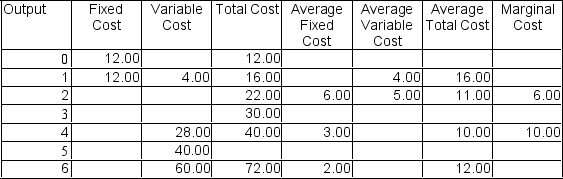
(80) 
Economists normally assume that a firm would? (i) sell a higher output if this would increase revenue
(ii) sell a lower output and collect less revenue, if this would increase profit
(iii) sell a higher output and incur more costs, if this would increase profit
(Multiple Choice)
4.8/5 (63)
(63) 
Filters
- Essay(0)
- Multiple Choice(0)
- Short Answer(0)
- True False(0)
- Matching(0)