



 Chat with AI
Exam 13: The Costs of Production

Exam 1: Ten Lessons From Economics149 Questions
Exam 2: Thinking Like an Economist147 Questions
Exam 3: Interdependence and the Gains From Trade153 Questions
Exam 4: The Market Forces of Supply and Demand222 Questions
Exam 5: Elasticity and Its Application181 Questions
Exam 6: Supply, Demand and Government Policies148 Questions
Exam 7: Consumers, Producers and the Efficiency of Markets177 Questions
Exam 8: Application: The Costs of Taxation141 Questions
Exam 9: Application: International Trade161 Questions
Exam 10: Externalities199 Questions
Exam 11: Public Goods and Common Resources182 Questions
Exam 12: The Design of the Tax System154 Questions
Exam 13: The Costs of Production191 Questions
Exam 14: Firms in Competitive Markets200 Questions
Exam 15: Monopoly214 Questions
Exam 16: Business Strategy184 Questions
Exam 17: Competition Policy104 Questions
Exam 18: Monopolistic Competition214 Questions
Exam 19: The Markets for the Factors of Production215 Questions
Exam 20: Earnings, Unions and Discrimination206 Questions
Exam 21: Income Inequity and Poverty111 Questions
Exam 22: The Theory of Consumer Choice161 Questions
Exam 23: Frontiers of Microeconomics120 Questions
Exam 24: Measuring a Nations Income51 Questions
Exam 25: Measuring the Cost of Living52 Questions
Exam 26: Production and Growth62 Questions
Exam 27: Saving, Investment and the Financial System62 Questions
Exam 28: The Natural Rate of Unemployment59 Questions
Exam 29: The Monetary System66 Questions
Exam 30: Inflation: Its Causes and Costs74 Questions
Exam 31: Open-Economy Macroeconomics: Basic Concepts68 Questions
Exam 32: A Macroeconomic Theory of the Open Economy64 Questions
Exam 33: Aggregate Demand and Aggregate Supply82 Questions
Exam 34: The Influence of Monetary and Fiscal Policy on Aggregate Demand73 Questions
Exam 35: The Short-Run Trade-Off Between Inflation and Unemployment58 Questions
Exam 36: Five Debates Over Macroeconomic Policy38 Questions
Select questions type


Table 13-1
Measures of Cost for Splashy Cardboard Kayak Factory.
 -Refer to Table 13-1. What is the marginal cost of producing the first kayak?
 (Multiple Choice)
4.8/5  (84)
(84) Graph 13-5
 The set of curves above reflect information about the cost structure of a firm. Use this graph to answer the following question(s).
-Refer to Graph 13-5. Which of the curves is most likely to represent average fixed cost?
The set of curves above reflect information about the cost structure of a firm. Use this graph to answer the following question(s).
-Refer to Graph 13-5. Which of the curves is most likely to represent average fixed cost? (Multiple Choice)
4.7/5 (90)
(90) Farmer Jack is a watermelon farmer. If Jack plants no seeds on his farm, he gets no harvest. If he plants one bag of seeds, he gets 30 watermelons. If he plants two bags of seeds, he gets 50 watermelons. If he plants three bags of seeds he gets 60 watermelons. A bag of seeds costs $100 and seeds are his only costs.
-According to the information provided, which of the following statements is(are) true? (i) farmer Jack experiences decreasing marginal product
(ii) farmer Jack's total cost curve is linear
(iii) farmer Jack's production function is nonlinear
(Multiple Choice)
4.9/5 (72)
(72) Graph 13-2
 This graph depicts a total cost function for a firm that produces cookies. Use the graph to answer the following question(s).
-Refer to Graph 13-2. Which of the statements below best captures information about the underlying production function?
This graph depicts a total cost function for a firm that produces cookies. Use the graph to answer the following question(s).
-Refer to Graph 13-2. Which of the statements below best captures information about the underlying production function? (Multiple Choice)
4.9/5 (73)
(73) The efficient scale of the firm is the quantity of output that:
(Multiple Choice)
4.8/5 (92)
(92) The cost of capital includes both any interest payments in loans as well as any forgone interest on savings used to finance the business.
(True/False)
4.8/5 (77)
(77) The production function depicts a relationship between which two variables? Draw a production function that exhibits diminishing marginal product.
(Essay)
4.9/5 (82)
(82) Average variable cost is equal to the quantity of output divided by the total variable cost.
(True/False)
4.9/5 (77)
(77) Table 13-1
Measures of Cost for Splashy Cardboard Kayak Factory.
-Refer to Table 13-1. What is the variable cost of producing 5 kayaks?
-Refer to Table 13-1. What is the variable cost of producing 5 kayaks? (Multiple Choice)
4.7/5 (87)
(87) Farmer Jack is a watermelon farmer. If Jack plants no seeds on his farm, he gets no harvest. If he plants one bag of seeds, he gets 30 watermelons. If he plants two bags of seeds, he gets 50 watermelons. If he plants three bags of seeds he gets 60 watermelons. A bag of seeds costs $100 and seeds are his only costs.
-Harry Hoarder runs a small street vendor service which contracts to produce and sell moulded plastic souvenirs (key chains, commemorative plastic coins, plastic animals, etc.) at small theatre shows. As owner of the firm, Harry must decide how much of each product to produce. The key element of this decision is:
(Multiple Choice)
4.8/5 (72)
(72) A production function is a relationship between inputs and:
(Multiple Choice)
4.9/5 (82)
(82) Which of the following would be categorised as an opportunity cost? (i) wages of workers
(ii) raw material costs
(iii) forgone investment opportunities
(Multiple Choice)
4.8/5 (87)
(87) If total costs are divided by the change in quantity produced we calculate the:
(Multiple Choice)
4.8/5 (73)
(73) The cost to produce an additional unit of output is the firm's:
(Multiple Choice)
4.8/5 (82)
(82) Table 13-3
Consider the following firm which makes high-performance racing bicycles. All costs are given in dollars. Output is shown on a monthly basis. The firm's fixed costs include a rent of $800 and a lease cost of $400 per month.
 -Refer to Table 13-3. What is the marginal cost of producing the tenth bicycle in a given month?
 (Multiple Choice)
4.8/5 (88)
(88) Graph 13-3
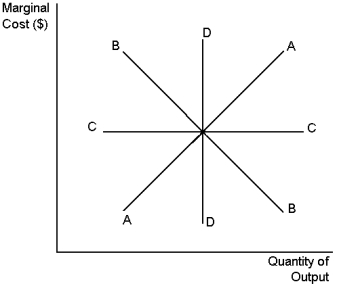 -Refer to Graph 13-3. Which of the marginal cost curves shown reflects the existence of diminishing marginal product?
 (Multiple Choice)
5.0/5 (70)
(70) 
Filters
- Essay(0)
- Multiple Choice(0)
- Short Answer(0)
- True False(0)
- Matching(0)