



 Chat with AI
Exam 7: Consumers, Producers and the Efficiency of Markets

Exam 1: Ten Lessons From Economics149 Questions
Exam 2: Thinking Like an Economist147 Questions
Exam 3: Interdependence and the Gains From Trade153 Questions
Exam 4: The Market Forces of Supply and Demand222 Questions
Exam 5: Elasticity and Its Application181 Questions
Exam 6: Supply, Demand and Government Policies148 Questions
Exam 7: Consumers, Producers and the Efficiency of Markets177 Questions
Exam 8: Application: The Costs of Taxation141 Questions
Exam 9: Application: International Trade161 Questions
Exam 10: Externalities199 Questions
Exam 11: Public Goods and Common Resources182 Questions
Exam 12: The Design of the Tax System154 Questions
Exam 13: The Costs of Production191 Questions
Exam 14: Firms in Competitive Markets200 Questions
Exam 15: Monopoly214 Questions
Exam 16: Business Strategy184 Questions
Exam 17: Competition Policy104 Questions
Exam 18: Monopolistic Competition214 Questions
Exam 19: The Markets for the Factors of Production215 Questions
Exam 20: Earnings, Unions and Discrimination206 Questions
Exam 21: Income Inequity and Poverty111 Questions
Exam 22: The Theory of Consumer Choice161 Questions
Exam 23: Frontiers of Microeconomics120 Questions
Exam 24: Measuring a Nations Income51 Questions
Exam 25: Measuring the Cost of Living52 Questions
Exam 26: Production and Growth62 Questions
Exam 27: Saving, Investment and the Financial System62 Questions
Exam 28: The Natural Rate of Unemployment59 Questions
Exam 29: The Monetary System66 Questions
Exam 30: Inflation: Its Causes and Costs74 Questions
Exam 31: Open-Economy Macroeconomics: Basic Concepts68 Questions
Exam 32: A Macroeconomic Theory of the Open Economy64 Questions
Exam 33: Aggregate Demand and Aggregate Supply82 Questions
Exam 34: The Influence of Monetary and Fiscal Policy on Aggregate Demand73 Questions
Exam 35: The Short-Run Trade-Off Between Inflation and Unemployment58 Questions
Exam 36: Five Debates Over Macroeconomic Policy38 Questions
Select questions type


In what way(s) are free-market outcomes, where supply equals demand, beneficial to society?
(Essay)
4.8/5  (77)
(77) Graph 7-2
 -Refer to Graph 7-2. When the price rises from P1 to P2, consumer surplus:
 (Multiple Choice)
4.8/5 (81)
(81) Table A
 -Use the information in Table A to graph a demand curve for this product.
Table B

-Use the information in Table A to graph a demand curve for this product.
Table B
(Essay)
4.8/5 (78)
(78) Restrictions against ticket scalping actually drive up the cost of many tickets.
(True/False)
4.8/5 (71)
(71) Table C
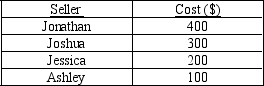 -Use the information in Table C to graph a supply curve for this product.
 (Essay)
4.9/5 (86)
(86) For any given quantity, the price on a supply curve represents the marginal buyer's willingness to pay.
(True/False)
4.9/5 (98)
(98) Graph 7-4
 -In Graph 7-4, at the market-clearing equilibrium, total producer surplus is represented by the area:
 (Multiple Choice)
4.8/5 (70)
(70) To measure the total consumer surplus in a market, the area above the demand curve is added to the area below the price.
(True/False)
4.7/5 (90)
(90) Graph 7-3
 -According to Graph 7-3, at the price P1, producer surplus is:
 (Multiple Choice)
5.0/5 (76)
(76) Khan is a financial analyst and provides a consultancy service. He charges clients $2000 per day. His producer surplus is $1200. Khan's willingness to sell is:
(Multiple Choice)
4.8/5 (83)
(83) Donald produces nails at a cost of $200 per ton. If he sells the nails for $500 per ton, his producer surplus is:
(Multiple Choice)
5.0/5 (86)
(86) Laissez-faire is a French expression that literally means 'let the market fare well'.
(True/False)
4.9/5 (81)
(81) Table 7-1
This table refers to five possible buyers' willingness to pay for good Z.
 -Refer to Table 7-1. If the market price is $5.50, the consumer surplus in the market will be:
 (Multiple Choice)
4.7/5 (81)
(81) Graph 7-4
-In Graph 7-4, at the market-clearing equilibrium, total consumer surplus is represented by the area:
-In Graph 7-4, at the market-clearing equilibrium, total consumer surplus is represented by the area: (Multiple Choice)
4.9/5 (70)
(70) Would a market that was characterised by unregulated pollution be classed as efficient? Why or why not?
(Essay)
4.9/5 (95)
(95) Graph 7-3
-According to Graph 7-3, when the price falls from P2 to P1, producer surplus:
-According to Graph 7-3, when the price falls from P2 to P1, producer surplus: (Multiple Choice)
4.9/5 (85)
(85) 
Filters
- Essay(0)
- Multiple Choice(0)
- Short Answer(0)
- True False(0)
- Matching(0)