



 Chat with AI
Exam 7: Consumers, Producers and the Efficiency of Markets

Exam 1: Ten Lessons From Economics149 Questions
Exam 2: Thinking Like an Economist147 Questions
Exam 3: Interdependence and the Gains From Trade153 Questions
Exam 4: The Market Forces of Supply and Demand222 Questions
Exam 5: Elasticity and Its Application181 Questions
Exam 6: Supply, Demand and Government Policies148 Questions
Exam 7: Consumers, Producers and the Efficiency of Markets177 Questions
Exam 8: Application: The Costs of Taxation141 Questions
Exam 9: Application: International Trade161 Questions
Exam 10: Externalities199 Questions
Exam 11: Public Goods and Common Resources182 Questions
Exam 12: The Design of the Tax System154 Questions
Exam 13: The Costs of Production191 Questions
Exam 14: Firms in Competitive Markets200 Questions
Exam 15: Monopoly214 Questions
Exam 16: Business Strategy184 Questions
Exam 17: Competition Policy104 Questions
Exam 18: Monopolistic Competition214 Questions
Exam 19: The Markets for the Factors of Production215 Questions
Exam 20: Earnings, Unions and Discrimination206 Questions
Exam 21: Income Inequity and Poverty111 Questions
Exam 22: The Theory of Consumer Choice161 Questions
Exam 23: Frontiers of Microeconomics120 Questions
Exam 24: Measuring a Nations Income51 Questions
Exam 25: Measuring the Cost of Living52 Questions
Exam 26: Production and Growth62 Questions
Exam 27: Saving, Investment and the Financial System62 Questions
Exam 28: The Natural Rate of Unemployment59 Questions
Exam 29: The Monetary System66 Questions
Exam 30: Inflation: Its Causes and Costs74 Questions
Exam 31: Open-Economy Macroeconomics: Basic Concepts68 Questions
Exam 32: A Macroeconomic Theory of the Open Economy64 Questions
Exam 33: Aggregate Demand and Aggregate Supply82 Questions
Exam 34: The Influence of Monetary and Fiscal Policy on Aggregate Demand73 Questions
Exam 35: The Short-Run Trade-Off Between Inflation and Unemployment58 Questions
Exam 36: Five Debates Over Macroeconomic Policy38 Questions
Select questions type


Economists generally believe that although there may be advantages to society from ticket scalping, the costs to society of this activity outweigh the benefits.
(True/False)
4.7/5  (63)
(63) Ticket scalping leads to a reduction in economic efficiency and therefore to a reduction in economic wellbeing.
(True/False)
4.7/5 (72)
(72) Suppose the price of DVD rentals increases. Explain what will happen to:
a. potential renters who are illegally downloading movies.
b. renters who have not yet begun downloading movies.
c. the consumer surplus in the DVD rental market.
d. the number of downloads that will now occur.
(Essay)
4.9/5 (85)
(85) Table 7-7
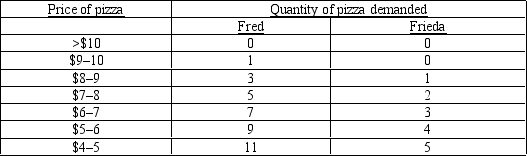 Antonio's Pizza
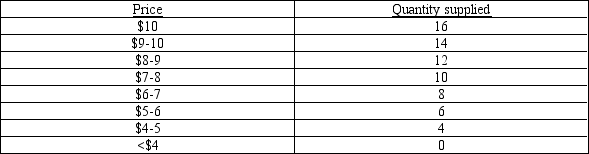 -Refer to Table 7-7. Is the pizza market described in the above tables efficient? Explain. Is it equitable? Explain.
Antonio's Pizza
-Refer to Table 7-7. Is the pizza market described in the above tables efficient? Explain. Is it equitable? Explain. (Essay)
4.8/5 (79)
(79) The Health Ministry announces that eating chocolate increases tooth decay. As a result, the equilibrium market price _____ and producer surplus of chocolate _____.
(Multiple Choice)
4.9/5 (85)
(85) Graph 7-2
 -Refer to Graph 7-2. When the price rises from P1 to P2, which of the following is NOT true?
 (Multiple Choice)
4.8/5 (84)
(84) What is the relationship between the demand curve and the willingness to pay?
(Essay)
5.0/5 (80)
(80) Graph 7-7
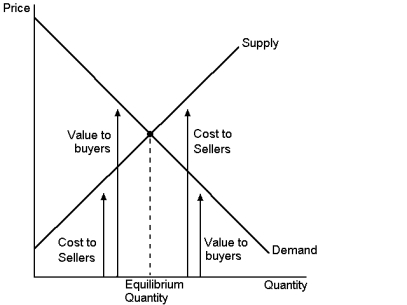 -Refer to Graph 7-7. Explain why this graph verifies the fact that the market equilibrium (quantity) maximises the sum of producer and consumer surplus.
 (Essay)
4.7/5 (66)
(66) The appropriate measure for buyers' valuation of a good is how willing they are to pay.
(True/False)
4.7/5 (79)
(79) Many economists believe that a market for human organs would lead to an:
(Multiple Choice)
5.0/5 (75)
(75) Lucy often buys fish and is able to buy it for less than she is willing-to-pay. She later learns that fish has more health benefits than she realised. She now values fish even more than before. If the market price of fish does not change then:
(Multiple Choice)
4.8/5 (84)
(84) A buyer is willing to buy a product at a price greater than or equal to his willingness to pay, but would refuse to buy a product at a price less than his willingness to pay.
(True/False)
4.7/5 (90)
(90) Graph 7-1
 -Refer to Graph 7-1. What area represents consumer surplus when the price is P1?
 (Multiple Choice)
4.9/5 (73)
(73) A group of people are bidding on an internet auction for a used car. Each bidder will not bid more than a maximum amount that is unique to them. This maximum is called:
(Multiple Choice)
4.9/5 (76)
(76) Public policy can improve market efficiency when there are instances of market failure.
(True/False)
4.8/5 (89)
(89) Free markets allocate (1) the supply of goods to the buyers who value them most highly and (2) the demand for goods to the sellers who can produce them at least cost.
(True/False)
4.9/5 (75)
(75) If demand increases, the price of a product, as well as producer surplus:
(Multiple Choice)
4.7/5 (66)
(66) Even though participants in the economy are motivated by self-interest, the 'invisible hand' of the marketplace guides this self-interest into promoting general economic wellbeing.
(True/False)
4.8/5 (67)
(67) 
Filters
- Essay(0)
- Multiple Choice(0)
- Short Answer(0)
- True False(0)
- Matching(0)