



 Chat with AI
Exam 7: Consumers, Producers and the Efficiency of Markets

Exam 1: Ten Lessons From Economics149 Questions
Exam 2: Thinking Like an Economist147 Questions
Exam 3: Interdependence and the Gains From Trade153 Questions
Exam 4: The Market Forces of Supply and Demand222 Questions
Exam 5: Elasticity and Its Application181 Questions
Exam 6: Supply, Demand and Government Policies148 Questions
Exam 7: Consumers, Producers and the Efficiency of Markets177 Questions
Exam 8: Application: The Costs of Taxation141 Questions
Exam 9: Application: International Trade161 Questions
Exam 10: Externalities199 Questions
Exam 11: Public Goods and Common Resources182 Questions
Exam 12: The Design of the Tax System154 Questions
Exam 13: The Costs of Production191 Questions
Exam 14: Firms in Competitive Markets200 Questions
Exam 15: Monopoly214 Questions
Exam 16: Business Strategy184 Questions
Exam 17: Competition Policy104 Questions
Exam 18: Monopolistic Competition214 Questions
Exam 19: The Markets for the Factors of Production215 Questions
Exam 20: Earnings, Unions and Discrimination206 Questions
Exam 21: Income Inequity and Poverty111 Questions
Exam 22: The Theory of Consumer Choice161 Questions
Exam 23: Frontiers of Microeconomics120 Questions
Exam 24: Measuring a Nations Income51 Questions
Exam 25: Measuring the Cost of Living52 Questions
Exam 26: Production and Growth62 Questions
Exam 27: Saving, Investment and the Financial System62 Questions
Exam 28: The Natural Rate of Unemployment59 Questions
Exam 29: The Monetary System66 Questions
Exam 30: Inflation: Its Causes and Costs74 Questions
Exam 31: Open-Economy Macroeconomics: Basic Concepts68 Questions
Exam 32: A Macroeconomic Theory of the Open Economy64 Questions
Exam 33: Aggregate Demand and Aggregate Supply82 Questions
Exam 34: The Influence of Monetary and Fiscal Policy on Aggregate Demand73 Questions
Exam 35: The Short-Run Trade-Off Between Inflation and Unemployment58 Questions
Exam 36: Five Debates Over Macroeconomic Policy38 Questions
Select questions type


Suppose a market clears and this generates an equilibrium price and quantity. An important outcome of this equilibrium is that it maximises the total benefits to both buyers and sellers.
(True/False)
4.9/5  (81)
(81) The highest price a buyer is prepared to spend on a good, is that buyer's willingness to pay.
(True/False)
4.8/5 (78)
(78) What was the 'invisible hand' doctrine that Adam Smith discussed in his 1776 book An Inquiry into the Nature and Causes of the Wealth of Nations?
(Essay)
4.8/5 (84)
(84) If the cost of producing automobiles increases, consumer surplus will:
(Multiple Choice)
4.9/5 (66)
(66) A seller would be willing to sell a product ONLY if the price received is:
(Multiple Choice)
4.8/5 (79)
(79) The area below a demand curve and above the price measures:
(Multiple Choice)
4.8/5 (73)
(73)  -According to Graph 7-3, area B represents:
Graph 7-2
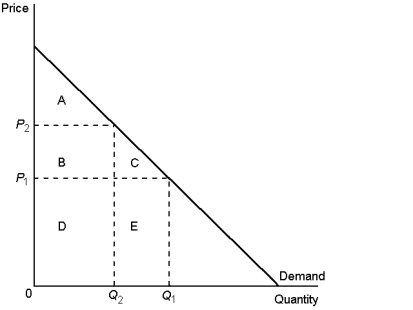 -Refer to Graph 7-2. When the price is P1, consumer surplus is:
 (Multiple Choice)
4.8/5 (94)
(94) Jean wants to sell her camera. Greg offers her $250. Lee offers her $300. Jean decides to sell the camera to Greg because he made the first offer. This is an example of an efficient market transaction.
(True/False)
4.8/5 (81)
(81) At all quantity levels the price given by the supply curve shows the cost of the lowest cost seller.
(True/False)
4.8/5 (83)
(83) Table 7-2
The costs of five possible sellers
 -Refer to Table 7-2. If the price is $1000, Landon's producer surplus will be:
 (Multiple Choice)
4.9/5 (80)
(80) Many economists believe that a market in human organs would lead to both an efficient allocation and fair distribution of organs.
(True/False)
4.9/5 (74)
(74) In order for market outcomes to maximise the total benefits to buyers and sellers, the markets must be perfectly competitive.
(True/False)
4.7/5 (71)
(71) Many countries allow people to visit national parks, lakes or rivers for free. If a good is free in the sense of having zero market price, does this mean that the consumer surplus is also zero?
(Essay)
4.8/5 (69)
(69) Nick's willingness to sell his homemade chocolate chip biscuits is $4 per dozen. He sells them and realises a producer surplus of $4 per dozen. Nick sells his biscuits for:
(Multiple Choice)
4.7/5 (90)
(90) 
Filters
- Essay(0)
- Multiple Choice(0)
- Short Answer(0)
- True False(0)
- Matching(0)