



 Chat with AI
Exam 3: Interdependence and the Gains From Trade

Exam 1: Ten Lessons From Economics149 Questions
Exam 2: Thinking Like an Economist147 Questions
Exam 3: Interdependence and the Gains From Trade153 Questions
Exam 4: The Market Forces of Supply and Demand222 Questions
Exam 5: Elasticity and Its Application181 Questions
Exam 6: Supply, Demand and Government Policies148 Questions
Exam 7: Consumers, Producers and the Efficiency of Markets177 Questions
Exam 8: Application: The Costs of Taxation141 Questions
Exam 9: Application: International Trade161 Questions
Exam 10: Externalities199 Questions
Exam 11: Public Goods and Common Resources182 Questions
Exam 12: The Design of the Tax System154 Questions
Exam 13: The Costs of Production191 Questions
Exam 14: Firms in Competitive Markets200 Questions
Exam 15: Monopoly214 Questions
Exam 16: Business Strategy184 Questions
Exam 17: Competition Policy104 Questions
Exam 18: Monopolistic Competition214 Questions
Exam 19: The Markets for the Factors of Production215 Questions
Exam 20: Earnings, Unions and Discrimination206 Questions
Exam 21: Income Inequity and Poverty111 Questions
Exam 22: The Theory of Consumer Choice161 Questions
Exam 23: Frontiers of Microeconomics120 Questions
Exam 24: Measuring a Nations Income51 Questions
Exam 25: Measuring the Cost of Living52 Questions
Exam 26: Production and Growth62 Questions
Exam 27: Saving, Investment and the Financial System62 Questions
Exam 28: The Natural Rate of Unemployment59 Questions
Exam 29: The Monetary System66 Questions
Exam 30: Inflation: Its Causes and Costs74 Questions
Exam 31: Open-Economy Macroeconomics: Basic Concepts68 Questions
Exam 32: A Macroeconomic Theory of the Open Economy64 Questions
Exam 33: Aggregate Demand and Aggregate Supply82 Questions
Exam 34: The Influence of Monetary and Fiscal Policy on Aggregate Demand73 Questions
Exam 35: The Short-Run Trade-Off Between Inflation and Unemployment58 Questions
Exam 36: Five Debates Over Macroeconomic Policy38 Questions
Select questions type


Rusty can edit two pages in one minute, and can type 80 words in one minute. Emily can edit one page in one minute and can type 100 words in one minute. Rusty has both an absolute and a comparative advantage in editing and Emily has both an absolute and a comparative advantage in typing.
(True/False)
4.9/5  (79)
(79) Use the accompanying table to answer the following questions.
Table 3-4
 -Refer to Table 3-4. If England and Spain specialise and trade according to their comparative advantages:
 (Multiple Choice)
4.8/5 (91)
(91) Table 3-1
 -Refer to Table 3-1. For the potato farmer, the opportunity cost of 1 kg of meat is:
 (Multiple Choice)
4.9/5 (81)
(81) Shaquille can score 32 points or produce 12 rebounds in one game. Karl can score three points or produce one rebound in one game. Shaquille has both an absolute and a comparative advantage in both scoring and rebounding.
(True/False)
4.9/5 (82)
(82) The producer who has the smaller opportunity cost of producing a good is said to have a comparative advantage in producing that good.
(True/False)
4.7/5 (87)
(87) Khan can catch three cockatoos or 18 crocodile eggs per day. James can catch four cockatoos or 24 crocodile eggs per day. Khan does not have a comparative advantage in either catching cockatoos or crocodile eggs.
(True/False)
4.9/5 (81)
(81) Table 3-3
 -Refer to Table 3-3. The opportunity cost of one aeroplane for Europe is:
 (Multiple Choice)
4.8/5 (81)
(81) Table 3-3
-Refer to Table 3-3. The opportunity cost of one car for Europe is:
-Refer to Table 3-3. The opportunity cost of one car for Europe is: (Multiple Choice)
4.8/5 (80)
(80) How do consumption possibilities differ between a situation of no trade and a situation of trade?
(Essay)
4.7/5 (82)
(82) What roles were played by Adam Smith and David Ricardo in developing the idea that trade is beneficial?
(Essay)
4.7/5 (79)
(79) Trade can benefit everyone in society because it allows people to specialise in activities in which they have a comparative advantage.
(True/False)
4.9/5 (79)
(79) In order to have a linear production possibilities frontier (one that is not bowed out), it must be that:
(Multiple Choice)
4.9/5 (92)
(92) Graph 3-2
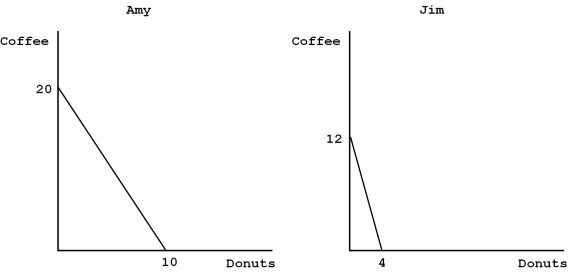 These figures illustrate the production possibilities available to Amy and Jim with 8 hours of labour.
-According to Graph 3-2, if Amy and Jim both specialise completely in the good in which they have a comparative advantage, total production of coffee and total production of doughnuts will be _____ respectively.
These figures illustrate the production possibilities available to Amy and Jim with 8 hours of labour.
-According to Graph 3-2, if Amy and Jim both specialise completely in the good in which they have a comparative advantage, total production of coffee and total production of doughnuts will be _____ respectively. (Multiple Choice)
4.8/5 (76)
(76) Graph 3-1
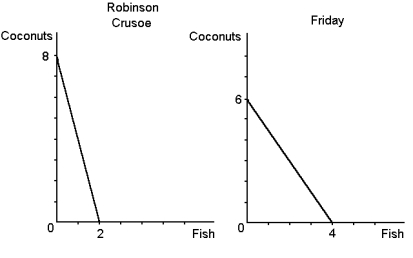 These figures illustrate the production possibilities frontiers for Robinson Crusoe and Friday with 12 hours of labour.
-Refer to Graph 3-1. For Robinson Crusoe, the opportunity cost of one kg of coconuts is:
These figures illustrate the production possibilities frontiers for Robinson Crusoe and Friday with 12 hours of labour.
-Refer to Graph 3-1. For Robinson Crusoe, the opportunity cost of one kg of coconuts is: (Multiple Choice)
4.9/5 (90)
(90) Graph 3-1
These figures illustrate the production possibilities frontiers for Robinson Crusoe and Friday with 12 hours of labour.
-According to Graph 3-1:
These figures illustrate the production possibilities frontiers for Robinson Crusoe and Friday with 12 hours of labour.
-According to Graph 3-1: (Multiple Choice)
4.8/5 (76)
(76) The principle of absolute advantage explains the gains from trade and why economic interdependence occurs.
(True/False)
4.9/5 (81)
(81) Use the accompanying table to answer the following questions.
Table 3-4
-Refer to Table 3-4. The opportunity cost of one unit of bread in England is:
-Refer to Table 3-4. The opportunity cost of one unit of bread in England is: (Multiple Choice)
4.8/5 (63)
(63) 
Filters
- Essay(0)
- Multiple Choice(0)
- Short Answer(0)
- True False(0)
- Matching(0)