



 Chat with AI
Exam 3: Interdependence and the Gains From Trade

Exam 1: Ten Lessons From Economics149 Questions
Exam 2: Thinking Like an Economist147 Questions
Exam 3: Interdependence and the Gains From Trade153 Questions
Exam 4: The Market Forces of Supply and Demand222 Questions
Exam 5: Elasticity and Its Application181 Questions
Exam 6: Supply, Demand and Government Policies148 Questions
Exam 7: Consumers, Producers and the Efficiency of Markets177 Questions
Exam 8: Application: The Costs of Taxation141 Questions
Exam 9: Application: International Trade161 Questions
Exam 10: Externalities199 Questions
Exam 11: Public Goods and Common Resources182 Questions
Exam 12: The Design of the Tax System154 Questions
Exam 13: The Costs of Production191 Questions
Exam 14: Firms in Competitive Markets200 Questions
Exam 15: Monopoly214 Questions
Exam 16: Business Strategy184 Questions
Exam 17: Competition Policy104 Questions
Exam 18: Monopolistic Competition214 Questions
Exam 19: The Markets for the Factors of Production215 Questions
Exam 20: Earnings, Unions and Discrimination206 Questions
Exam 21: Income Inequity and Poverty111 Questions
Exam 22: The Theory of Consumer Choice161 Questions
Exam 23: Frontiers of Microeconomics120 Questions
Exam 24: Measuring a Nations Income51 Questions
Exam 25: Measuring the Cost of Living52 Questions
Exam 26: Production and Growth62 Questions
Exam 27: Saving, Investment and the Financial System62 Questions
Exam 28: The Natural Rate of Unemployment59 Questions
Exam 29: The Monetary System66 Questions
Exam 30: Inflation: Its Causes and Costs74 Questions
Exam 31: Open-Economy Macroeconomics: Basic Concepts68 Questions
Exam 32: A Macroeconomic Theory of the Open Economy64 Questions
Exam 33: Aggregate Demand and Aggregate Supply82 Questions
Exam 34: The Influence of Monetary and Fiscal Policy on Aggregate Demand73 Questions
Exam 35: The Short-Run Trade-Off Between Inflation and Unemployment58 Questions
Exam 36: Five Debates Over Macroeconomic Policy38 Questions
Select questions type


Robinson Crusoe can produce 20 coconuts or 10 palm leaves in one day. Friday can produce 25 coconuts or five palm leaves in one day. Both individuals will be made better off through trade if Robinson specialises in producing coconuts and Friday specialises in producing palm leaves.
(True/False)
4.8/5  (76)
(76) Goods produced abroad and sold domestically are called exports and goods produced domestically and sold abroad are called imports.
(True/False)
5.0/5 (80)
(80) Use the accompanying table to answer the following questions.
Table 3-4
 -According to Table 3-4, if England and Spain trade according to the principle of comparative advantage, they will export _____ respectively.
 (Multiple Choice)
4.9/5 (79)
(79) Table 3-3
 -Refer to Table 3-3. The opportunity cost of one car for the US is:
 (Multiple Choice)
4.8/5 (87)
(87) Two individuals or two nations benefit from trade only if it is impossible for each individual or nation to produce the good or service purchased from the other.
(True/False)
4.9/5 (82)
(82) Table 3-2
 -Refer to Table 3-2. The opportunity cost of one kg of butter for John is:
 (Multiple Choice)
4.8/5 (88)
(88) Economists' support of trade restrictions is still based largely on the failure of the principle of comparative advantage.
(True/False)
4.8/5 (77)
(77) The central argument for free trade has changed a lot in the past two centuries.
(True/False)
4.7/5 (67)
(67) Table 3-3
-Refer to Table 3-3. If the US and Europe trade according to the principle of comparative advantage:
-Refer to Table 3-3. If the US and Europe trade according to the principle of comparative advantage: (Multiple Choice)
5.0/5 (86)
(86) It takes Barbara three hours to make a pie and four hours to make a shirt. It takes Gary two hours to make a pie and five hours to make a shirt. Barbara should specialise in making pies and Gary should specialise in making shirts. Then they should trade.
(True/False)
4.9/5 (77)
(77) Graph 3-2
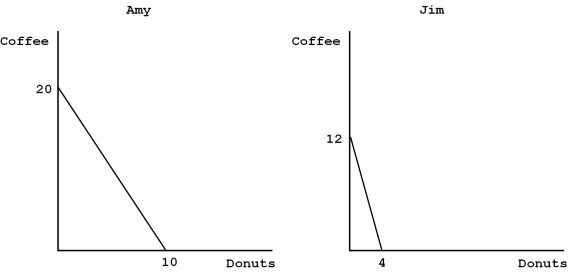 These figures illustrate the production possibilities available to Amy and Jim with 8 hours of labour.
-According to Graph 3-2:
These figures illustrate the production possibilities available to Amy and Jim with 8 hours of labour.
-According to Graph 3-2: (Multiple Choice)
4.9/5 (58)
(58) Table 3-1
 -Refer to Table 3-1. For the potato farmer, the opportunity cost of 1 kg of potatoes is:
 (Multiple Choice)
4.9/5 (72)
(72) Martha can prepare a meal in one hour, and her opportunity cost of one hour is $50. Stewart can prepare the same kind of meal in two hours and his opportunity cost of one hour is $20. Will both Martha and Stewart be better off if she pays him $45 per meal to prepare her meals? Explain.
(Essay)
4.9/5 (82)
(82) Graph 3-2
These figures illustrate the production possibilities available to Amy and Jim with 8 hours of labour.
-Refer to Graph 3-2. The opportunity cost of one doughnut for Jim is:
These figures illustrate the production possibilities available to Amy and Jim with 8 hours of labour.
-Refer to Graph 3-2. The opportunity cost of one doughnut for Jim is: (Multiple Choice)
4.8/5 (98)
(98) 
Filters
- Essay(0)
- Multiple Choice(0)
- Short Answer(0)
- True False(0)
- Matching(0)