



 Chat with AI
Exam 2: Thinking Like an Economist

Exam 1: Ten Lessons From Economics149 Questions
Exam 2: Thinking Like an Economist147 Questions
Exam 3: Interdependence and the Gains From Trade153 Questions
Exam 4: The Market Forces of Supply and Demand222 Questions
Exam 5: Elasticity and Its Application181 Questions
Exam 6: Supply, Demand and Government Policies148 Questions
Exam 7: Consumers, Producers and the Efficiency of Markets177 Questions
Exam 8: Application: The Costs of Taxation141 Questions
Exam 9: Application: International Trade161 Questions
Exam 10: Externalities199 Questions
Exam 11: Public Goods and Common Resources182 Questions
Exam 12: The Design of the Tax System154 Questions
Exam 13: The Costs of Production191 Questions
Exam 14: Firms in Competitive Markets200 Questions
Exam 15: Monopoly214 Questions
Exam 16: Business Strategy184 Questions
Exam 17: Competition Policy104 Questions
Exam 18: Monopolistic Competition214 Questions
Exam 19: The Markets for the Factors of Production215 Questions
Exam 20: Earnings, Unions and Discrimination206 Questions
Exam 21: Income Inequity and Poverty111 Questions
Exam 22: The Theory of Consumer Choice161 Questions
Exam 23: Frontiers of Microeconomics120 Questions
Exam 24: Measuring a Nations Income51 Questions
Exam 25: Measuring the Cost of Living52 Questions
Exam 26: Production and Growth62 Questions
Exam 27: Saving, Investment and the Financial System62 Questions
Exam 28: The Natural Rate of Unemployment59 Questions
Exam 29: The Monetary System66 Questions
Exam 30: Inflation: Its Causes and Costs74 Questions
Exam 31: Open-Economy Macroeconomics: Basic Concepts68 Questions
Exam 32: A Macroeconomic Theory of the Open Economy64 Questions
Exam 33: Aggregate Demand and Aggregate Supply82 Questions
Exam 34: The Influence of Monetary and Fiscal Policy on Aggregate Demand73 Questions
Exam 35: The Short-Run Trade-Off Between Inflation and Unemployment58 Questions
Exam 36: Five Debates Over Macroeconomic Policy38 Questions
Select questions type


Describe two problems that economists should consider when dealing with graphs.
(Essay)
4.8/5  (81)
(81) Draw a production possibilities frontier for the production of hamburgers and pizzas. On the graph, identify the area of feasible outcomes and the area of infeasible outcomes. Now locate and label an efficient point A and an inefficient point
B.
(Essay)
4.9/5 (66)
(66) The effect of a pollution tax is an economic issue most likely to be analysed by a microeconomist.
(True/False)
4.8/5 (70)
(70) Identify each of the following topics as being part of microeconomics or macroeconomics.
a. the impact of a decrease in consumer income on the purchase of lobster
b. the effect of a change in the price of digital cameras on the purchase of film cameras
c. the impact of the budget deficit on the rate of inflation in Australia
d. factors influencing the rate of economic growth
e. factors influencing the demand for digital cameras
f. the impact of tax policy on the trade deficit
g. the effect of carbon taxes on the Australian forestry sector
h. the degree of competition in the retail banking sector
i. the effect of exchange rate policies on economic stability
j. the impact of minimum wages laws on the labour market
(Short Answer)
4.9/5 (77)
(77) Table 2-1
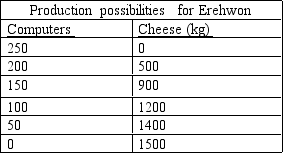 -Refer to Table 2-1. What is the opportunity cost to Erehwon of increasing the production of computers from 150 to 200?
 (Multiple Choice)
4.8/5 (91)
(91) If an economist develops a theory about international trade based on the assumption that there are only two countries and two goods:
(Multiple Choice)
4.8/5 (79)
(79) Graph 2-8
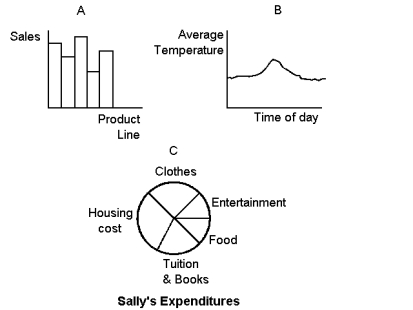 -Refer to Graph 2-8. Which of the graphs shown is a time series graph?
 (Multiple Choice)
4.9/5 (71)
(71) The single most important purpose of an economics principles text and course is to help students learn the economist's way of thinking.
(True/False)
4.8/5 (71)
(71) If we know an assumption about an economic system is not true, what is the justification for keeping this assumption in a model?
(Essay)
4.9/5 (73)
(73) Graph 2-1
 -Refer to Graph 2-1. In the graph shown, the opportunity cost of moving from point D to point B is 20 pieces of art.
 (True/False)
4.8/5 (84)
(84) Which of the following concepts is illustrated by the production possibilities frontier?
(Multiple Choice)
4.9/5 (82)
(82) An economist who says that all policy decisions are easy is an economist not to be trusted.
(True/False)
4.7/5 (70)
(70) Economics differs from some of the natural sciences like physics because:
(Multiple Choice)
4.8/5 (71)
(71) Select the statement below that is an example of a microeconomic issue?
(Multiple Choice)
4.9/5 (80)
(80) The main objective of economic science is to develop policies for the government.
(True/False)
4.8/5 (81)
(81) The efficient production points for the production possibilities frontier, all lie on the actual frontier itself.
(True/False)
4.8/5 (85)
(85) 
Filters
- Essay(0)
- Multiple Choice(0)
- Short Answer(0)
- True False(0)
- Matching(0)