



 Chat with AI
Exam 2: Thinking Like an Economist

Exam 1: Ten Lessons From Economics149 Questions
Exam 2: Thinking Like an Economist147 Questions
Exam 3: Interdependence and the Gains From Trade153 Questions
Exam 4: The Market Forces of Supply and Demand222 Questions
Exam 5: Elasticity and Its Application181 Questions
Exam 6: Supply, Demand and Government Policies148 Questions
Exam 7: Consumers, Producers and the Efficiency of Markets177 Questions
Exam 8: Application: The Costs of Taxation141 Questions
Exam 9: Application: International Trade161 Questions
Exam 10: Externalities199 Questions
Exam 11: Public Goods and Common Resources182 Questions
Exam 12: The Design of the Tax System154 Questions
Exam 13: The Costs of Production191 Questions
Exam 14: Firms in Competitive Markets200 Questions
Exam 15: Monopoly214 Questions
Exam 16: Business Strategy184 Questions
Exam 17: Competition Policy104 Questions
Exam 18: Monopolistic Competition214 Questions
Exam 19: The Markets for the Factors of Production215 Questions
Exam 20: Earnings, Unions and Discrimination206 Questions
Exam 21: Income Inequity and Poverty111 Questions
Exam 22: The Theory of Consumer Choice161 Questions
Exam 23: Frontiers of Microeconomics120 Questions
Exam 24: Measuring a Nations Income51 Questions
Exam 25: Measuring the Cost of Living52 Questions
Exam 26: Production and Growth62 Questions
Exam 27: Saving, Investment and the Financial System62 Questions
Exam 28: The Natural Rate of Unemployment59 Questions
Exam 29: The Monetary System66 Questions
Exam 30: Inflation: Its Causes and Costs74 Questions
Exam 31: Open-Economy Macroeconomics: Basic Concepts68 Questions
Exam 32: A Macroeconomic Theory of the Open Economy64 Questions
Exam 33: Aggregate Demand and Aggregate Supply82 Questions
Exam 34: The Influence of Monetary and Fiscal Policy on Aggregate Demand73 Questions
Exam 35: The Short-Run Trade-Off Between Inflation and Unemployment58 Questions
Exam 36: Five Debates Over Macroeconomic Policy38 Questions
Select questions type


Which of the following is an example of a normative statement?
(Multiple Choice)
4.8/5  (87)
(87) Graph 2-3
 -Refer to Graph 2-3. On the production possibilities frontier shown, which point represents the maximum possible production of CDs?
 (Multiple Choice)
5.0/5 (83)
(83) In the circular-flow diagram, the only return households get from supplying factors of production to firms are wages.
(True/False)
4.9/5 (78)
(78) Which of the following statements are positive, and which are normative?
a. The minimum wage creates unemployment among young and unskilled workers.
b. The minimum wage ought to be increased.
c. If there is a reduction in competition in a market, then other things being equal, prices will increase.
d. A little bit of unemployment is worse for society than a little bit of inflation.
e. There is a trade-off between inflation and unemployment in the short run.
f. Endangered species would be better off if the trade in wildlife was stopped.
g. If interest rates increase, forestry plantings will decrease.
h. If welfare benefits were reduced, the country would be better off.
(Short Answer)
4.7/5 (83)
(83) Graph 2-2
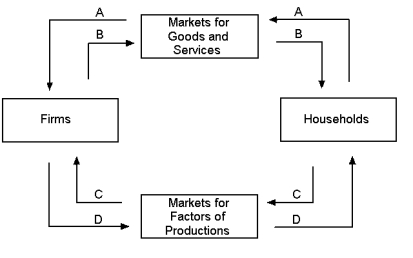 -Refer to Graph 2-2. In the circular-flow diagram shown, which arrow shows the flow of spending by households?
 (Multiple Choice)
4.8/5 (80)
(80) Economists may disagree on how the government can reduce unemployment.
(True/False)
4.9/5 (73)
(73) Draw a production possibilities frontier representing the economy's possible production of milk and eggs. Now show what will happen to the frontier or the production point under each of the following circumstances. Use a separate graph to illustrate each situation.
a. the outcome for the economy is efficient, with society choosing approximately equal amounts of milk and eggs
b. a recession causes a significant percentage of the labour force to become unemployed
c. some cows are found to be infected with mad cow disease and many of the cows must be destroyed
d. chickens are infected with a rare disease and egg-laying is reduced
e. improvements in animal nutrition raise the general productivity of cows and chickens
f. the cow and chicken populations increase
g. the Surgeon General announces that drinking milk prolongs life
(Essay)
4.9/5 (83)
(83) Graph 2-1
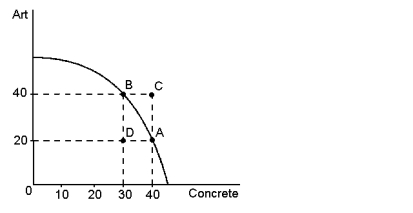 -Refer to Graph 2-1. In the graph shown, the opportunity cost of more art increases as more art is produced.
 (True/False)
4.8/5 (97)
(97) Sometimes economists who have the same positive views about how the economy works give conflicting advice on policy because they have different values.
(True/False)
4.9/5 (74)
(74) Sir Isaac Newton's development of the theory of gravity after observing an apple fall from a tree is an example of:
(Multiple Choice)
4.8/5 (88)
(88) The revenue from sales that firms have left after paying for the factors of production is:
(Multiple Choice)
4.9/5 (78)
(78) An economic outcome is said to be efficient if the economy is:
(Multiple Choice)
4.8/5 (81)
(81) Graph 2-9
 -Refer to Graph 2-9. In the graph, the curves shown are:
 (Multiple Choice)
4.9/5 (73)
(73) Points inside the production possibilities frontier represent inefficient outcomes for the economy.
(True/False)
4.9/5 (82)
(82) A circular-flow diagram is a simple, equation-based model of how an economy is organised.
(True/False)
4.9/5 (96)
(96) Suppose an economy produces two products. These are fish and logs. If technology is introduced that improves the efficiency of logging what would occur to the production possibilities frontier?
(Essay)
4.9/5 (72)
(72) All scientific models, including economic models, simplify reality in order to improve our understanding of it.
(True/False)
5.0/5 (82)
(82) Graph 2-2
-Refer to Graph 2-2. In the circular-flow diagram shown, which arrow shows the flow of income payments?
-Refer to Graph 2-2. In the circular-flow diagram shown, which arrow shows the flow of income payments? (Multiple Choice)
4.9/5 (80)
(80) Dean says that, 'the imposition of a tax on beer will raise its price'. Kylie argues that, 'taxes should be imposed on beer because university students drink too much'. We can conclude that:
(Multiple Choice)
4.8/5 (80)
(80) 
Filters
- Essay(0)
- Multiple Choice(0)
- Short Answer(0)
- True False(0)
- Matching(0)