



 Chat with AI
Exam 20: Consumer Choice

Exam 1: The Nature of Economics347 Questions
Exam 2: Scarcity and the World of Trade-Offs412 Questions
Exam 3: Demand and Supply448 Questions
Exam 4: Extensions of Demand and Supply Analysis399 Questions
Exam 5: Public Spending and Public Choice359 Questions
Exam 6: Funding the Public Sector202 Questions
Exam 7: The Macroeconomy: Unemployment, Inflation, and Deflation412 Questions
Exam 8: Measuring the Economys Performance413 Questions
Exam 9: Global Economic Growth and Development282 Questions
Exam 10: Real GDP and the Price Level in the Long Run290 Questions
Exam 11: Classical and Keynesian Macro Analyses365 Questions
Exam 12: Consumption, Real GDP, and the Multiplier445 Questions
Exam 13: Fiscal Policy273 Questions
Exam 14: Deficit Spending and the Public Debt145 Questions
Exam 15: Money, Banking, and Central Banking517 Questions
Exam 16: Domestic and International Dimensions of Monetary Policy357 Questions
Exam 17: Stabilization in an Integrated World Economy306 Questions
Exam 18: Policies and Prospects for Global Economic Growth216 Questions
Exam 19: Demand and Supply Elasticity413 Questions
Exam 20: Consumer Choice458 Questions
Exam 21: Rents, Profits, and the Financial Environment of Business445 Questions
Exam 22: The Firm: Cost and Output Determination387 Questions
Exam 23: Perfect Competition431 Questions
Exam 24: Monopoly386 Questions
Exam 25: Monopolistic Competition309 Questions
Exam 26: Oligopoly and Strategic Behavior306 Questions
Exam 27: Regulation and Antitrust Policy in a Globalized Economy309 Questions
Exam 28: The Labor Market: Demand, Supply and Outsourcing376 Questions
Exam 29: Unions and Labor Market Monopoly Power318 Questions
Exam 30: Income, Poverty, and Health Care302 Questions
Exam 31: Environmental Economics300 Questions
Exam 32: Comparative Advantage and the Open Economy314 Questions
Exam 33: Exchange Rates and the Balance of Payments300 Questions
Select questions type


Kathleen eats three TV dinners. The third TV dinner makes Kathleen sick. This means that for Kathleen
(Multiple Choice)
4.7/5  (73)
(73)  -Refer to the above table. Which of the four people have utility schedules characterized by the law of diminishing marginal utility?
 (Multiple Choice)
4.7/5 (82)
(82) The price of hamburgers is $2 and the price of movies is $4. The consumer has $16 of income. The consumer is purchasing 3 hamburgers and receiving 20 utils for the last hamburger. He is also purchasing 2 movies and receiving 40 utils for the last movie. This set of goods
(Multiple Choice)
4.8/5 (82)
(82) A representative unit that measures the want-satisfying power of a good is
(Multiple Choice)
5.0/5 (77)
(77) Regretting a last unit of consumption of cake implies that
(Multiple Choice)
4.8/5 (94)
(94) The price of good "a" is $5 and the price of good "b" is $15. If the marginal utility of good "a" is 20 then the marginal utility of good "b" must be ________ to have an optimum combination of goods purchased.
(Multiple Choice)
4.9/5 (99)
(99) The change in total utility derived when a customer consumes one more unit of a good or service is called
(Multiple Choice)
4.8/5 (82)
(82) The law of diminishing marginal utility implies that the marginal utility for a particular product
(Multiple Choice)
4.9/5 (88)
(88)  -In the above figure, if the budget line is the line DF, the consumer will maximize utility at point
 (Multiple Choice)
4.7/5 (85)
(85) Dave is undecided about whether to eat at a restaurant or to order pizza at home. He then obtains a coupon for 20 percent off at the restaurant and decides to go there to eat. This is an example of
(Multiple Choice)
4.9/5 (68)
(68) If the commercial is correct that every additional bite tastes as good as the first, the marginal utility from consuming more of the advertised product must be
(Multiple Choice)
4.8/5 (69)
(69) Bob's Marginal Utility for consuming beer and pizza with $8.00 in income
 -In the above table, how much total utility does Bob get from consuming 4 beers?
 (Multiple Choice)
4.9/5 (70)
(70) The change in people's purchasing power that occurs when the price of a good they purchase changes, assuming all else is held constant is known as
(Multiple Choice)
4.9/5 (92)
(92) The price of hamburgers is $2 and the price of movies is $4. The consumer has $14 of income. The consumer is purchasing 3 hamburgers and receiving 20 utils for the last hamburger. He is also purchasing 2 movies and receiving 40 utils for the last movie. This set of goods
(Multiple Choice)
4.9/5 (84)
(84) Suppose that the quantity of hamburgers is measured along the vertical axis and that the quantity of popcorn is measured along the horizontal axis. The vertical intercept is 10 hamburgers, and the slope of the budget line is -2. If the price of popcorn falls from $1 to $0.50, then we know that
(Multiple Choice)
4.8/5 (73)
(73) Newspaper vending machines are often built so that customers can pay to lift a door and take a paper off a pile of daily newspapers. Newspaper distributors are not concerned about customers taking the whole stack of papers because
(Multiple Choice)
4.7/5 (89)
(89) When economists refer to people making decisions at the margin, they mean that we compare ________ benefits with ________ costs.
(Multiple Choice)
4.8/5 (87)
(87) 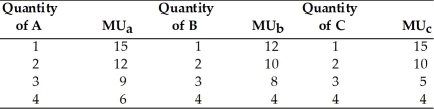 -Based on the information in the above table, the price of A is $3, the price of B is $2, and the price of C is $5. If Mary has $22 to spend, what combination of products A, B, and C should she buy in order to maximize her satisfaction?
 (Multiple Choice)
4.8/5 (81)
(81) 
Filters
- Essay(0)
- Multiple Choice(0)
- Short Answer(0)
- True False(0)
- Matching(0)