



 Chat with AI
Exam 20: Consumer Choice

Exam 1: The Nature of Economics347 Questions
Exam 2: Scarcity and the World of Trade-Offs412 Questions
Exam 3: Demand and Supply448 Questions
Exam 4: Extensions of Demand and Supply Analysis399 Questions
Exam 5: Public Spending and Public Choice359 Questions
Exam 6: Funding the Public Sector202 Questions
Exam 7: The Macroeconomy: Unemployment, Inflation, and Deflation412 Questions
Exam 8: Measuring the Economys Performance413 Questions
Exam 9: Global Economic Growth and Development282 Questions
Exam 10: Real GDP and the Price Level in the Long Run290 Questions
Exam 11: Classical and Keynesian Macro Analyses365 Questions
Exam 12: Consumption, Real GDP, and the Multiplier445 Questions
Exam 13: Fiscal Policy273 Questions
Exam 14: Deficit Spending and the Public Debt145 Questions
Exam 15: Money, Banking, and Central Banking517 Questions
Exam 16: Domestic and International Dimensions of Monetary Policy357 Questions
Exam 17: Stabilization in an Integrated World Economy306 Questions
Exam 18: Policies and Prospects for Global Economic Growth216 Questions
Exam 19: Demand and Supply Elasticity413 Questions
Exam 20: Consumer Choice458 Questions
Exam 21: Rents, Profits, and the Financial Environment of Business445 Questions
Exam 22: The Firm: Cost and Output Determination387 Questions
Exam 23: Perfect Competition431 Questions
Exam 24: Monopoly386 Questions
Exam 25: Monopolistic Competition309 Questions
Exam 26: Oligopoly and Strategic Behavior306 Questions
Exam 27: Regulation and Antitrust Policy in a Globalized Economy309 Questions
Exam 28: The Labor Market: Demand, Supply and Outsourcing376 Questions
Exam 29: Unions and Labor Market Monopoly Power318 Questions
Exam 30: Income, Poverty, and Health Care302 Questions
Exam 31: Environmental Economics300 Questions
Exam 32: Comparative Advantage and the Open Economy314 Questions
Exam 33: Exchange Rates and the Balance of Payments300 Questions
Select questions type


 -Refer to the above table. If the consumer's equilibrium consists of 4 magazines and 4 books, then we know that
 (Multiple Choice)
4.9/5  (87)
(87) The price of hamburgers is $2 and the price of movies is $4. The consumer has $14 of income. The consumer is purchasing 3 hamburgers and receiving 30 utils for the last hamburger. He is also purchasing 2 movies and receiving 40 utils for the last movie. This set of goods
(Multiple Choice)
4.8/5 (78)
(78) 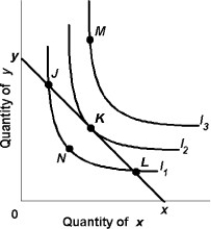 -Use the above figure. The optimal position for the consumer is at
 (Multiple Choice)
4.8/5 (100)
(100) If a consumer is initially at an optimum, and then the price of Y increases, then
(Multiple Choice)
4.8/5 (77)
(77) 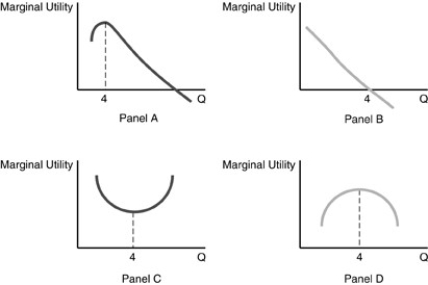 -Refer to the above figures. Amy's total utility for chocolate chip cookies reaches a maximum at 4 cookies. Which panel best represents marginal utility?
 (Multiple Choice)
4.9/5 (81)
(81) The principle that "as more of a good is consumed, its extra benefit declines" is known as
(Multiple Choice)
4.8/5 (85)
(85) The expression "getting the most bang for your buck" is an illustration of the
(Multiple Choice)
4.9/5 (92)
(92) 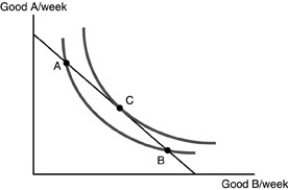 -Refer to the above figure. Given the indifference map and budget constraint represented above the consumer will maximize utility when she consumes at
 (Multiple Choice)
4.8/5 (71)
(71) On a hot summer day, a construction worker enters a McDonald's fast-food restaurant. He orders the first Big Mac. He consumes it within 3 minutes. He then orders a second Big Mac and consumes it in 10 minutes. He eats only half of the third one in 18 minutes and throws away the rest. The store manager offers him the fourth for free. The construction worker says: "No thanks." Why?
(Multiple Choice)
4.9/5 (80)
(80) Initially, a consumer is at an optimum. Then the price of X increases. Consequently,
(Multiple Choice)
4.9/5 (81)
(81) The quantities of Good M are plotted on the vertical axis while the quantities of Good N are plotted on the horizontal axis. The prices of both M and N fall. The intercepts of the budget line would
(Multiple Choice)
4.7/5 (74)
(74) John is currently spending all of his income. For the last unit of Good A consumed John gets 20 utils and for the last unit of Good B consumed he gets 10 utils. The price of Good A is $2. The price of Good B is $5. If John wants to maximize his utility he should
(Multiple Choice)
4.9/5 (78)
(78) When you purchase the lower-priced store brand bread instead of the more expensive name brand, you are experiencing
(Multiple Choice)
4.9/5 (84)
(84) If an individual's utility from consuming two goods increases, then there must be
(Multiple Choice)
4.8/5 (80)
(80) The concept of marginality is important in economics because
(Multiple Choice)
4.9/5 (74)
(74) 
Filters
- Essay(0)
- Multiple Choice(0)
- Short Answer(0)
- True False(0)
- Matching(0)