



 Chat with AI
Exam 33: Exchange Rates and the Balance of Payments

Exam 1: The Nature of Economics347 Questions
Exam 2: Scarcity and the World of Trade-Offs412 Questions
Exam 3: Demand and Supply448 Questions
Exam 4: Extensions of Demand and Supply Analysis399 Questions
Exam 5: Public Spending and Public Choice359 Questions
Exam 6: Funding the Public Sector202 Questions
Exam 7: The Macroeconomy: Unemployment, Inflation, and Deflation412 Questions
Exam 8: Measuring the Economys Performance413 Questions
Exam 9: Global Economic Growth and Development282 Questions
Exam 10: Real GDP and the Price Level in the Long Run290 Questions
Exam 11: Classical and Keynesian Macro Analyses365 Questions
Exam 12: Consumption, Real GDP, and the Multiplier445 Questions
Exam 13: Fiscal Policy273 Questions
Exam 14: Deficit Spending and the Public Debt145 Questions
Exam 15: Money, Banking, and Central Banking517 Questions
Exam 16: Domestic and International Dimensions of Monetary Policy357 Questions
Exam 17: Stabilization in an Integrated World Economy306 Questions
Exam 18: Policies and Prospects for Global Economic Growth216 Questions
Exam 19: Demand and Supply Elasticity413 Questions
Exam 20: Consumer Choice458 Questions
Exam 21: Rents, Profits, and the Financial Environment of Business445 Questions
Exam 22: The Firm: Cost and Output Determination387 Questions
Exam 23: Perfect Competition431 Questions
Exam 24: Monopoly386 Questions
Exam 25: Monopolistic Competition309 Questions
Exam 26: Oligopoly and Strategic Behavior306 Questions
Exam 27: Regulation and Antitrust Policy in a Globalized Economy309 Questions
Exam 28: The Labor Market: Demand, Supply and Outsourcing376 Questions
Exam 29: Unions and Labor Market Monopoly Power318 Questions
Exam 30: Income, Poverty, and Health Care302 Questions
Exam 31: Environmental Economics300 Questions
Exam 32: Comparative Advantage and the Open Economy314 Questions
Exam 33: Exchange Rates and the Balance of Payments300 Questions
Select questions type


If interest rates in the European Union decrease,

Free
(Multiple Choice)
4.9/5  (86)
(86) Correct Answer: Verified
C
 -Based on the transactions in the above table, what is the change in the U.S. balance of trade?
Free
(Multiple Choice)
4.7/5 (63)
(63) Correct Answer:Verified
VerifiedB
If the foreign exchange rate is one dollar for 10 South African rand, then how many dollars are needed to purchase an item that costs 400 rand?
Free
(Multiple Choice)
4.8/5 (85)
(85) Correct Answer:Verified
VerifiedB
The foreign exchange system that has the highest foreign exchange risk is
(Multiple Choice)
4.9/5 (83)
(83) Assume the U.S. government wants to hold the value of the dollar at $1.00 U.S. equals 10 Chinese yuan, but it finds that the value of yuan is depreciating against the U.S. dollar. What would be an appropriate policy to reverse this trend?
(Multiple Choice)
4.8/5 (90)
(90) Which of the following is an advantage of fixing exchange rates?
(Multiple Choice)
4.9/5 (72)
(72) If an exporter wants to limit the effect of possible changes in the exchange rate on the value of her exports, then she can adopt a strategy known as
(Multiple Choice)
4.7/5 (77)
(77) Suppose that the current exchange rate between the dollar and peso is $1 equals 10 pesos. If a firm in Mexico wanted to purchase $100,000 worth of U.S. televisions, how many pesos must they exchange?
(Multiple Choice)
4.8/5 (69)
(69) Assume there is an increased demand in the United States for Australian wines. If all other factors are held constant, this will result in
(Multiple Choice)
4.7/5 (88)
(88) Country X-2013 Transactions (billions of dollars)
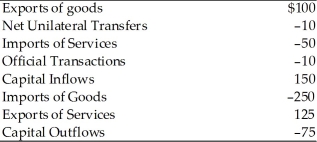 -In the above table, the trade balance on goods and services for Country X is ________ billion dollars.
 (Multiple Choice)
4.9/5 (79)
(79) Suppose the current account of a country is initially in balance. A new transaction occurs so that the current account is now in surplus. Official reserve balance is maintained before and after the transaction occurs. From this, we know that
(Multiple Choice)
4.9/5 (72)
(72) Which of the following will lead to an appreciation of the U.S. dollar against the British pound?
(Multiple Choice)
4.8/5 (66)
(66) A U.S. automobile dealer has ordered a fleet of Japanese cars worth 10 million yen. The terms of payment is C.O.D. (cash on delivery). At the time the order was placed, the exchange rate was 100 yen per U.S. dollar. When the fleet arrived the exchange rate had become 200 yen per U.S. dollar.
(Multiple Choice)
5.0/5 (83)
(83) Which of the following is a surplus item in the U.S. current account?
(Multiple Choice)
4.9/5 (82)
(82) An increase in the inflation rate of one country relative to another country will probably cause
(Multiple Choice)
4.8/5 (85)
(85) 
Filters
- Essay(0)
- Multiple Choice(0)
- Short Answer(0)
- True False(0)
- Matching(0)