



 Chat with AI
Exam 33: Exchange Rates and the Balance of Payments

Exam 1: The Nature of Economics347 Questions
Exam 2: Scarcity and the World of Trade-Offs412 Questions
Exam 3: Demand and Supply448 Questions
Exam 4: Extensions of Demand and Supply Analysis399 Questions
Exam 5: Public Spending and Public Choice359 Questions
Exam 6: Funding the Public Sector202 Questions
Exam 7: The Macroeconomy: Unemployment, Inflation, and Deflation412 Questions
Exam 8: Measuring the Economys Performance413 Questions
Exam 9: Global Economic Growth and Development282 Questions
Exam 10: Real GDP and the Price Level in the Long Run290 Questions
Exam 11: Classical and Keynesian Macro Analyses365 Questions
Exam 12: Consumption, Real GDP, and the Multiplier445 Questions
Exam 13: Fiscal Policy273 Questions
Exam 14: Deficit Spending and the Public Debt145 Questions
Exam 15: Money, Banking, and Central Banking517 Questions
Exam 16: Domestic and International Dimensions of Monetary Policy357 Questions
Exam 17: Stabilization in an Integrated World Economy306 Questions
Exam 18: Policies and Prospects for Global Economic Growth216 Questions
Exam 19: Demand and Supply Elasticity413 Questions
Exam 20: Consumer Choice458 Questions
Exam 21: Rents, Profits, and the Financial Environment of Business445 Questions
Exam 22: The Firm: Cost and Output Determination387 Questions
Exam 23: Perfect Competition431 Questions
Exam 24: Monopoly386 Questions
Exam 25: Monopolistic Competition309 Questions
Exam 26: Oligopoly and Strategic Behavior306 Questions
Exam 27: Regulation and Antitrust Policy in a Globalized Economy309 Questions
Exam 28: The Labor Market: Demand, Supply and Outsourcing376 Questions
Exam 29: Unions and Labor Market Monopoly Power318 Questions
Exam 30: Income, Poverty, and Health Care302 Questions
Exam 31: Environmental Economics300 Questions
Exam 32: Comparative Advantage and the Open Economy314 Questions
Exam 33: Exchange Rates and the Balance of Payments300 Questions
Select questions type


All of the following are surplus items on the balance of payments accounts EXCEPT
(Multiple Choice)
4.8/5  (83)
(83) Caitlin has just decided to order a computer that is made in Japan. She needs to convert U.S. dollars for Japanese yen. This conversion takes place in the
(Multiple Choice)
5.0/5 (81)
(81) Suppose the U.S. dollar price of the Japanese yen decreases. Given this information, which of the following is correct?
(Multiple Choice)
4.8/5 (81)
(81) Under flexible exchange rates, the exchange rate is set by
(Multiple Choice)
4.9/5 (90)
(90) The market in which households, firms and governments buy and sell national currencies is known as
(Multiple Choice)
4.8/5 (76)
(76) If the foreign exchange rate for 1 Hungarian forint is 0.5 cent, then
(Multiple Choice)
4.8/5 (73)
(73) A system of accounts that measures the transactions of goods, services, income, and financial assets between domestic households, businesses, and governments and residents of the rest of the world during a specific time period is the
(Multiple Choice)
4.8/5 (83)
(83) Jane has just sent a gift that was made in the U.S. to her relatives in Italy. As far as the balance of payments is concerned this gift will
(Multiple Choice)
4.7/5 (85)
(85) When a Mexican resident buys a ukulele from a U.S. producer, there is a(n)
(Multiple Choice)
4.8/5 (82)
(82) If you go to Europe to work and send funds home to your family living in the United States, this is known as a
(Multiple Choice)
4.8/5 (79)
(79) If the exchange rate measured in euros per dollar increases, then
(Multiple Choice)
4.9/5 (77)
(77)  -Use the above figure. A rightward shift of the demand curve, ceteris paribus, would result in
 (Multiple Choice)
4.9/5 (72)
(72) Suppose the foreign exchange market is in equilibrium. Then, the U.S. government increases borrowing, causing American interest rates to increase. What will happen to the price of the Japanese yen? Why?
(Essay)
4.9/5 (75)
(75) 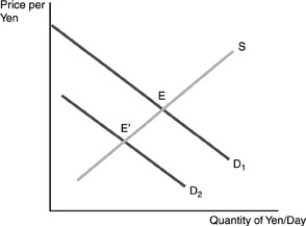 -In the diagram above, which of the following could cause a movement from point E to point
 ?
-In the diagram above, which of the following could cause a movement from point E to point ? (Multiple Choice)
5.0/5 (87)
(87) Assets that the IMF created to be used by countries to settle international payment obligations are called
(Multiple Choice)
4.7/5 (68)
(68) When a dinner in Bulgaria costs 150 Bulgarian levas, it will cost a U.S. resident ________ dollars, if the exchange rate is 1.5 Bulgarian levas to the dollar.
(Multiple Choice)
4.8/5 (81)
(81) Which of the following is an example of a surplus item on the balance of payments?
(Multiple Choice)
4.9/5 (85)
(85)  -Refer to the above table. The balance of trade is

Filters
- Essay(0)
- Multiple Choice(0)
- Short Answer(0)
- True False(0)
- Matching(0)