



 Chat with AI
Exam 20: Consumer Choice

Exam 1: The Nature of Economics347 Questions
Exam 2: Scarcity and the World of Trade-Offs412 Questions
Exam 3: Demand and Supply448 Questions
Exam 4: Extensions of Demand and Supply Analysis399 Questions
Exam 5: Public Spending and Public Choice359 Questions
Exam 6: Funding the Public Sector202 Questions
Exam 7: The Macroeconomy: Unemployment, Inflation, and Deflation412 Questions
Exam 8: Measuring the Economys Performance413 Questions
Exam 9: Global Economic Growth and Development282 Questions
Exam 10: Real GDP and the Price Level in the Long Run290 Questions
Exam 11: Classical and Keynesian Macro Analyses365 Questions
Exam 12: Consumption, Real GDP, and the Multiplier445 Questions
Exam 13: Fiscal Policy273 Questions
Exam 14: Deficit Spending and the Public Debt145 Questions
Exam 15: Money, Banking, and Central Banking517 Questions
Exam 16: Domestic and International Dimensions of Monetary Policy357 Questions
Exam 17: Stabilization in an Integrated World Economy306 Questions
Exam 18: Policies and Prospects for Global Economic Growth216 Questions
Exam 19: Demand and Supply Elasticity413 Questions
Exam 20: Consumer Choice458 Questions
Exam 21: Rents, Profits, and the Financial Environment of Business445 Questions
Exam 22: The Firm: Cost and Output Determination387 Questions
Exam 23: Perfect Competition431 Questions
Exam 24: Monopoly386 Questions
Exam 25: Monopolistic Competition309 Questions
Exam 26: Oligopoly and Strategic Behavior306 Questions
Exam 27: Regulation and Antitrust Policy in a Globalized Economy309 Questions
Exam 28: The Labor Market: Demand, Supply and Outsourcing376 Questions
Exam 29: Unions and Labor Market Monopoly Power318 Questions
Exam 30: Income, Poverty, and Health Care302 Questions
Exam 31: Environmental Economics300 Questions
Exam 32: Comparative Advantage and the Open Economy314 Questions
Exam 33: Exchange Rates and the Balance of Payments300 Questions
Select questions type


 -Refer to the above table. The marginal utility of the 6th movie for Michelle is
 (Multiple Choice)
5.0/5  (75)
(75) 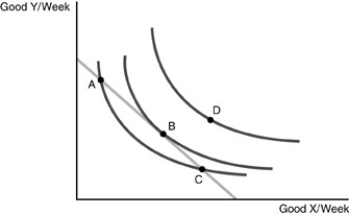 -Refer to the above figure. Given the indifference map and budget constraint represented above, what are all possible points at which that the individual can consume?
 (Multiple Choice)
4.8/5 (89)
(89)  -Using the above table, what is the total utility of the third piece of pizza?
 (Multiple Choice)
4.8/5 (80)
(80) 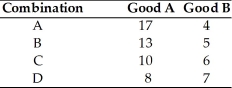 -Refer to the above table. The table gives the various combinations of Good A and Good B along Jane's indifference curve. The marginal rate of substitution when Jane goes from combination B to combination C is
 (Multiple Choice)
4.8/5 (83)
(83)  -Given the above figure, marginal utility becomes negative when Joey consumes the ________ piece of pizza.
 (Multiple Choice)
5.0/5 (91)
(91) 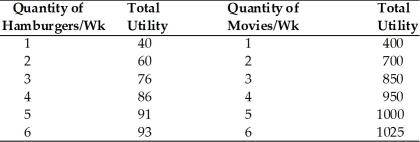 -Refer to the above table. Suppose the price of a movie is $5 and the income of the consumer is $29. What are the quantities demanded of hamburger at prices of $2 and $1 respectively?
 (Multiple Choice)
4.9/5 (74)
(74) If the price of a slice of pizza falls from $2 to $1, a pizza-loving consumer will
(Multiple Choice)
4.7/5 (86)
(86) Assuming that the marginal utility of the first four pieces of candy was 30, 28, 24, and 18 respectively, how much total utility was derived from eating the first three pieces of candy?
(Multiple Choice)
4.7/5 (82)
(82) For good A and good B, the consumer maximizes personal satisfaction when
(Multiple Choice)
4.8/5 (75)
(75)
-Refer to the above table. The marginal utility of the 7th movie for Michelle is
-Refer to the above table. The marginal utility of the 7th movie for Michelle is (Multiple Choice)
4.9/5 (87)
(87) For most goods, the real-income effect of a price change is
(Multiple Choice)
4.8/5 (73)
(73) The change in people's purchasing power that occurs when the price of one good that they purchase changes is the
(Multiple Choice)
4.8/5 (82)
(82) Suppose Lois usually buys two cups of coffee for two dollars each and one scone for two dollars each. If the price of scones falls to one dollar each and she now buys two cups of coffee and two scones, this illustrates the
(Multiple Choice)
5.0/5 (71)
(71) The price of a large pepperoni pizza used to be $14, but this week the price rose to $18. With a budget of just $30, you can't afford as many pizzas at the higher price. This change in consumer behavior reflects the
(Multiple Choice)
4.7/5 (82)
(82) 
Filters
- Essay(0)
- Multiple Choice(0)
- Short Answer(0)
- True False(0)
- Matching(0)