



 Chat with AI
Exam 20: Consumer Choice

Exam 1: The Nature of Economics347 Questions
Exam 2: Scarcity and the World of Trade-Offs412 Questions
Exam 3: Demand and Supply448 Questions
Exam 4: Extensions of Demand and Supply Analysis399 Questions
Exam 5: Public Spending and Public Choice359 Questions
Exam 6: Funding the Public Sector202 Questions
Exam 7: The Macroeconomy: Unemployment, Inflation, and Deflation412 Questions
Exam 8: Measuring the Economys Performance413 Questions
Exam 9: Global Economic Growth and Development282 Questions
Exam 10: Real GDP and the Price Level in the Long Run290 Questions
Exam 11: Classical and Keynesian Macro Analyses365 Questions
Exam 12: Consumption, Real GDP, and the Multiplier445 Questions
Exam 13: Fiscal Policy273 Questions
Exam 14: Deficit Spending and the Public Debt145 Questions
Exam 15: Money, Banking, and Central Banking517 Questions
Exam 16: Domestic and International Dimensions of Monetary Policy357 Questions
Exam 17: Stabilization in an Integrated World Economy306 Questions
Exam 18: Policies and Prospects for Global Economic Growth216 Questions
Exam 19: Demand and Supply Elasticity413 Questions
Exam 20: Consumer Choice458 Questions
Exam 21: Rents, Profits, and the Financial Environment of Business445 Questions
Exam 22: The Firm: Cost and Output Determination387 Questions
Exam 23: Perfect Competition431 Questions
Exam 24: Monopoly386 Questions
Exam 25: Monopolistic Competition309 Questions
Exam 26: Oligopoly and Strategic Behavior306 Questions
Exam 27: Regulation and Antitrust Policy in a Globalized Economy309 Questions
Exam 28: The Labor Market: Demand, Supply and Outsourcing376 Questions
Exam 29: Unions and Labor Market Monopoly Power318 Questions
Exam 30: Income, Poverty, and Health Care302 Questions
Exam 31: Environmental Economics300 Questions
Exam 32: Comparative Advantage and the Open Economy314 Questions
Exam 33: Exchange Rates and the Balance of Payments300 Questions
Select questions type


Economists assume that people make decisions regarding consumption based on comparing
(Multiple Choice)
4.9/5  (86)
(86) Given the utility-optimizing rule and the presence of diminishing marginal utility for a good,
(Multiple Choice)
4.9/5 (90)
(90) John has just eaten another potato chip and his total utility increased. This means that John's marginal utility for this additional potato chip is
(Multiple Choice)
4.8/5 (76)
(76) A certain athlete loves donuts. He receives 100 units of utility for the first donut, an additional 80 for the second, an additional 60 for the third, another 40 for the fourth, and another 20 for the fifth. The marginal utility of the fourth donut is ________ and the total utility from consuming four donuts is ________.
(Multiple Choice)
4.8/5 (68)
(68) Olga buys a bag of potato chips every day after her economics class. The first potato chip always tastes wonderful. The second does not taste quite as good as the first. The third does not taste quite as good as the second. Olga is experiencing
(Multiple Choice)
4.9/5 (95)
(95) The tendency of people to substitute cheaper commodities for more expensive commodities is the
(Multiple Choice)
4.7/5 (89)
(89)  -In the above figure, the budget line will change from line DE to line DF when
 (Multiple Choice)
5.0/5 (88)
(88)  -After consuming what quantity of pizza does the consumer in the table below experience diminishing marginal utility?
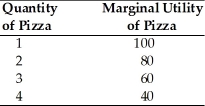
-After consuming what quantity of pizza does the consumer in the table below experience diminishing marginal utility? (Multiple Choice)
4.9/5 (87)
(87) Suppose that Jacob is going to a buffet restaurant that allows him to eat as many chicken wings as he wants at a fixed price. How would you predict the number of chicken wings that Jack will eat using utility theory?
(Essay)
4.8/5 (71)
(71) Given the price of a good or service, what determines how much a person is willing to pay for that good or service?
(Multiple Choice)
4.8/5 (88)
(88) 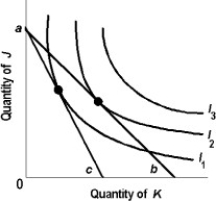 -Use the above figure. When the budget line rotates from "c" to "b"
 (Multiple Choice)
4.8/5 (80)
(80)  -Refer to the above figure. Which point represents the second highest level of utility?
 (Multiple Choice)
4.9/5 (91)
(91)  -According to the above table, what is David's marginal utility of the 7th unit?
 (Multiple Choice)
4.9/5 (82)
(82) One piece of evidence that possibly supports the bounded-rationality assumption of behavioral economics is that experiments appear to have shown that
(Multiple Choice)
4.9/5 (73)
(73) Why is water much cheaper than diamonds even though water is essential to human lives while diamonds are not?
(Essay)
4.9/5 (75)
(75) 
Filters
- Essay(0)
- Multiple Choice(0)
- Short Answer(0)
- True False(0)
- Matching(0)