



 Chat with AI
Exam 20: Consumer Choice

Exam 1: The Nature of Economics347 Questions
Exam 2: Scarcity and the World of Trade-Offs412 Questions
Exam 3: Demand and Supply448 Questions
Exam 4: Extensions of Demand and Supply Analysis399 Questions
Exam 5: Public Spending and Public Choice359 Questions
Exam 6: Funding the Public Sector202 Questions
Exam 7: The Macroeconomy: Unemployment, Inflation, and Deflation412 Questions
Exam 8: Measuring the Economys Performance413 Questions
Exam 9: Global Economic Growth and Development282 Questions
Exam 10: Real GDP and the Price Level in the Long Run290 Questions
Exam 11: Classical and Keynesian Macro Analyses365 Questions
Exam 12: Consumption, Real GDP, and the Multiplier445 Questions
Exam 13: Fiscal Policy273 Questions
Exam 14: Deficit Spending and the Public Debt145 Questions
Exam 15: Money, Banking, and Central Banking517 Questions
Exam 16: Domestic and International Dimensions of Monetary Policy357 Questions
Exam 17: Stabilization in an Integrated World Economy306 Questions
Exam 18: Policies and Prospects for Global Economic Growth216 Questions
Exam 19: Demand and Supply Elasticity413 Questions
Exam 20: Consumer Choice458 Questions
Exam 21: Rents, Profits, and the Financial Environment of Business445 Questions
Exam 22: The Firm: Cost and Output Determination387 Questions
Exam 23: Perfect Competition431 Questions
Exam 24: Monopoly386 Questions
Exam 25: Monopolistic Competition309 Questions
Exam 26: Oligopoly and Strategic Behavior306 Questions
Exam 27: Regulation and Antitrust Policy in a Globalized Economy309 Questions
Exam 28: The Labor Market: Demand, Supply and Outsourcing376 Questions
Exam 29: Unions and Labor Market Monopoly Power318 Questions
Exam 30: Income, Poverty, and Health Care302 Questions
Exam 31: Environmental Economics300 Questions
Exam 32: Comparative Advantage and the Open Economy314 Questions
Exam 33: Exchange Rates and the Balance of Payments300 Questions
Select questions type


Consumers do not buy as many units of each good as they want because
(Multiple Choice)
4.9/5  (84)
(84) 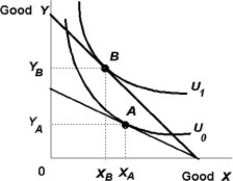 -Use the above figure. Last week Joe consumed combination "A" of goods "X" and "Y." This week he purchased combination "B." The reason for this change is that the
 (Multiple Choice)
4.8/5 (76)
(76) John has just eaten another potato chip and his total utility decreased. This means that John's marginal utility for this additional potato chip is
(Multiple Choice)
4.9/5 (77)
(77) The price of a hamburger is $1 and the price of a movie is $6 and the consumer has $14. A consumer has purchased 2 hamburgers and 2 movies, receiving 20 units of utility for the second hamburger and 100 units of utility for the second movie. The set of goods
(Multiple Choice)
4.9/5 (71)
(71) 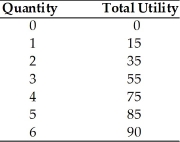 -Refer to the above table. At what quantity does diminishing marginal utility set in?
 (Multiple Choice)
4.8/5 (73)
(73) Using indifference curve analysis, an optimum is characterized by
(Multiple Choice)
4.8/5 (87)
(87) If the quantity of hamburgers is measured along the horizontal axis and the quantity of movies is measured along the vertical axis, and the price of a hamburger is $2.00 while the price of a movie is $12, then the slope of the budget line is
(Multiple Choice)
4.9/5 (78)
(78) 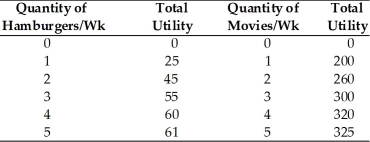 -Refer to the above table. Assume the consumer spends his entire income. The price of a hamburger is $1, the price of a movie is $6, and the consumer has $15. What is the consumer's optimum?
 (Multiple Choice)
4.9/5 (84)
(84) Assume that the marginal utility from good x is 10 units and that the price of good x is $5 per unit. The marginal utility from good y is 15 units and its unit price is $7. In this situation, a utility-maximizing consumer should
(Multiple Choice)
4.8/5 (80)
(80) If your money income stays the same but the price of one good that you are buying goes up, your effective purchasing power
(Multiple Choice)
4.8/5 (81)
(81) Utility analysis assumes that the consumer's tastes and preferences are
(Multiple Choice)
5.0/5 (67)
(67) Discuss the substitution and real-income effects of a price decrease.
(Essay)
4.9/5 (85)
(85) The quantity of good M is measured along the vertical axis, and the quantity of good N is measured along the horizontal axis. If the prices of both goods M and N declines by 50% each, then the budget line
(Multiple Choice)
4.9/5 (83)
(83) If you and a group of friends have been consuming large quantities of liquid beverages on a hot summer afternoon and you decide to refrain from any additional consumption, it can be concluded that
(Multiple Choice)
4.9/5 (75)
(75) If a consumer chooses a combination of goods that are inside of her budget line, than
(Multiple Choice)
4.9/5 (73)
(73) If marginal utility is positive but decreasing, total utility is
(Multiple Choice)
4.9/5 (83)
(83) 
Filters
- Essay(0)
- Multiple Choice(0)
- Short Answer(0)
- True False(0)
- Matching(0)