



 Chat with AI
Exam 20: Consumer Choice

Exam 1: The Nature of Economics347 Questions
Exam 2: Scarcity and the World of Trade-Offs412 Questions
Exam 3: Demand and Supply448 Questions
Exam 4: Extensions of Demand and Supply Analysis399 Questions
Exam 5: Public Spending and Public Choice359 Questions
Exam 6: Funding the Public Sector202 Questions
Exam 7: The Macroeconomy: Unemployment, Inflation, and Deflation412 Questions
Exam 8: Measuring the Economys Performance413 Questions
Exam 9: Global Economic Growth and Development282 Questions
Exam 10: Real GDP and the Price Level in the Long Run290 Questions
Exam 11: Classical and Keynesian Macro Analyses365 Questions
Exam 12: Consumption, Real GDP, and the Multiplier445 Questions
Exam 13: Fiscal Policy273 Questions
Exam 14: Deficit Spending and the Public Debt145 Questions
Exam 15: Money, Banking, and Central Banking517 Questions
Exam 16: Domestic and International Dimensions of Monetary Policy357 Questions
Exam 17: Stabilization in an Integrated World Economy306 Questions
Exam 18: Policies and Prospects for Global Economic Growth216 Questions
Exam 19: Demand and Supply Elasticity413 Questions
Exam 20: Consumer Choice458 Questions
Exam 21: Rents, Profits, and the Financial Environment of Business445 Questions
Exam 22: The Firm: Cost and Output Determination387 Questions
Exam 23: Perfect Competition431 Questions
Exam 24: Monopoly386 Questions
Exam 25: Monopolistic Competition309 Questions
Exam 26: Oligopoly and Strategic Behavior306 Questions
Exam 27: Regulation and Antitrust Policy in a Globalized Economy309 Questions
Exam 28: The Labor Market: Demand, Supply and Outsourcing376 Questions
Exam 29: Unions and Labor Market Monopoly Power318 Questions
Exam 30: Income, Poverty, and Health Care302 Questions
Exam 31: Environmental Economics300 Questions
Exam 32: Comparative Advantage and the Open Economy314 Questions
Exam 33: Exchange Rates and the Balance of Payments300 Questions
Select questions type


The idea that people will substitute cheaper commodities for more expensive commodities is called
(Multiple Choice)
4.8/5  (81)
(81) The inverse relationship between quantity demanded and price of a good or service can be explained, in part, by
(Multiple Choice)
4.9/5 (89)
(89) All possible combinations of goods that can be purchased at fixed prices with a specific income is
(Multiple Choice)
4.7/5 (74)
(74) 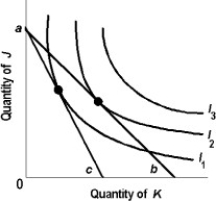 -Use the above figure. When the budget line rotates from "b" to "c"
 (Multiple Choice)
4.8/5 (75)
(75)  -According to the above table, Mary's marginal utility from watching the 6th movie is
 (Multiple Choice)
4.9/5 (76)
(76) The idea that consumers continue to adjust their purchases until the marginal utility per last dollar spent on all items is equal is called the
(Multiple Choice)
4.8/5 (96)
(96) If a college student stays home and watches a rented DVD for $5 rather than going out to a $10 movie, this is an example of the
(Multiple Choice)
4.8/5 (71)
(71) A consumer who has chosen the right mix of goods and services to maximize his or her utility is said to have achieved
(Multiple Choice)
4.9/5 (71)
(71) Economists infer that a consumer receives more utility from one good than another by
(Multiple Choice)
4.9/5 (80)
(80) Why does a price increase of a product result in a decrease in the quantity demanded of that product, according to utility analysis?
(Essay)
4.7/5 (72)
(72) 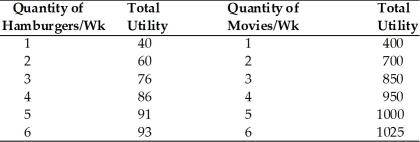 -Refer to the above table. The price of a hamburger is $2, the price of a movie is $10, and the consumer has $44. What is the change in quantity demanded of hamburgers if the price of a hamburger decreases to $1?
 (Multiple Choice)
4.7/5 (93)
(93) The negative relationship between the quantity demanded of a commodity and its price can be explained by the principle of
(Multiple Choice)
4.8/5 (85)
(85) The marginal utility of good A is 6 and the marginal utility of good B is 15. The price of good A is $2. The price of good B must be ________ if the consumer is optimizing her utility.
(Multiple Choice)
4.8/5 (76)
(76) Which of the following statements is FALSE, with respect to what economist Adam Smith called the diamond-water paradox?
(Multiple Choice)
4.9/5 (76)
(76)
-Refer to the above table. What is the marginal utility for the 10th unit for Mary and for John?
-Refer to the above table. What is the marginal utility for the 10th unit for Mary and for John? (Multiple Choice)
4.8/5 (92)
(92) 
Filters
- Essay(0)
- Multiple Choice(0)
- Short Answer(0)
- True False(0)
- Matching(0)