



 Chat with AI
Exam 20: Consumer Choice

Exam 1: The Nature of Economics347 Questions
Exam 2: Scarcity and the World of Trade-Offs412 Questions
Exam 3: Demand and Supply448 Questions
Exam 4: Extensions of Demand and Supply Analysis399 Questions
Exam 5: Public Spending and Public Choice359 Questions
Exam 6: Funding the Public Sector202 Questions
Exam 7: The Macroeconomy: Unemployment, Inflation, and Deflation412 Questions
Exam 8: Measuring the Economys Performance413 Questions
Exam 9: Global Economic Growth and Development282 Questions
Exam 10: Real GDP and the Price Level in the Long Run290 Questions
Exam 11: Classical and Keynesian Macro Analyses365 Questions
Exam 12: Consumption, Real GDP, and the Multiplier445 Questions
Exam 13: Fiscal Policy273 Questions
Exam 14: Deficit Spending and the Public Debt145 Questions
Exam 15: Money, Banking, and Central Banking517 Questions
Exam 16: Domestic and International Dimensions of Monetary Policy357 Questions
Exam 17: Stabilization in an Integrated World Economy306 Questions
Exam 18: Policies and Prospects for Global Economic Growth216 Questions
Exam 19: Demand and Supply Elasticity413 Questions
Exam 20: Consumer Choice458 Questions
Exam 21: Rents, Profits, and the Financial Environment of Business445 Questions
Exam 22: The Firm: Cost and Output Determination387 Questions
Exam 23: Perfect Competition431 Questions
Exam 24: Monopoly386 Questions
Exam 25: Monopolistic Competition309 Questions
Exam 26: Oligopoly and Strategic Behavior306 Questions
Exam 27: Regulation and Antitrust Policy in a Globalized Economy309 Questions
Exam 28: The Labor Market: Demand, Supply and Outsourcing376 Questions
Exam 29: Unions and Labor Market Monopoly Power318 Questions
Exam 30: Income, Poverty, and Health Care302 Questions
Exam 31: Environmental Economics300 Questions
Exam 32: Comparative Advantage and the Open Economy314 Questions
Exam 33: Exchange Rates and the Balance of Payments300 Questions
Select questions type


The quantity of good A is measured along the vertical axis, and the quantity of good B is measures along the horizontal axis. If the price of Good A falls
(Multiple Choice)
5.0/5  (68)
(68) As more of a product is consumed, total utility increases up to a point at which
(Multiple Choice)
4.8/5 (72)
(72) Assume that Jackie concludes that he should eat less and play racquetball more. In this situation, it must be true that the marginal utility of the last dollar spent on food is
(Multiple Choice)
4.9/5 (82)
(82) 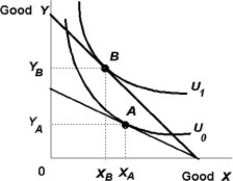 -Use the above figure. Last week Joe consumed combination "B" of goods "X" and "Y." This week he purchased combination "A." The reason for this change is that the
 (Multiple Choice)
4.8/5 (99)
(99) Your allergies are bad this summer so your allergist writes you a prescription to relieve your symptoms. When you get to the pharmacy, you notice the name brand allergy medicine is more expensive than its generic equivalent. You purchase the generic equivalent and demonstrate all of the following EXCEPT
(Multiple Choice)
4.8/5 (86)
(86)  -Refer to the above table If the price of a magazine is $2 and the price of a paperback book is $5 and the consumer has $40, the rational consumer will purchase
 (Multiple Choice)
5.0/5 (82)
(82) 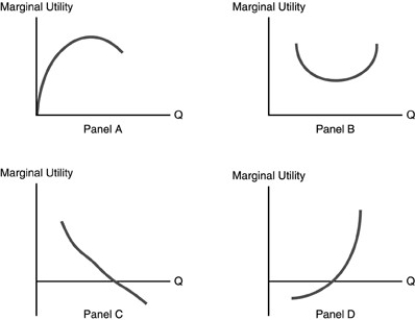 -Refer to the above figures. Which panel best represents marginal utility?
 (Multiple Choice)
4.9/5 (70)
(70) Suppose that indifference curve I1 lies to the left of indifference curve I2. We can conclude that
(Multiple Choice)
4.7/5 (70)
(70) The total utility of consuming 6 units of a good is 255. The marginal utility of the 6th unit is 45 and the marginal utility of the 5th unit is 60. The total utility of consuming 5 units of the good is
(Multiple Choice)
4.8/5 (76)
(76)  -Refer to the above table. If the price of Good X is $2, the price of Good Y is $2, and the consumer has $14, the rational consumer will purchase
 (Multiple Choice)
4.8/5 (73)
(73) Carol is very hungry. She has just sat down to eat. Her first bite gives her a certain level of utility. Her second bite increases her utility by more than the first bite. Her third bite increases her utility by more than the second bite. Carol has 40 bites left before she finishes. Which of the following statements is true about Carol?
(Multiple Choice)
4.9/5 (91)
(91)  -Adam has 3 apples and 3 oranges. Eve has 2 apples and 2 oranges. The marginal utilities for Adam and Eve are summarized in the above table. Adam asks Eve to exchange one of her apples for an orange.
 (Multiple Choice)
4.8/5 (80)
(80) 
Filters
- Essay(0)
- Multiple Choice(0)
- Short Answer(0)
- True False(0)
- Matching(0)