



 Chat with AI
Exam 20: Consumer Choice

Exam 1: The Nature of Economics347 Questions
Exam 2: Scarcity and the World of Trade-Offs412 Questions
Exam 3: Demand and Supply448 Questions
Exam 4: Extensions of Demand and Supply Analysis399 Questions
Exam 5: Public Spending and Public Choice359 Questions
Exam 6: Funding the Public Sector202 Questions
Exam 7: The Macroeconomy: Unemployment, Inflation, and Deflation412 Questions
Exam 8: Measuring the Economys Performance413 Questions
Exam 9: Global Economic Growth and Development282 Questions
Exam 10: Real GDP and the Price Level in the Long Run290 Questions
Exam 11: Classical and Keynesian Macro Analyses365 Questions
Exam 12: Consumption, Real GDP, and the Multiplier445 Questions
Exam 13: Fiscal Policy273 Questions
Exam 14: Deficit Spending and the Public Debt145 Questions
Exam 15: Money, Banking, and Central Banking517 Questions
Exam 16: Domestic and International Dimensions of Monetary Policy357 Questions
Exam 17: Stabilization in an Integrated World Economy306 Questions
Exam 18: Policies and Prospects for Global Economic Growth216 Questions
Exam 19: Demand and Supply Elasticity413 Questions
Exam 20: Consumer Choice458 Questions
Exam 21: Rents, Profits, and the Financial Environment of Business445 Questions
Exam 22: The Firm: Cost and Output Determination387 Questions
Exam 23: Perfect Competition431 Questions
Exam 24: Monopoly386 Questions
Exam 25: Monopolistic Competition309 Questions
Exam 26: Oligopoly and Strategic Behavior306 Questions
Exam 27: Regulation and Antitrust Policy in a Globalized Economy309 Questions
Exam 28: The Labor Market: Demand, Supply and Outsourcing376 Questions
Exam 29: Unions and Labor Market Monopoly Power318 Questions
Exam 30: Income, Poverty, and Health Care302 Questions
Exam 31: Environmental Economics300 Questions
Exam 32: Comparative Advantage and the Open Economy314 Questions
Exam 33: Exchange Rates and the Balance of Payments300 Questions
Select questions type


Other things being equal, when the money price of a good increases, its relative price
(Multiple Choice)
4.9/5  (104)
(104) You consider yourself to be wise consumer. The marginal utility/price ratio of coffee is 12 utils per dollar. If the price of a donut is $0.75, you should only buy the donut if it gives you at least
(Multiple Choice)
4.8/5 (89)
(89) Observations of violations of consumer optimum predicted by consumer choice theory could provide support forI. utility analysis II. bounded rationality
III) behavioral economics
(Multiple Choice)
4.7/5 (84)
(84) The consumer optimum is the set of goods and services, subject to the limited income of the consumer, that
(Multiple Choice)
4.9/5 (84)
(84) The state of consumer optimum is reached when the consumer's
(Multiple Choice)
4.9/5 (73)
(73) At a ball game we can observe people eating hot dogs, chips, and burgers. If all are priced the same and we observe Michelle eating a hot dog and David eating a hamburger, we can conclude that
(Multiple Choice)
4.9/5 (65)
(65)  -Given the above figure, when Joey eats a third piece of pizza his marginal utility is ________ and his total utility is ________.
 (Multiple Choice)
4.9/5 (76)
(76) Juan and Sophia have decided to stop studying economics and get a bite to eat. Juan wants to go for a pizza and Sophia wants a hamburger. They decide to go for pizza. What can we conclude from this?
(Multiple Choice)
4.9/5 (72)
(72) The price of a hamburger is $1, the price of a movie is $5, and the consumer has $13. A consumer has purchased 3 hamburgers and two movies, receiving 10 units of utility for the last hamburger and 10 units of utility for the last movie. The set of goods
(Multiple Choice)
4.8/5 (77)
(77) The change in the consumption of one good that just offsets a one-unit change in the consumption of another good is the
(Multiple Choice)
4.8/5 (78)
(78)  -Use the above figure. The consumer's choice changes from YB to YA. Which of the following statements about good Y is true?
 (Multiple Choice)
4.8/5 (81)
(81) Behavioral economics suggests that people face human limitations that prevent them from examining every possible choice available to them, with the implication that
(Multiple Choice)
4.9/5 (86)
(86) As an individual consumes more of a particular commodity, the total level of utility derived from that consumption usually
(Multiple Choice)
4.7/5 (90)
(90) 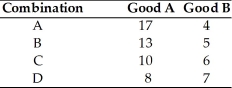 -Refer to the above table. The table gives the various combinations of Good A and Good B along Jane's indifference curve. The marginal rate of substitution when Jane goes from combination C to combination D is
 (Multiple Choice)
4.8/5 (79)
(79) When marginal utility is positive, but decreasing, then total utility is
(Multiple Choice)
4.8/5 (85)
(85) If a person claims, "I wouldn't eat liver if you paid me," we can assume that his marginal utility of liver is
(Multiple Choice)
4.7/5 (67)
(67) 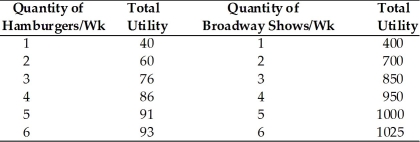 -Refer to the above table. If the price of a hamburger is $2, the price of a Broadway Show is $60, and the consumer has $190, what is the consumer optimum?
 (Multiple Choice)
4.9/5 (81)
(81) 
Filters
- Essay(0)
- Multiple Choice(0)
- Short Answer(0)
- True False(0)
- Matching(0)