



 Chat with AI
Exam 7: Consumers, Producers, and the Efficiency of Markets

Exam 1: Ten Principles of Economics347 Questions
Exam 2: Thinking Like an Economist535 Questions
Exam 3: Interdependence and the Gains From Trade442 Questions
Exam 4: The Market Forces of Supply and Demand569 Questions
Exam 5: Elasticity and Its Application503 Questions
Exam 6: Supply, Demand, and Government Policies556 Questions
Exam 7: Consumers, Producers, and the Efficiency of Markets460 Questions
Exam 8: Application: The Costs of Taxation422 Questions
Exam 9: Application: International Trade409 Questions
Exam 10: Measuring a Nations Income428 Questions
Exam 11: Measuring the Cost of Living436 Questions
Exam 12: Production and Growth417 Questions
Exam 13: Saving, Investment, and the Financial System473 Questions
Exam 14: The Basic Tools of Finance419 Questions
Exam 15: Unemployment571 Questions
Exam 16: The Monetary System423 Questions
Exam 17: Money Growth and Inflation388 Questions
Exam 18: Open-Economy Macroeconomic Models448 Questions
Exam 19: A Macroeconomic Theory of the Open Economy374 Questions
Exam 20: Aggregate Demand and Aggregate Supply471 Questions
Exam 21: The Influence of Monetary and Fiscal Policy on Aggregate Demand416 Questions
Exam 22: The Short-Run Trade-Off Between Inflation and Unemployment400 Questions
Exam 23: Six Debates Over Macroeconomic Policy235 Questions
Select questions type


Table 7-7
The following table represents the costs of five possible sellers. Seller Cost Abby \ 1,500 Babby \ 1,200 Carlos \ 1,000 Dianne \ 750 Evalina \ 500
-Refer to Table 7-7. If the market price is $1,100, the combined total cost of all participating sellers is
(Multiple Choice)
5.0/5  (75)
(75) Suppose that the equilibrium price in the market for widgets is $5. If a law increased the minimum legal price for widgets to $6, producer surplus
(Multiple Choice)
4.8/5 (80)
(80) Brock is willing to pay $400 for a new suit, but he is able to buy the suit for $350. His consumer surplus is
(Multiple Choice)
4.8/5 (83)
(83) Suppose Katie, Kendra, and Kristen each purchase a particular type of cell phone at a price of $80. Katie's willingness to pay was $100, Kendra's willingness to pay was $95, and Kristen's willingness to pay was $80. Which of the following statements is correct?
(Multiple Choice)
4.8/5 (77)
(77) Table 7-11
Price Quantity Demanded Quantity Supplied \ 12.00 0 36 \ 10.00 3 30 \ 8.00 6 24 \ 6.00 9 18 \ 4.00 12 12 \ 2.00 15 6 \ 0.00 18 0
-Refer to Table 7-11. Both the demand curve and the supply curve are straight lines. If 6 units are bought and sold, then total surplus is
(Multiple Choice)
5.0/5 (90)
(90) Bill created a new software program he is willing to sell for $300. He sells his first copy and enjoys a producer surplus of $250. What is the price paid for the software?
(Multiple Choice)
4.8/5 (85)
(85) Connie can clean windows in large office buildings at a cost of $1 per window. The market price for window-cleaning services is $3 per window. If Connie cleans 100 windows, her producer surplus is $100.
(True/False)
4.8/5 (102)
(102) A simultaneous increase in both the demand for MP3 players and the supply of MP3 players would imply that
(Multiple Choice)
4.7/5 (75)
(75) Henry is willing to pay 45 cents, and Janine is willing to pay 55 cents, for 1 pound of bananas. When the price of bananas falls from 50 cents a pound to 40 cents a pound,
(Multiple Choice)
4.8/5 (71)
(71) All else equal, what happens to consumer surplus if the price of a good increases?
(Multiple Choice)
4.9/5 (84)
(84) All else equal, an increase in demand will cause an increase in producer surplus.
(True/False)
4.7/5 (83)
(83) David tunes pianos in his spare time for extra income. Buyers of his service are willing to pay $135 per tuning. One particular week, David is willing to tune the first piano for $115, the second piano for $125, the third piano for $140, and the fourth piano for $175. Assume David is rational in deciding how many pianos to tune. His producer surplus is
(Multiple Choice)
4.9/5 (88)
(88) Figure 7-18  -Refer to Figure 7-18. If the price decreases from $22 to $16 due to a shift in the supply curve, consumer surplus increases by
 (Multiple Choice)
4.9/5 (80)
(80) Kelly is willing to pay $68 for a pair of shoes for a wedding. She finds a pair at her favorite outlet shoe store for $58. Kelly's consumer surplus is
(Multiple Choice)
5.0/5 (80)
(80) Figure 7-3 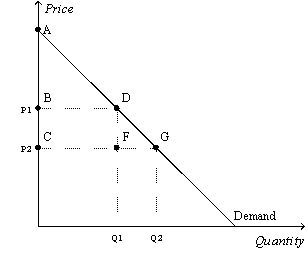 -Refer to Figure 7-3. Which area represents the increase in consumer surplus when the price falls from P1 to P2?
 (Multiple Choice)
4.8/5 (78)
(78) If the government imposes a binding price floor in a market, then the consumer surplus in that market will increase.
(True/False)
4.8/5 (60)
(60) 
Filters
- Essay(0)
- Multiple Choice(0)
- Short Answer(0)
- True False(0)
- Matching(0)