



 Chat with AI
Exam 7: Consumers, Producers, and the Efficiency of Markets

Exam 1: Ten Principles of Economics347 Questions
Exam 2: Thinking Like an Economist535 Questions
Exam 3: Interdependence and the Gains From Trade442 Questions
Exam 4: The Market Forces of Supply and Demand569 Questions
Exam 5: Elasticity and Its Application503 Questions
Exam 6: Supply, Demand, and Government Policies556 Questions
Exam 7: Consumers, Producers, and the Efficiency of Markets460 Questions
Exam 8: Application: The Costs of Taxation422 Questions
Exam 9: Application: International Trade409 Questions
Exam 10: Measuring a Nations Income428 Questions
Exam 11: Measuring the Cost of Living436 Questions
Exam 12: Production and Growth417 Questions
Exam 13: Saving, Investment, and the Financial System473 Questions
Exam 14: The Basic Tools of Finance419 Questions
Exam 15: Unemployment571 Questions
Exam 16: The Monetary System423 Questions
Exam 17: Money Growth and Inflation388 Questions
Exam 18: Open-Economy Macroeconomic Models448 Questions
Exam 19: A Macroeconomic Theory of the Open Economy374 Questions
Exam 20: Aggregate Demand and Aggregate Supply471 Questions
Exam 21: The Influence of Monetary and Fiscal Policy on Aggregate Demand416 Questions
Exam 22: The Short-Run Trade-Off Between Inflation and Unemployment400 Questions
Exam 23: Six Debates Over Macroeconomic Policy235 Questions
Select questions type


Which of the following is not true when the price of a good or service falls?
(Multiple Choice)
4.8/5  (86)
(86) Figure 7-12 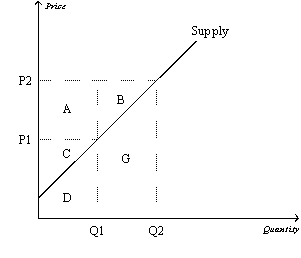 -Refer to Figure 7-12. When the price rises from P1 to P2, which area represents the increase in producer surplus due to new producers entering the market?
 (Multiple Choice)
4.8/5 (73)
(73) All else equal, an increase in demand will always increase consumer surplus.
(True/False)
4.9/5 (74)
(74) Figure 7-17  -Refer to Figure 7-17. Which area represents consumer surplus when the price is P1?
 (Multiple Choice)
4.7/5 (64)
(64) Figure 7-2  -Refer to Figure 7-2. When the price rises from P1 to P2, consumer surplus
 (Multiple Choice)
4.9/5 (84)
(84) Table 7-5
For each of three potential buyers of oranges, the table displays the willingness to pay for the first three oranges of the day. Assume Alex, Barb, and Carlos are the only three buyers of oranges, and only three oranges can be supplied per day. First Orangp Second Orange Third Orange Alliton \ 2.00 \ 1.50 \ 0.75 Bob \ 1.50 \ 1.00 \ 0.80 Chariste \ 0.75 \ 0.25 \ 0
-Refer to Table 7-5. Which of the following statements is correct?
(Multiple Choice)
4.7/5 (70)
(70) Figure 7-19 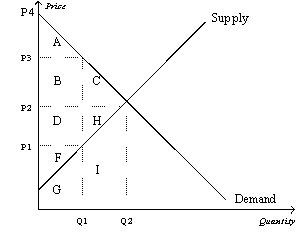 -Refer to Figure 7-19. At equilibrium, producer surplus is represented by the area
 (Multiple Choice)
4.8/5 (84)
(84) When policymakers are considering a particular action, they can use consumer surplus as a(n)
(Multiple Choice)
4.8/5 (72)
(72) Dallas buys strawberries, and he would be willing to pay more than he now pays. Suppose that Dallas has a change in his tastes such that he values strawberries more than before. If the market price is the same as before, then
(Multiple Choice)
4.9/5 (84)
(84) Kristi and Rebecca sell lemonade on the corner. It costs them 7 cents to make each cup. On a certain day, they sell 40 cups. Their producer surplus for that day amounts to $19.20. Kristi & Rebecca sold each cup for
(Multiple Choice)
4.8/5 (84)
(84) Suppose Brent, Callie, and Danielle each purchase a particular type of electric pencil sharpener at a price of $20. Brent's willingness to pay was $22, Callie's willingness to pay was $25, and Danielle's willingness to pay was $30. Which of the following statements is correct?
(Multiple Choice)
4.9/5 (71)
(71) Table 7-6
Buygr Willingrins to Pay Michad \ 500 Farvin \ 400 Larry \ 350 Charles \ 300
-Refer to Table 7-6. You are selling extra tickets to the Midwest Regional Sweet 16 game in the men's NCAA basketball tournament. The table shows the willingness to pay of the four potential buyers in the market for a ticket to the game. Which of the following graphs represents the market demand curve?
(Multiple Choice)
4.9/5 (71)
(71) Figure 7-11 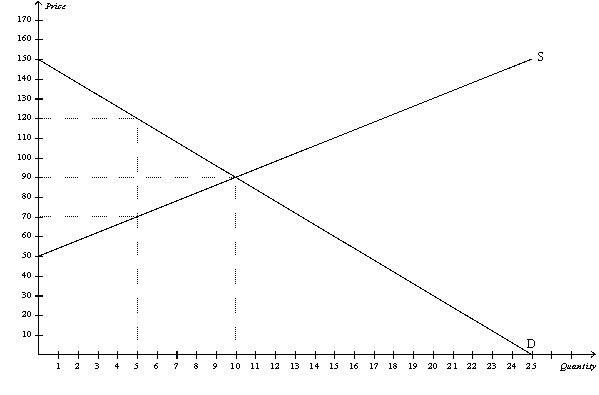 -Refer to Figure 7-11. If the government imposes a price ceiling of $70 in this market, then the new producer surplus will be
 (Multiple Choice)
4.8/5 (71)
(71) Table 7-6
Buygr Willingrins to Pay Michad \ 500 Farvin \ 400 Larry \ 350 Charles \ 300
-Refer to Table 7-6. You have two essentially identical extra tickets to the Midwest Regional Sweet 16 game in the men's NCAA basketball tournament. The table shows the willingness to pay of the four potential buyers in the market for a ticket to the game. You hold an auction to sell the two tickets. Who makes the winning bids, and what do they offer to pay for the tickets?
(Multiple Choice)
4.8/5 (79)
(79) You are offered a free ticket to see the Chicago Cubs play the Chicago White Sox at Wrigley Field. Assume the ticket has no resale value. Willie Nelson is performing on the same night, and his concert is your next-best alternative activity. Tickets to see Willie Nelson cost $40. On any given day, you would be willing to pay up to $50 to see and hear Willie Nelson perform. Assume there are no other costs of seeing either event. Based on this information, at a minimum, how much would you have to value seeing the Cubs play the White Sox to accept the ticket and go to the game?
(Multiple Choice)
4.9/5 (79)
(79) Suppose there is an increase in supply that reduces market price. Consumer surplus increases because (1) consumer surplus received by existing buyers increases and (2) new buyers enter the market.
(True/False)
4.9/5 (75)
(75) Figure 7-12
-Refer to Figure 7-12. When the price is P1, producer surplus is
-Refer to Figure 7-12. When the price is P1, producer surplus is (Multiple Choice)
4.9/5 (81)
(81) Figure 7-18  -Refer to Figure 7-18. The efficient price is
 (Multiple Choice)
4.9/5 (104)
(104) Suppose that the equilibrium price in the market for widgets is $5. If a law increased the minimum legal price for widgets to $6,
(Multiple Choice)
4.9/5 (75)
(75) 
Filters
- Essay(0)
- Multiple Choice(0)
- Short Answer(0)
- True False(0)
- Matching(0)