



 Chat with AI
Exam 7: Consumers, Producers, and the Efficiency of Markets

Exam 1: Ten Principles of Economics347 Questions
Exam 2: Thinking Like an Economist535 Questions
Exam 3: Interdependence and the Gains From Trade442 Questions
Exam 4: The Market Forces of Supply and Demand569 Questions
Exam 5: Elasticity and Its Application503 Questions
Exam 6: Supply, Demand, and Government Policies556 Questions
Exam 7: Consumers, Producers, and the Efficiency of Markets460 Questions
Exam 8: Application: The Costs of Taxation422 Questions
Exam 9: Application: International Trade409 Questions
Exam 10: Measuring a Nations Income428 Questions
Exam 11: Measuring the Cost of Living436 Questions
Exam 12: Production and Growth417 Questions
Exam 13: Saving, Investment, and the Financial System473 Questions
Exam 14: The Basic Tools of Finance419 Questions
Exam 15: Unemployment571 Questions
Exam 16: The Monetary System423 Questions
Exam 17: Money Growth and Inflation388 Questions
Exam 18: Open-Economy Macroeconomic Models448 Questions
Exam 19: A Macroeconomic Theory of the Open Economy374 Questions
Exam 20: Aggregate Demand and Aggregate Supply471 Questions
Exam 21: The Influence of Monetary and Fiscal Policy on Aggregate Demand416 Questions
Exam 22: The Short-Run Trade-Off Between Inflation and Unemployment400 Questions
Exam 23: Six Debates Over Macroeconomic Policy235 Questions
Select questions type


A seller is willing to sell a product only if the seller receives a price that is at least as great as the
(Multiple Choice)
4.9/5  (85)
(85) Figure 7-7  -Refer to Figure 7-7. If the price of the good is $14, then producer surplus is
 (Multiple Choice)
4.9/5 (96)
(96) Figure 7-15 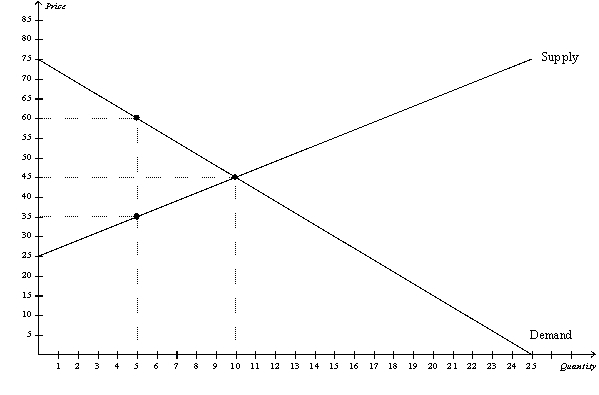 -Refer to Figure 7-15. At the equilibrium price, producer surplus is
 (Multiple Choice)
4.8/5 (73)
(73) Table 7-3
The only four consumers in a market have the following willingness to pay for a good:
Buyer Willingritis to Pay Carlos \ 15 Quilena \ 25 Wilbur \ 35 Ming-la \ 45
-Refer to Table 7-3. Who experiences the largest loss of consumer surplus when the price of the good increases from $20 to $22?
(Multiple Choice)
4.7/5 (84)
(84) Figure 7-20  -Refer to Figure 7-20. At equilibrium, producer surplus is
 (Multiple Choice)
4.9/5 (83)
(83) Consumer surplus can be measured as the area between the demand curve and the equilibrium price.
(True/False)
4.7/5 (74)
(74) If a consumer is willing and able to pay $20 for a particular good and if he pays $16 for the good, then for that consumer, consumer surplus amounts to
(Multiple Choice)
4.9/5 (72)
(72) Jeff decides that he would pay as much as $3,000 for a new laptop computer. He buys the computer and realizes consumer surplus of $700. How much did Jeff pay for his computer?
(Multiple Choice)
4.8/5 (86)
(86) Figure 7-16  -Refer to Figure 7-16. For quantities less than M, the value to the marginal buyer is
 (Multiple Choice)
4.9/5 (78)
(78) Figure 7-21  -Refer to Figure 7-21. If the government mandated a price increase from P1 to a higher price, then
 (Multiple Choice)
4.8/5 (90)
(90) Free markets allocate (a) the supply of goods to the buyers who value them most highly and (b) the demand for goods to the sellers who can produce them at least cost.
(True/False)
4.7/5 (79)
(79) All else equal, what happens to consumer surplus if the price of a good decreases?
(Multiple Choice)
4.8/5 (83)
(83) Producer surplus is the cost of production minus the amount a seller is paid.
(True/False)
4.9/5 (74)
(74) Ronnie operates a lawn-care service. On each day, the cost of mowing the first lawn is $10, the cost of mowing the second lawn is $12, and the cost of mowing the third lawn is $15. His producer surplus on the first three lawns of the day is $53. If Ronnie charges all customers the same price for lawn mowing, that price is
(Multiple Choice)
5.0/5 (70)
(70) Abraham drinks Mountain Dew. He can buy as many cans of Mountain Dew as he wishes at a price of $0.55 per can. On a particular day, he is willing to pay $0.95 for the first can, $0.80 for the second can, $0.60 for the third can, and $0.40 for the fourth can. Assume Abraham is rational in deciding how many cans to buy. His consumer surplus is
(Multiple Choice)
4.9/5 (84)
(84) The distinction between efficiency and equality can be described as follows:
(Multiple Choice)
4.9/5 (80)
(80) Table 7-7
The following table represents the costs of five possible sellers. Seller Cost Abby \ 1,500 Babby \ 1,200 Carlos \ 1,000 Dianne \ 750 Evalina \ 500
-Refer to Table 7-7. Who is a marginal seller when the price is $1,200?
(Multiple Choice)
4.8/5 (82)
(82) Figure 7-8 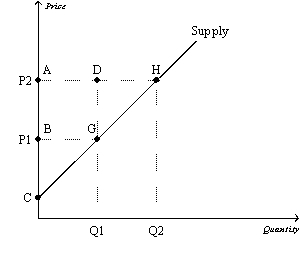 -Refer to Figure 7-8. Which area represents the increase in producer surplus when the price rises from P1 to P2 due to new producers entering the market?
 (Multiple Choice)
4.8/5 (72)
(72) Let P represent price; let QS represent quantity supplied; and assume the equation of the supply curve is . If 90 units of the good are produced and sold, then producer surplus amounts to $1,350.
(True/False)
4.9/5 (90)
(90) 
Filters
- Essay(0)
- Multiple Choice(0)
- Short Answer(0)
- True False(0)
- Matching(0)