



 Chat with AI
Exam 7: Consumers, Producers, and the Efficiency of Markets

Exam 1: Ten Principles of Economics347 Questions
Exam 2: Thinking Like an Economist535 Questions
Exam 3: Interdependence and the Gains From Trade442 Questions
Exam 4: The Market Forces of Supply and Demand569 Questions
Exam 5: Elasticity and Its Application503 Questions
Exam 6: Supply, Demand, and Government Policies556 Questions
Exam 7: Consumers, Producers, and the Efficiency of Markets460 Questions
Exam 8: Application: The Costs of Taxation422 Questions
Exam 9: Application: International Trade409 Questions
Exam 10: Measuring a Nations Income428 Questions
Exam 11: Measuring the Cost of Living436 Questions
Exam 12: Production and Growth417 Questions
Exam 13: Saving, Investment, and the Financial System473 Questions
Exam 14: The Basic Tools of Finance419 Questions
Exam 15: Unemployment571 Questions
Exam 16: The Monetary System423 Questions
Exam 17: Money Growth and Inflation388 Questions
Exam 18: Open-Economy Macroeconomic Models448 Questions
Exam 19: A Macroeconomic Theory of the Open Economy374 Questions
Exam 20: Aggregate Demand and Aggregate Supply471 Questions
Exam 21: The Influence of Monetary and Fiscal Policy on Aggregate Demand416 Questions
Exam 22: The Short-Run Trade-Off Between Inflation and Unemployment400 Questions
Exam 23: Six Debates Over Macroeconomic Policy235 Questions
Select questions type


Table 7-7
The following table represents the costs of five possible sellers. Seller Cost Abby \ 1,500 Babby \ 1,200 Carlos \ 1,000 Dianne \ 750 Evalina \ 500
-Refer to Table 7-7. If the price is $1,000,
(Multiple Choice)
5.0/5  (81)
(81) Connie can clean windows in large office buildings at a cost of $1 per window. The market price for window-cleaning services is $3 per window. If Connie cleans 100 windows, her producer surplus is $200.
(True/False)
4.8/5 (75)
(75) Kristi and Rebecca sell lemonade on the corner. It costs them 9 cents to make each cup. On a certain day, they sell 40 cups, and their producer surplus for that day amounts to $12.40. Kristi and Rebecca sold each cup for
(Multiple Choice)
4.9/5 (86)
(86) If producing a soccer ball costs Jake $5, and he sells it for $40, his producer surplus is $35.
(True/False)
4.8/5 (83)
(83) Table 7-5
For each of three potential buyers of oranges, the table displays the willingness to pay for the first three oranges of the day. Assume Alex, Barb, and Carlos are the only three buyers of oranges, and only three oranges can be supplied per day. First Orangp Second Orange Third Orange Alliton \ 2.00 \ 1.50 \ 0.75 Bob \ 1.50 \ 1.00 \ 0.80 Chariste \ 0.75 \ 0.25 \ 0
-Refer to Table 7-5. The market quantity of oranges demanded per day is exactly 5 if the price of an orange, P, satisfies
(Multiple Choice)
4.9/5 (71)
(71) Figure 7-21  -Refer to Figure 7-21. Buyers who value this good more than the equilibrium price are represented by which line segment?
 (Multiple Choice)
5.0/5 (79)
(79) Denise values a stainless steel dishwasher for her new house at $500. The actual price of the dishwasher is $650. Denise
(Multiple Choice)
4.9/5 (77)
(77) Figure 7-8 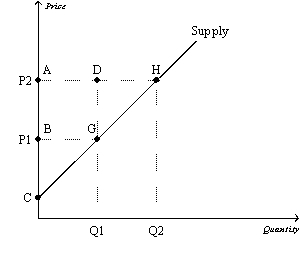 -Refer to Figure 7-8. Which area represents producer surplus when the price is P1?
 (Multiple Choice)
4.9/5 (84)
(84) Table 7-9
The numbers reveal the opportunity costs of providing 10 piano lessons of equal quality. Sallar Cast Marcia \ 200 Jan \ 250 Cindy \ 350 Grea \ 400 Peter \ 700 Babby \ 800
-Refer to Table 7-9. You wish to purchase 10 piano lessons for yourself and for your brother, so you take bids from each of the sellers. You will take lessons at the same time, so one teacher cannot provide lessons to both of you. You must pay the same price for both sets of lessons, and you will not accept a bid below a seller's cost because you are concerned that the seller will not provide all 10 lessons. What bid will you accept?
(Multiple Choice)
4.8/5 (77)
(77) Each seller of a product is willing to sell as long as the price he or she can receive is greater than the opportunity cost of producing the product.
(True/False)
4.8/5 (71)
(71) Figure 7-20  -Refer to Figure 7-20. At equilibrium, consumer surplus is
 (Multiple Choice)
4.9/5 (80)
(80) Denise values a stainless steel dishwasher for her new house at $500, but she succeeds in buying one for $350. Denise's consumer surplus is
(Multiple Choice)
4.8/5 (83)
(83) Efficiency is related to the size of the economic pie, whereas equality is related to how the pie gets sliced and distributed.
(True/False)
4.9/5 (90)
(90) Suppose there is an early freeze in California that reduces the size of the lemon crop. What happens to consumer surplus in the market for lemons?
(Multiple Choice)
4.8/5 (95)
(95) 
Filters
- Essay(0)
- Multiple Choice(0)
- Short Answer(0)
- True False(0)
- Matching(0)