



 Chat with AI
Exam 7: Consumers, Producers, and the Efficiency of Markets

Exam 1: Ten Principles of Economics347 Questions
Exam 2: Thinking Like an Economist535 Questions
Exam 3: Interdependence and the Gains From Trade442 Questions
Exam 4: The Market Forces of Supply and Demand569 Questions
Exam 5: Elasticity and Its Application503 Questions
Exam 6: Supply, Demand, and Government Policies556 Questions
Exam 7: Consumers, Producers, and the Efficiency of Markets460 Questions
Exam 8: Application: The Costs of Taxation422 Questions
Exam 9: Application: International Trade409 Questions
Exam 10: Measuring a Nations Income428 Questions
Exam 11: Measuring the Cost of Living436 Questions
Exam 12: Production and Growth417 Questions
Exam 13: Saving, Investment, and the Financial System473 Questions
Exam 14: The Basic Tools of Finance419 Questions
Exam 15: Unemployment571 Questions
Exam 16: The Monetary System423 Questions
Exam 17: Money Growth and Inflation388 Questions
Exam 18: Open-Economy Macroeconomic Models448 Questions
Exam 19: A Macroeconomic Theory of the Open Economy374 Questions
Exam 20: Aggregate Demand and Aggregate Supply471 Questions
Exam 21: The Influence of Monetary and Fiscal Policy on Aggregate Demand416 Questions
Exam 22: The Short-Run Trade-Off Between Inflation and Unemployment400 Questions
Exam 23: Six Debates Over Macroeconomic Policy235 Questions
Select questions type


Figure 7-18  -Refer to Figure 7-18. If 40 units of the good are being bought and sold, then
 (Multiple Choice)
4.9/5  (85)
(85) Janine would be willing to pay $50 to see Les Misérables, but she buys a ticket for only $30. Janine values the performance at
(Multiple Choice)
4.9/5 (92)
(92) Given the following two equations:
1) Tatal Suplus = Consumer Suplus + Produce Suplus
2) Total Surglus = Value to Buyers - Cost to Sellers Show how equation (1) can be used to derive equation (2).
(Essay)
4.8/5 (79)
(79) Suppose Lauren, Leslie and Lydia all purchase bulletin boards for their rooms for $15 each. Lauren's willingness to pay was $35, Leslie's willingness to pay was $25, and Lydia's willingness to pay was $30. Total consumer surplus for these three would be
(Multiple Choice)
4.9/5 (81)
(81) Figure 7-5 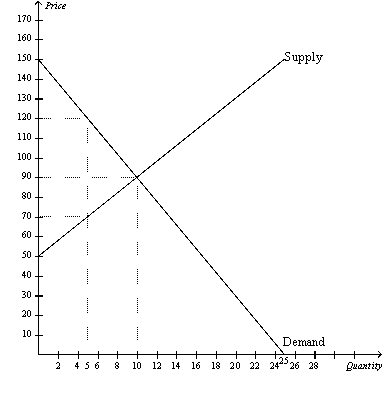 -Refer to Figure 7-5. At the equilibrium price, consumer surplus is
 (Multiple Choice)
4.8/5 (79)
(79) Figure 7-19 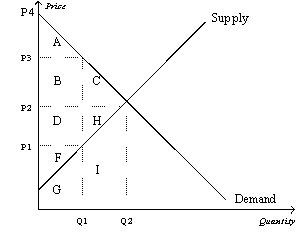 -Refer to Figure 7-19. If the price were P3, consumer surplus would be represented by the area
 (Multiple Choice)
4.8/5 (79)
(79) Figure 7-1  -Refer to Figure 7-1. The value of the good to consumers minus the cost of the good to consumers amounts to $325 if the price of the good is
 (Multiple Choice)
4.9/5 (90)
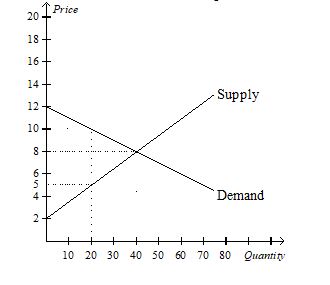
(90) Answer the following questions based on the graph that represents J.R.'s demand for ribs per week at Judy's Rib Shack.
a. At the equilibrium price, how many ribs would J.R. be willing to purchase?
b. How much is J.R. willing to pay for 20 ribs?
c. What is the magnitude of J.R.'s consumer surplus at the equilibrium price?
d. At the equilibrium price, how many ribs would Judy be willing to sell?
e. How high must the price of ribs be for Judy to supply 20 ribs to the market?
f. At the equilibrium price, what is the magnitude of total surplus in the market?
g. If the price of ribs rose to $10, what would happen to J.R.'s consumer surplus?
h. If the price of ribs fell to $5, what would happen to Judy's producer surplus?
i. Explain why the graph that is shown verifies the fact that the market equilibrium (quantity) maximizes the sum of producer and consumer surplus.
(Essay)
4.9/5 (84)
(84) Figure 7-17  -Refer to Figure 7-17. Which area represents total surplus in the market when the price is P1?
 (Multiple Choice)
4.8/5 (91)
(91) Answer each of the following questions about demand and consumer surplus.
a.What is consumer surplus, and how is it measured?
b.What is the relationship between the demand curve and the willingness to pay?
c.Other things equal, what happens to consumer surplus if the price of a good falls? Why? Illustrate using a demand curve.
d.In what way does the demand curve represent the benefit consumers receive from participating in a market? In addition to the demand curve, what else must be considered to determine consumer surplus?
(Essay)
4.7/5 (74)
(74) At Nick's Bakery, the cost to make homemade chocolate cake is $3 per cake. As a result of selling three cakes, Nick experiences a producer surplus in the amount of $19.50. Nick must be selling his cakes for
(Multiple Choice)
4.9/5 (74)
(74) Table 7-4
The numbers in Table 7-1 reveal the maximum willingness to pay for a ticket to a Chicago Cubs vs. St. Louis Cardinal's baseball game at Wrigley Field. Buyer Willingnes to Pay Jenrifer \ 10 Bryce \ 15 Dan \ 20 David \ 25 Ker \ 50 Lisa \ 60
-Refer to Table 7-4. If you have a ticket that you sell to the group in an auction, what will be the selling price?
(Multiple Choice)
4.9/5 (94)
(94) 
Filters
- Essay(0)
- Multiple Choice(0)
- Short Answer(0)
- True False(0)
- Matching(0)