



 Chat with AI
Exam 7: Consumers, Producers, and the Efficiency of Markets

Exam 1: Ten Principles of Economics347 Questions
Exam 2: Thinking Like an Economist535 Questions
Exam 3: Interdependence and the Gains From Trade442 Questions
Exam 4: The Market Forces of Supply and Demand569 Questions
Exam 5: Elasticity and Its Application503 Questions
Exam 6: Supply, Demand, and Government Policies556 Questions
Exam 7: Consumers, Producers, and the Efficiency of Markets460 Questions
Exam 8: Application: The Costs of Taxation422 Questions
Exam 9: Application: International Trade409 Questions
Exam 10: Measuring a Nations Income428 Questions
Exam 11: Measuring the Cost of Living436 Questions
Exam 12: Production and Growth417 Questions
Exam 13: Saving, Investment, and the Financial System473 Questions
Exam 14: The Basic Tools of Finance419 Questions
Exam 15: Unemployment571 Questions
Exam 16: The Monetary System423 Questions
Exam 17: Money Growth and Inflation388 Questions
Exam 18: Open-Economy Macroeconomic Models448 Questions
Exam 19: A Macroeconomic Theory of the Open Economy374 Questions
Exam 20: Aggregate Demand and Aggregate Supply471 Questions
Exam 21: The Influence of Monetary and Fiscal Policy on Aggregate Demand416 Questions
Exam 22: The Short-Run Trade-Off Between Inflation and Unemployment400 Questions
Exam 23: Six Debates Over Macroeconomic Policy235 Questions
Select questions type


Producing a soccer ball costs Jake $5. He sells it to Darby for $35. Darby values the soccer ball at $50. For this transaction, the total surplus in the market is $40.
(True/False)
4.9/5  (76)
(76) Figure 7-14 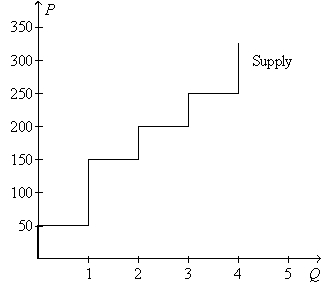 -Refer to Figure 7-14. If total surplus is $750 and consumer surplus is
 (Multiple Choice)
5.0/5 (85)
(85) Efficiency refers to whether a market outcome is fair, while equality refers to whether the maximum amount of output was produced from a given number of inputs.
(True/False)
4.9/5 (69)
(69) Michael values a stainless steel refrigerator for his new house at $3,500, but he succeeds in buying one for $3,000. Michael's consumer surplus is
(Multiple Choice)
4.9/5 (81)
(81) Which of the Ten Principles of Economics does welfare economics explain more fully?
(Multiple Choice)
5.0/5 (82)
(82) Figure 7-20  -Refer to Figure 7-20. At equilibrium, consumer surplus is measured by the area
 (Multiple Choice)
4.8/5 (82)
(82) Which of the following will cause no change in producer surplus?
(Multiple Choice)
4.7/5 (73)
(73) Bill created a new software program he is willing to sell for $200. He sells his first copy and enjoys a producer surplus of $150. What is the price paid for the software?
(Multiple Choice)
5.0/5 (74)
(74) If the United States legally allowed for a market in transplant organs, it is estimated that one kidney would sell for at least $100,000.
(True/False)
5.0/5 (76)
(76) Table 7-5
For each of three potential buyers of oranges, the table displays the willingness to pay for the first three oranges of the day. Assume Alex, Barb, and Carlos are the only three buyers of oranges, and only three oranges can be supplied per day. First Orangp Second Orange Third Orange Alliton \ 2.00 \ 1.50 \ 0.75 Bob \ 1.50 \ 1.00 \ 0.80 Chariste \ 0.75 \ 0.25 \ 0
-Refer to Table 7-5. If the market price of an orange is $1.20, then the market quantity of oranges demanded per day is
(Multiple Choice)
4.9/5 (82)
(82) Chuck would be willing to pay $20 to attend a dog show, but he buys a ticket for $15. Chuck values the dog show at
(Multiple Choice)
4.8/5 (80)
(80) 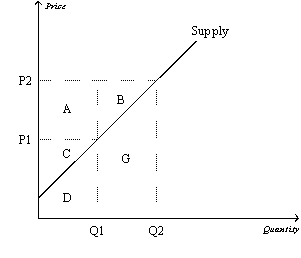 -Refer to Figure 7-12. Area B represents
If the price of oak lumber increases, what happens to consumer surplus in the market for oak cabinets?
(Multiple Choice)
4.8/5 (87)
(87) Total surplus in a market can be measured as the area below the supply curve plus the area above the demand curve, up to the point of equilibrium.
(True/False)
4.8/5 (89)
(89) If the government imposes a binding price floor in a market, then the consumer surplus in that market will decrease.
(True/False)
4.9/5 (75)
(75) Suppose you sell a kayak for $600, but you were willing to sell it for $450. The buyer was willing to pay $650. The total surplus is $200.
(True/False)
4.8/5 (78)
(78) Pat bought a new car for $15,500 but was willing to pay $24,000. The consumer surplus is
(Multiple Choice)
4.9/5 (80)
(80) A simultaneous decrease in both the demand for MP3 players and the supply of MP3 players would imply that
(Multiple Choice)
4.9/5 (86)
(86) 
Filters
- Essay(0)
- Multiple Choice(0)
- Short Answer(0)
- True False(0)
- Matching(0)