



 Chat with AI
Exam 7: Consumers, Producers, and the Efficiency of Markets

Exam 1: Ten Principles of Economics347 Questions
Exam 2: Thinking Like an Economist535 Questions
Exam 3: Interdependence and the Gains From Trade442 Questions
Exam 4: The Market Forces of Supply and Demand569 Questions
Exam 5: Elasticity and Its Application503 Questions
Exam 6: Supply, Demand, and Government Policies556 Questions
Exam 7: Consumers, Producers, and the Efficiency of Markets460 Questions
Exam 8: Application: The Costs of Taxation422 Questions
Exam 9: Application: International Trade409 Questions
Exam 10: Measuring a Nations Income428 Questions
Exam 11: Measuring the Cost of Living436 Questions
Exam 12: Production and Growth417 Questions
Exam 13: Saving, Investment, and the Financial System473 Questions
Exam 14: The Basic Tools of Finance419 Questions
Exam 15: Unemployment571 Questions
Exam 16: The Monetary System423 Questions
Exam 17: Money Growth and Inflation388 Questions
Exam 18: Open-Economy Macroeconomic Models448 Questions
Exam 19: A Macroeconomic Theory of the Open Economy374 Questions
Exam 20: Aggregate Demand and Aggregate Supply471 Questions
Exam 21: The Influence of Monetary and Fiscal Policy on Aggregate Demand416 Questions
Exam 22: The Short-Run Trade-Off Between Inflation and Unemployment400 Questions
Exam 23: Six Debates Over Macroeconomic Policy235 Questions
Select questions type


When the demand for a good increases and the supply of the good remains unchanged, consumer surplus
(Multiple Choice)
4.8/5  (76)
(76) Figure 7-13  -Refer to Figure 7-13. Suppose the price of the good is $450. Then, on the first unit of the good that is sold, producer surplus is
 (Multiple Choice)
4.9/5 (93)
(93) Table 7-2
This table refers to five possible buyers' willingness to pay for a case of Vanilla Coke. Buyer Willinenes Ta Raz David \ 8.50 Laura \ 7.00 Mepan \ 5.50 Mallary \ 4.00 Audrey \ 3.50
-Refer to Table 7-2. If the market price is $3.80,
(Multiple Choice)
4.9/5 (81)
(81) Table 7-6
Buygr Willingrins to Pay Michad \ 500 Farvin \ 400 Larry \ 350 Charles \ 300
-Refer to Table 7-6. You have an extra ticket to the Midwest Regional Sweet 16 game in the men's NCAA basketball tournament. The table shows the willingness to pay of the four potential buyers in the market for a ticket to the game. You hold an auction to sell the ticket. Who makes the winning bid, and what does he offer to pay for the ticket?
(Multiple Choice)
4.8/5 (63)
(63) Suppose the demand for peaches decreases. What will happen to producer surplus in the market for peaches?
(Multiple Choice)
4.8/5 (77)
(77) Table 7-3
The only four consumers in a market have the following willingness to pay for a good:
Buyer Willingritis to Pay Carlos \ 15 Quilena \ 25 Wilbur \ 35 Ming-la \ 45
-Refer to Table 7-3. If there is only one unit of the good and if the buyers bid against each other for the right to purchase it, then the consumer surplus will be
(Multiple Choice)
4.9/5 (81)
(81) In a competitive market, sales go to those producers who are willing to supply the product at the lowest price.
(True/False)
4.7/5 (64)
(64) Figure 7-10  -Refer to Figure 7-10. If the equilibrium price rises from $50 to $200, what is the additional producer surplus to initial producers?
 (Multiple Choice)
4.8/5 (82)
(82) Table 7-1
Buger Willingnits Ta Raz Lari \ 50.00 Audrey \ 30.00 Zach \ 20.00 Calvin \ 10.00
-Refer to Table 7-1. If the price of the product is $51, then who would be willing to purchase the product?
(Multiple Choice)
4.9/5 (75)
(75) Raisin bran and milk are complementary goods. A decrease in the price of raisins will
(Multiple Choice)
4.7/5 (84)
(84) Figure 7-8 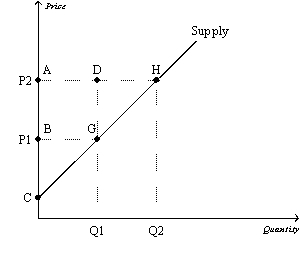 -Refer to Figure 7-8. Which area represents producer surplus when the price is P2?
 (Multiple Choice)
4.9/5 (76)
(76) Economists generally believe that, although there may be advantages to society from ticket-scalping, the costs to society of this activity outweigh the benefits.
(True/False)
4.9/5 (79)
(79) Suppose your own demand curve for tomatoes slopes downward. Suppose also that, for the last tomato you bought this week, you paid a price exactly equal to your willingness to pay. Then
(Multiple Choice)
5.0/5 (74)
(74) Consumer surplus is the amount a buyer is willing to pay for a good minus the amount the buyer actually has to pay for it.
(True/False)
4.8/5 (87)
(87) Table 7-5
For each of three potential buyers of oranges, the table displays the willingness to pay for the first three oranges of the day. Assume Alex, Barb, and Carlos are the only three buyers of oranges, and only three oranges can be supplied per day. First Orangp Second Orange Third Orange Alliton \ 2.00 \ 1.50 \ 0.75 Bob \ 1.50 \ 1.00 \ 0.80 Chariste \ 0.75 \ 0.25 \ 0
-Refer to Table 7-5. If the market price of an orange is $0.70, then the market quantity of oranges demanded per day is
(Multiple Choice)
4.9/5 (78)
(78) If the government allowed a free market for transplant organs such as kidneys to exist, the
(Multiple Choice)
4.8/5 (73)
(73) Figure 7-21  -Refer to Figure 7-21. Buyers who value this good less than the equilibrium price are represented by which line segment?
 (Multiple Choice)
4.8/5 (70)
(70) 
Filters
- Essay(0)
- Multiple Choice(0)
- Short Answer(0)
- True False(0)
- Matching(0)