



 Chat with AI
Exam 7: Consumers, Producers, and the Efficiency of Markets

Exam 1: Ten Principles of Economics347 Questions
Exam 2: Thinking Like an Economist535 Questions
Exam 3: Interdependence and the Gains From Trade442 Questions
Exam 4: The Market Forces of Supply and Demand569 Questions
Exam 5: Elasticity and Its Application503 Questions
Exam 6: Supply, Demand, and Government Policies556 Questions
Exam 7: Consumers, Producers, and the Efficiency of Markets460 Questions
Exam 8: Application: The Costs of Taxation422 Questions
Exam 9: Application: International Trade409 Questions
Exam 10: Measuring a Nations Income428 Questions
Exam 11: Measuring the Cost of Living436 Questions
Exam 12: Production and Growth417 Questions
Exam 13: Saving, Investment, and the Financial System473 Questions
Exam 14: The Basic Tools of Finance419 Questions
Exam 15: Unemployment571 Questions
Exam 16: The Monetary System423 Questions
Exam 17: Money Growth and Inflation388 Questions
Exam 18: Open-Economy Macroeconomic Models448 Questions
Exam 19: A Macroeconomic Theory of the Open Economy374 Questions
Exam 20: Aggregate Demand and Aggregate Supply471 Questions
Exam 21: The Influence of Monetary and Fiscal Policy on Aggregate Demand416 Questions
Exam 22: The Short-Run Trade-Off Between Inflation and Unemployment400 Questions
Exam 23: Six Debates Over Macroeconomic Policy235 Questions
Select questions type


Figure 7-20  -Refer to Figure 7-20. At equilibrium, total surplus is measured by the area
 (Multiple Choice)
4.9/5  (92)
(92) The lower the price, the lower the consumer surplus, all else equal.
(True/False)
4.7/5 (87)
(87) Producer surplus is the amount a seller is paid minus the cost of production.
(True/False)
5.0/5 (72)
(72) If the cost of producing sofas decreases, then consumer surplus in the sofa market will
(Multiple Choice)
4.8/5 (68)
(68) Raisin bran and milk are complements. An increase in the price of raisins will
(Multiple Choice)
4.9/5 (86)
(86) All else equal, a decrease in demand will cause an increase in producer surplus.
(True/False)
4.9/5 (83)
(83) Suppose that Firms A and B each produce high-resolution computer monitors, but Firm A can do so at a lower cost. Cassie and David each want to purchase a high-resolution computer monitor, but David is willing to pay more than Cassie. If Firm A produces a monitor that Cassie buys but David does not, then the market outcome illustrates which of the following principles? (i)
Free markets allocate the supply of goods to the buyers who value them most highly, as measured by their willingness to pay.(ii)
Free markets allocate the demand for goods to the sellers who can produce them at the least cost.
(Multiple Choice)
4.8/5 (95)
(95) A buyer is willing to buy a product at a price greater than or equal to his willingness to pay, but would refuse to buy a product at a price less than his willingness to pay.
(True/False)
4.9/5 (60)
(60) Consumer surplus is the amount a buyer actually has to pay for a good minus the amount the buyer is willing to pay for it.
(True/False)
4.8/5 (82)
(82) Figure 7-11 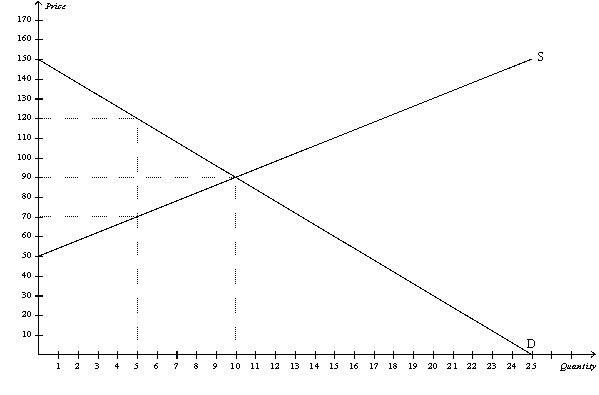 -Refer to Figure 7-11. At the equilibrium price, producer surplus is
 (Multiple Choice)
4.9/5 (75)
(75) Many economists believe that restrictions against ticket scalping result in each of the following except
(Multiple Choice)
4.9/5 (74)
(74) Table 7-4
The numbers in Table 7-1 reveal the maximum willingness to pay for a ticket to a Chicago Cubs vs. St. Louis Cardinal's baseball game at Wrigley Field. Buyer Willingnes to Pay Jenrifer \ 10 Bryce \ 15 Dan \ 20 David \ 25 Ker \ 50 Lisa \ 60
-Refer to Table 7-4. If you have two (essentially) identical tickets that you sell to the group in an auction, what will be the selling price for each ticket?
(Multiple Choice)
4.8/5 (79)
(79) Chad is willing to pay $5.00 to get his first cup of morning latté; he is willing to pay $4.50 for a second cup. He buys his first cup from a vendor selling latté for $3.75 per cup. He returns to that vendor later in the morning to find that the vendor has increased her price to $3.90 per cup. Chad buys a second cup. Which of the following statements is correct?
(Multiple Choice)
4.8/5 (81)
(81) Table 7-1
Buger Willingnits Ta Raz Lari \ 50.00 Audrey \ 30.00 Zach \ 20.00 Calvin \ 10.00
-Refer to Table 7-1. If the price of the product is $18, then the total consumer surplus is
(Multiple Choice)
4.9/5 (80)
(80) Figure 7-2  -Refer to Figure 7-2. When the price is P1, consumer surplus is
 (Multiple Choice)
4.9/5 (72)
(72) Figure 7-6  -Refer to Figure 7-6. What happens to the consumer surplus if the price rises from $100 to $150?
 (Multiple Choice)
4.8/5 (85)
(85) Suppose the demand for peanuts increases. What will happen to producer surplus in the market for peanuts?
(Multiple Choice)
4.9/5 (80)
(80) Ivana produces cookies. Her production cost is $6 per dozen. She sells the cookies for $8 per dozen. Her producer surplus per dozen cookies is
(Multiple Choice)
4.9/5 (71)
(71) Total surplus in a market will increase when the government
(Multiple Choice)
5.0/5 (76)
(76) 
Filters
- Essay(0)
- Multiple Choice(0)
- Short Answer(0)
- True False(0)
- Matching(0)