



 Chat with AI
Exam 12: The Economics of Information

Exam 1: Thinking Like an Economist142 Questions
Exam 2: Comparative Advantage163 Questions
Exam 3: Supply and Demand181 Questions
Exam 4: Elasticity154 Questions
Exam 5: Demand144 Questions
Exam 6: Perfectly Competitive Supply159 Questions
Exam 7: Efficiency, Exchange, and the Invisible Hand in Action159 Questions
Exam 8: Monopoly, Oligopoly, and Monopolistic Competition147 Questions
Exam 9: Games and Strategic Behavior150 Questions
Exam 10: An Introduction to Behavioral Economics111 Questions
Exam 11: Externalities, Property Rights, and the Environment184 Questions
Exam 12: The Economics of Information127 Questions
Exam 13: Labor Markets, Poverty, and Income Distribution138 Questions
Exam 14: Public Goods and Tax Policy142 Questions
Exam 15: International Trade and Trade Policy164 Questions
Exam 16: Macroeconomics: The Birds Eye View of the Economy154 Questions
Exam 17: Measuring Economic Activity: GDP and Unemployment210 Questions
Exam 18: Measuring the Price Level and Inflation160 Questions
Exam 19: Economic Growth, Productivity, and Living Standards158 Questions
Exam 20: The Labor Market: Workers, Wages, and Unemployment121 Questions
Exam 21: Saving and Capital Formation144 Questions
Exam 22: Money Prices and the Federal Reserve107 Questions
Exam 23: Financial Markets and International Capital Flows104 Questions
Exam 24: Short-Term Economic Fluctuations: An Introduction124 Questions
Exam 25: Spending and Output in the Short Run146 Questions
Exam 26: Stabilizing the Economy: The Role of the Fed162 Questions
Exam 27: Aggregate Demand, Aggregate Supply, and Inflation159 Questions
Exam 28: Exchange Rates and the Open Economy157 Questions
Select questions type


This graph illustrates the marginal costs and marginal benefits of acquiring information before making a major purchase. 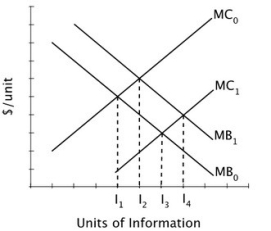 Suppose the marginal cost and marginal benefit curves were MC₀ and MB₀ several decades ago. However, because information about this product is now available online, the:
 (Multiple Choice)
5.0/5  (85)
(85) Alex, who is risk-neutral, is looking for a one-bedroom apartment to rent for the month of August while he's on vacation in Seattle. All of the one-bedroom apartments in the neighborhood where he wants to stay are of equal quality, but 70 percent rent for $700 per month, 20 percent rent for $600 per month, and 10 percent rent for $500 per month. The first apartment Alex finds rents for $700 per month. Suppose Alex is risk-neutral. If the cost to Alex of searching for another apartment is $30, then will he search for another apartment?
(Multiple Choice)
4.8/5 (87)
(87) Which one of the following policies mitigates the negative effects of moral hazard?
(Multiple Choice)
4.8/5 (73)
(73) Hans decides to start brushing his teeth less often after signing up for dental insurance. This is an example of:
(Multiple Choice)
4.9/5 (81)
(81) Statistical discrimination in the automobile insurance industry means that young male drivers who drive ________ will pay ________ rates relative to the claims they generate.
(Multiple Choice)
4.7/5 (84)
(84) 
Filters
- Essay(0)
- Multiple Choice(0)
- Short Answer(0)
- True False(0)
- Matching(0)