



 Chat with AI
Exam 12: The Economics of Information

Exam 1: Thinking Like an Economist142 Questions
Exam 2: Comparative Advantage163 Questions
Exam 3: Supply and Demand181 Questions
Exam 4: Elasticity154 Questions
Exam 5: Demand144 Questions
Exam 6: Perfectly Competitive Supply159 Questions
Exam 7: Efficiency, Exchange, and the Invisible Hand in Action159 Questions
Exam 8: Monopoly, Oligopoly, and Monopolistic Competition147 Questions
Exam 9: Games and Strategic Behavior150 Questions
Exam 10: An Introduction to Behavioral Economics111 Questions
Exam 11: Externalities, Property Rights, and the Environment184 Questions
Exam 12: The Economics of Information127 Questions
Exam 13: Labor Markets, Poverty, and Income Distribution138 Questions
Exam 14: Public Goods and Tax Policy142 Questions
Exam 15: International Trade and Trade Policy164 Questions
Exam 16: Macroeconomics: The Birds Eye View of the Economy154 Questions
Exam 17: Measuring Economic Activity: GDP and Unemployment210 Questions
Exam 18: Measuring the Price Level and Inflation160 Questions
Exam 19: Economic Growth, Productivity, and Living Standards158 Questions
Exam 20: The Labor Market: Workers, Wages, and Unemployment121 Questions
Exam 21: Saving and Capital Formation144 Questions
Exam 22: Money Prices and the Federal Reserve107 Questions
Exam 23: Financial Markets and International Capital Flows104 Questions
Exam 24: Short-Term Economic Fluctuations: An Introduction124 Questions
Exam 25: Spending and Output in the Short Run146 Questions
Exam 26: Stabilizing the Economy: The Role of the Fed162 Questions
Exam 27: Aggregate Demand, Aggregate Supply, and Inflation159 Questions
Exam 28: Exchange Rates and the Open Economy157 Questions
Select questions type


Imagine a world in which landlords always fix problems quickly, tenants never damage property and always pay their rent in a timely fashion. In such a world, lease agreements would ________.
(Multiple Choice)
4.9/5  (75)
(75) Suppose that the salary range for recent college graduates with a bachelor's degree in economics is $30,000 to $50,000, with 25 percent of jobs offering $30,000 per year, 50 percent offering $40,000 per year and 25 percent offering $50,000 per year and that in all other respects, the jobs are equally satisfying. Assume that in this market, a job offer remains open for only a short time so that continuing to search requires an applicant to reject any current job offer. If this scenario describes job searches in general, the segment of the population that is most risk-averse will tend to earn:
(Multiple Choice)
4.9/5 (76)
(76) Cal has a choice between two gambles. The first gamble offers a 50 percent chance of winning $20 and a 50 percent chance of losing $20. The second gamble offers a 20 percent chance of winning $100 and an 80% chance of losing $20. Which choice has the higher expected value?
(Multiple Choice)
4.9/5 (71)
(71) Suppose Sandy is moving to Washington, D.C. for a year-long job working for the government. She has decided to rent one of two apartments. Both apartments cost $1,000 per month and are identical except for the fact that one is a monthly rental and the other has a year-long lease. Which of the following best explains why Sandy might pick the year-long lease?
(Multiple Choice)
5.0/5 (81)
(81) Refer to the figure below. If the relevant curves are MC₁ and MB₂, a rational consumer will acquire ________ units of information, the amount for which marginal benefit for information is ________ its marginal cost. 
(Multiple Choice)
5.0/5 (86)
(86) Dan owns an autographed copy of a Brittany Spears CD that he values at $100. If he sells the CD at the garage sale he's planning to hold in a few weeks, it will be sold to a buyer with a reservation price of $175. If he sells it on eBay, it will be sold to a buyer with a reservation price of $500. eBay will charge Dan $50 to auction the CD, which just covers eBay's opportunity cost of running the auction. Relative to selling the CD at his garage sale, auctioning the CD on eBay will lead:
(Multiple Choice)
4.8/5 (84)
(84) There are two employers in Bucolic that hire people who do not have a high school degree: a grocery store and a hardware store. The grocery store pays $10 per hour and the hardware store pays $12 per hour. People who work at either store can work as many hours as they want at those wages. Assume that it takes two hours to interview for a job. Lee works at the grocery store, but would like to work at the hardware store. If Lee interviews at the hardware store, there is a 10% probability of being hired. Assume that Lee is risk-neutral. In terms of foregone earnings, what does it cost Lee to spending two hours interviewing for a job at the hardware store?
(Multiple Choice)
4.8/5 (89)
(89) Suppose that there are two types of houses for sale: those with solid foundations and those with cracked foundations. In all other respects, the two types of houses are identical. Houses with solid foundations are worth $200,000, while those with cracked foundations are worth $200,000 minus the $20,000 to fix the crack, or $180,000. Sellers know which type of house they have, but buyers cannot detect whether the foundation has a crack. Suppose that 80 percent of the houses for sale have a solid foundation and 20 percent of the houses for sale have a cracked foundation. How could the owner of a house with a solid foundation credibly signal to potential buyers that the house has a solid foundation?
(Multiple Choice)
4.8/5 (73)
(73) Conspicuous consumption is a more effective signal of ability for people who:
(Multiple Choice)
4.9/5 (64)
(64) A 65 percent chance of winning $10 and a 35 percent chance of losing $5 would be classified as a(n)
(Multiple Choice)
4.8/5 (82)
(82) Morgan lives in San Francisco and likes to dine out. Morgan has noticed that prices at restaurants near popular tourist destinations in the city tend to be higher than at restaurants of the same quality in other neighborhoods. One reason for this is that:
(Multiple Choice)
4.9/5 (80)
(80) Suppose Chris is offered the following gamble: with probability 0.1 he will win $90, with probability 0.4 he will win $50, and with probability 0.5 he will lose $60. Chris will:
(Multiple Choice)
4.9/5 (88)
(88) Suppose that the salary range for recent college graduates with a bachelor's degree in economics is $30,000 to $50,000, with 25 percent of jobs offering $30,000 per year, 50 percent offering $40,000 per year and 25 percent offering $50,000 per year and that in all other respects, the jobs are equally satisfying. Assume that in this market, a job offer remains open for only a short time so that continuing to search requires an applicant to reject any current job offer. Moe has just received a job offer that pays $40,000 per year. Moe should:
(Multiple Choice)
4.7/5 (90)
(90) There are two employers in Bucolic that hire people who do not have a high school degree: a grocery store and a hardware store. The grocery store pays $10 per hour and the hardware store pays $12 per hour. People who work at either store can work as many hours as they want at those wages. Assume that it takes two hours to interview for a job. Lee works at the grocery store, but would like to work at the hardware store. If Lee interviews at the hardware store, there is a 10 percent probability of being hired. Assume that Lee is risk-neutral. How many hours must Lee anticipate working at the hardware store to justify interviewing for the job?
(Multiple Choice)
4.7/5 (81)
(81) Sydney sells snow globes from a cart. When the cart is located on the sidewalk near a discount store, Sydney's customers have reservation prices of $5. When Sydney's cart is located on a sidewalk in an upscale mall, wealthier customers with reservation prices of $10 buy snow globes. Assume that Sydney can sell the same volume at either location and that marginal and average costs are $3 per globe at both locations. Total economic surplus will be maximized if Sydney:
(Multiple Choice)
4.9/5 (80)
(80) If a gamble has an expected value of zero, then it is termed a(n):
(Multiple Choice)
4.9/5 (78)
(78) One way sellers can credibly signal that they have a high-quality product is to:
(Multiple Choice)
4.8/5 (69)
(69) Refer to the figure below. If the original curves are MB₁ and MC₁, rational consumers will gather ________ units of information. 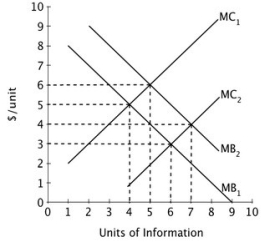
(Multiple Choice)
4.9/5 (63)
(63) Mel is thinking of going on a cruise. Mel values a cruise in nice weather at $2,000 and values a cruise in bad weather at $50. The probability of nice weather is 60 percent and the probability of bad weather is 40 percent. Trip insurance is sometimes available. If purchased, it allows travelers to delay the cruise until the weather is nice. The amount of money that Mel is willing to pay for trip insurance will be:
(Multiple Choice)
4.9/5 (84)
(84) Gasoline prices tend to be higher at stations that are just off the freeway than they are at stations in the middle of town. The most likely reason for this is that:
(Multiple Choice)
4.8/5 (66)
(66) 
Filters
- Essay(0)
- Multiple Choice(0)
- Short Answer(0)
- True False(0)
- Matching(0)