



 Chat with AI
Exam 5: Demand

Exam 1: Thinking Like an Economist142 Questions
Exam 2: Comparative Advantage163 Questions
Exam 3: Supply and Demand181 Questions
Exam 4: Elasticity154 Questions
Exam 5: Demand144 Questions
Exam 6: Perfectly Competitive Supply159 Questions
Exam 7: Efficiency, Exchange, and the Invisible Hand in Action159 Questions
Exam 8: Monopoly, Oligopoly, and Monopolistic Competition147 Questions
Exam 9: Games and Strategic Behavior150 Questions
Exam 10: An Introduction to Behavioral Economics111 Questions
Exam 11: Externalities, Property Rights, and the Environment184 Questions
Exam 12: The Economics of Information127 Questions
Exam 13: Labor Markets, Poverty, and Income Distribution138 Questions
Exam 14: Public Goods and Tax Policy142 Questions
Exam 15: International Trade and Trade Policy164 Questions
Exam 16: Macroeconomics: The Birds Eye View of the Economy154 Questions
Exam 17: Measuring Economic Activity: GDP and Unemployment210 Questions
Exam 18: Measuring the Price Level and Inflation160 Questions
Exam 19: Economic Growth, Productivity, and Living Standards158 Questions
Exam 20: The Labor Market: Workers, Wages, and Unemployment121 Questions
Exam 21: Saving and Capital Formation144 Questions
Exam 22: Money Prices and the Federal Reserve107 Questions
Exam 23: Financial Markets and International Capital Flows104 Questions
Exam 24: Short-Term Economic Fluctuations: An Introduction124 Questions
Exam 25: Spending and Output in the Short Run146 Questions
Exam 26: Stabilizing the Economy: The Role of the Fed162 Questions
Exam 27: Aggregate Demand, Aggregate Supply, and Inflation159 Questions
Exam 28: Exchange Rates and the Open Economy157 Questions
Select questions type


Suppose Suzanne allocates her spending on apples and bananas according to the rational spending rule. If the price of apples is less than the price of bananas, then at Suzanne's optimal consumption bundle, her marginal utility from apples will be:
(Multiple Choice)
4.9/5  (86)
(86) Sven likes to water ski, but can only water ski during the one week each year when he is on vacation. Therefore, he plans to ski every day, for eight hours a day. The first day, Sven skied for eight hours and enjoyed every hour. The second day, Sven slept in and then skied for seven hours, which was fun but not as much fun as the first day. The third day, Sven skied for six hours, but was starting to get a bit bored by the end. The fourth day, Sven skied for four hours and then took a nap. On the fifth day of Sven's vacation, Sven went blueberry picking all day. Sven's total utility ________ with each hour that he skied.
(Multiple Choice)
4.9/5 (82)
(82) Suppose the market for shoes consists of three consumers. The accompanying table shows the quantity demanded at various prices for each consumer: Price Per Pair Pairs Demanded by Pat Pairs Demanded by Leigh Pairs Demanded by Chris \ 100 1 0 \ 75 0 3 1 \ 50 1 7 3 \ 30 2 10 5 The data suggest that Leigh:
(Multiple Choice)
4.7/5 (77)
(77) Refer to the accompanying figure. If Laura and Chris are the only two consumers in this market then at a price of $2.50 per pound, the market demand for hamburger is: 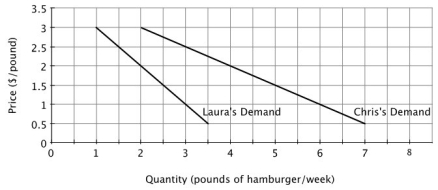
(Multiple Choice)
5.0/5 (85)
(85) 
Filters
- Essay(0)
- Multiple Choice(0)
- Short Answer(0)
- True False(0)
- Matching(0)