



 Chat with AI
Exam 5: Demand

Exam 1: Thinking Like an Economist142 Questions
Exam 2: Comparative Advantage163 Questions
Exam 3: Supply and Demand181 Questions
Exam 4: Elasticity154 Questions
Exam 5: Demand144 Questions
Exam 6: Perfectly Competitive Supply159 Questions
Exam 7: Efficiency, Exchange, and the Invisible Hand in Action159 Questions
Exam 8: Monopoly, Oligopoly, and Monopolistic Competition147 Questions
Exam 9: Games and Strategic Behavior150 Questions
Exam 10: An Introduction to Behavioral Economics111 Questions
Exam 11: Externalities, Property Rights, and the Environment184 Questions
Exam 12: The Economics of Information127 Questions
Exam 13: Labor Markets, Poverty, and Income Distribution138 Questions
Exam 14: Public Goods and Tax Policy142 Questions
Exam 15: International Trade and Trade Policy164 Questions
Exam 16: Macroeconomics: The Birds Eye View of the Economy154 Questions
Exam 17: Measuring Economic Activity: GDP and Unemployment210 Questions
Exam 18: Measuring the Price Level and Inflation160 Questions
Exam 19: Economic Growth, Productivity, and Living Standards158 Questions
Exam 20: The Labor Market: Workers, Wages, and Unemployment121 Questions
Exam 21: Saving and Capital Formation144 Questions
Exam 22: Money Prices and the Federal Reserve107 Questions
Exam 23: Financial Markets and International Capital Flows104 Questions
Exam 24: Short-Term Economic Fluctuations: An Introduction124 Questions
Exam 25: Spending and Output in the Short Run146 Questions
Exam 26: Stabilizing the Economy: The Role of the Fed162 Questions
Exam 27: Aggregate Demand, Aggregate Supply, and Inflation159 Questions
Exam 28: Exchange Rates and the Open Economy157 Questions
Select questions type


According to economists, the satisfaction people get from their consumption activities is called:
(Multiple Choice)
4.8/5  (90)
(90) Sven likes to water ski, but can only water ski during the one week each year when he is on vacation. Therefore, he plans to ski every day, for eight hours a day. The first day, Sven skied for eight hours and enjoyed every hour. The second day, Sven slept in and then skied for seven hours, which was fun but not as much fun as the first day. The third day, Sven skied for six hours, but was starting to get a bit bored by the end. The fourth day, Sven skied for four hours and then took a nap. On the fifth day of Sven's vacation, Sven went blueberry picking all day. Sven's marginal utility from his first hour of skiing was ________ his marginal utility from his tenth hour of skiing.
(Multiple Choice)
4.8/5 (83)
(83) Pat's total utility after eating 99 Reese's Peanut Butter Cups was greater than his total utility after eating 100 Reese's Peanut Butter Cups. Therefore, Pat's marginal utility from the 100ᵗʰ peanut butter cup was:
(Multiple Choice)
4.8/5 (62)
(62) The tendency for marginal utility to decline as consumption increases beyond some point is called:
(Multiple Choice)
4.8/5 (70)
(70) Sven likes to water ski, but can only water ski during the one week each year when he is on vacation. Therefore, he plans to ski every day, for eight hours a day. The first day, Sven skied for eight hours and enjoyed every hour. The second day, Sven slept in and then skied for seven hours, which was fun but not as much fun as the first day. The third day, Sven skied for six hours, but was starting to get a bit bored by the end. The fourth day, Sven skied for four hours and then took a nap. On the fifth day of Sven's vacation, Sven went blueberry picking all day. On the fifth day of Sven's vacation, he had decided that another hour of skiing would yield:
(Multiple Choice)
4.9/5 (72)
(72) When the price of a good falls, marginal utility per dollar spent on that good ________, prompting consumers to purchase ________ of that good.
(Multiple Choice)
4.7/5 (73)
(73) The absolute price of a good in dollar terms is the good's:
(Multiple Choice)
4.9/5 (68)
(68) Refer to the accompanying figure. Suppose the dairy lobby convinces the government to impose price controls in this market. If the government requires cheese to be sold for a price of $8 per pound, then, relative to before the price controls, total consumer surplus in the market would: 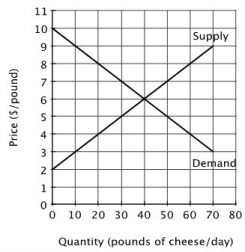
(Multiple Choice)
4.8/5 (62)
(62) Refer to the accompanying figure. The marginal utility of the 6ᵗʰ pizza is: 
(Multiple Choice)
4.9/5 (78)
(78) Refer to the accompanying figures. If Mallory and Rick are the only two consumers in this market, then the market demand for soda will be 90 cans per month when the price of a can of soda is ________. 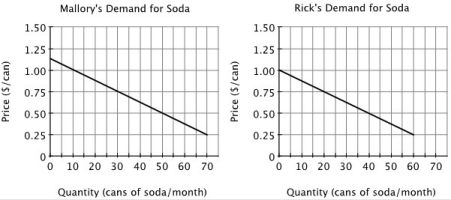
(Multiple Choice)
4.8/5 (72)
(72) Suppose Chris's marginal utility from the first taco he eats is 15, and his marginal utility from the second taco he eats is 12. One can infer that:
(Multiple Choice)
4.9/5 (80)
(80) Refer to the accompanying figure. If Laura and Chris are the only two consumers in this market, then the market demand for hamburger will be 9 pounds per week when the price of hamburger is: 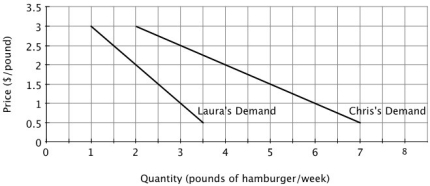
(Multiple Choice)
5.0/5 (73)
(73) Suppose that at your current consumption of two goods, A and B, MUA/PA = 25 and MUB/PB = 20. In order to maximize, your utility you should:
(Multiple Choice)
4.8/5 (88)
(88) Casey earns $150 a week and consumes only fish and shrimp. The price of fish is $3 a pound and the price of shrimp is $5 a pound. Casey can buy a maximum of ________ pounds of fish or a maximum of ________ pounds of shrimp.
(Multiple Choice)
4.9/5 (65)
(65) During Thanksgiving you participated in a pumpkin-pie eating contest. You really enjoyed the first two pies, the third one was okay, but as soon as you ate the fourth one you became ill and lost the contest. After the third pie, your total utility:
(Multiple Choice)
4.8/5 (84)
(84) Alex wants to maximize his utility. At his current level of consumption, Alex's marginal utility from an additional cup of coffee is 15 utils, and his marginal utility from an additional can of soda is 11 utils. If the price of a cup of coffee is $3 and the price of a can of soda is $2, Alex should:
(Multiple Choice)
4.9/5 (86)
(86) The term marginal utility denotes the amount by which ________ changes when consumption changes by ________ unit(s).
(Multiple Choice)
4.9/5 (61)
(61) Refer to the accompanying figure. 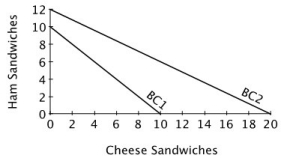 Suppose Zeynep's budget constraint is initially given by BC1. If her budget constraint shifts to BC2, this could be the result of:
 (Multiple Choice)
4.9/5 (77)
(77) The accompanying figure shows the demand curve for a product that can be sold only in whole-number amounts. 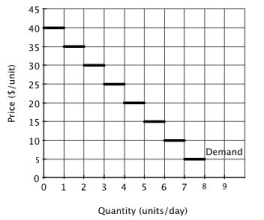 At a price of $15 per unit, what would be the total consumer surplus in this market each day?
 (Multiple Choice)
4.9/5 (85)
(85) 
Filters
- Essay(0)
- Multiple Choice(0)
- Short Answer(0)
- True False(0)
- Matching(0)