



 Chat with AI
Exam 5: Demand

Exam 1: Thinking Like an Economist142 Questions
Exam 2: Comparative Advantage163 Questions
Exam 3: Supply and Demand181 Questions
Exam 4: Elasticity154 Questions
Exam 5: Demand144 Questions
Exam 6: Perfectly Competitive Supply159 Questions
Exam 7: Efficiency, Exchange, and the Invisible Hand in Action159 Questions
Exam 8: Monopoly, Oligopoly, and Monopolistic Competition147 Questions
Exam 9: Games and Strategic Behavior150 Questions
Exam 10: An Introduction to Behavioral Economics111 Questions
Exam 11: Externalities, Property Rights, and the Environment184 Questions
Exam 12: The Economics of Information127 Questions
Exam 13: Labor Markets, Poverty, and Income Distribution138 Questions
Exam 14: Public Goods and Tax Policy142 Questions
Exam 15: International Trade and Trade Policy164 Questions
Exam 16: Macroeconomics: The Birds Eye View of the Economy154 Questions
Exam 17: Measuring Economic Activity: GDP and Unemployment210 Questions
Exam 18: Measuring the Price Level and Inflation160 Questions
Exam 19: Economic Growth, Productivity, and Living Standards158 Questions
Exam 20: The Labor Market: Workers, Wages, and Unemployment121 Questions
Exam 21: Saving and Capital Formation144 Questions
Exam 22: Money Prices and the Federal Reserve107 Questions
Exam 23: Financial Markets and International Capital Flows104 Questions
Exam 24: Short-Term Economic Fluctuations: An Introduction124 Questions
Exam 25: Spending and Output in the Short Run146 Questions
Exam 26: Stabilizing the Economy: The Role of the Fed162 Questions
Exam 27: Aggregate Demand, Aggregate Supply, and Inflation159 Questions
Exam 28: Exchange Rates and the Open Economy157 Questions
Select questions type


Cory gets 18, 23, and 25 units worth of total utility from consuming 10, 11, and 12 raw oysters, respectively, and the price per oyster is 25 cents. Thus, one can infer that Cory:
(Multiple Choice)
4.9/5  (71)
(71) Refer to the accompanying figure. What is the equilibrium quantity of bananas in this market?
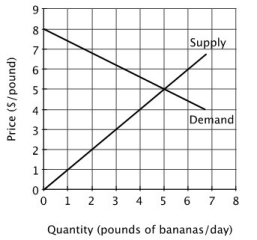
(Multiple Choice)
4.8/5 (82)
(82) The accompanying figure shows a a single consumer's demand for ice cream at the student union. 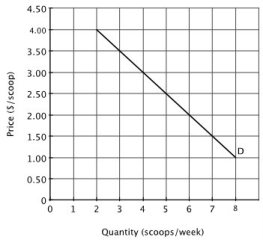 During the summer, there are 300 students on campus. Each student's weekly demand for ice cream is shown above. When the price of ice cream is $2.00 per scoop, those 300 students purchase a total of ________ scoops per week from the student union.
 (Multiple Choice)
4.8/5 (79)
(79) The tendency for consumers to purchase more of a good or service as its price falls is captured by the:
(Multiple Choice)
4.7/5 (84)
(84) Suppose that at Miles's current level of consumption, his marginal utility from a pizza is 10 utils, and his marginal utility from a pint of ice cream is 16 utils. If the price of a pizza is $8, and the price of a pint of ice cream is $5, is Miles maximizing his utility?
(Multiple Choice)
4.9/5 (90)
(90) For two goods, A and B, the rational spending rule is expressed as:
(Multiple Choice)
4.9/5 (86)
(86) Refer to the accompanying table. If the price of Good A is $1 and the price of Good B is $3, then the rational spending rule is satisfied when the consumer purchases ________ units of Good A and ________ units of Good B.
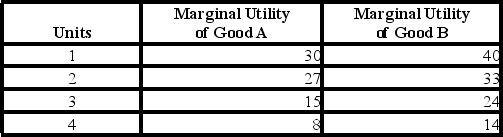
(Multiple Choice)
4.8/5 (80)
(80) Refer to the accompanying figure. At the equilibrium price, total consumer surplus in this market is:
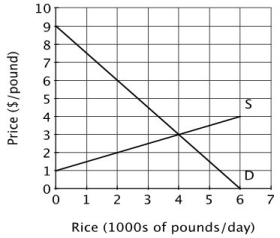
(Multiple Choice)
4.9/5 (82)
(82) Assume that Dusty has $30 in income, the price of a loaf of bread is $1.50, and the price of a jar of peanut butter is $3. Dusty can buy a maximum of ________ loaves of bread or a maximum of ________ jars of peanut butter.
(Multiple Choice)
5.0/5 (79)
(79) It is impossible for total utility to be ________ when marginal utility is ________.
(Multiple Choice)
4.9/5 (80)
(80) Refer to the accompanying table. If the price of a t-shirt is $6 and the price of a sweater is $80, then the rational spending rule is satisfied when the consumer purchases ________ t-shirts and ________ sweaters.
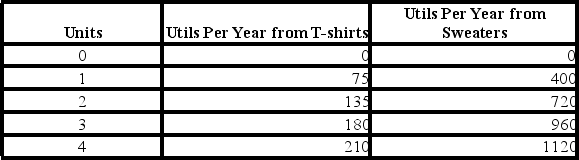
(Multiple Choice)
5.0/5 (82)
(82) Refer to the accompanying figure.
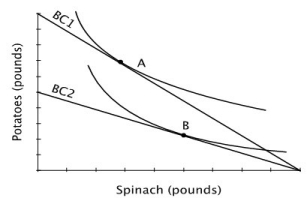 Suppose that James' initial budget constraint shifts from BC1 to BC2, and as a result, his best affordable bundle moves from point A to point B. According to this figure:
 (Multiple Choice)
4.9/5 (68)
(68) The accompanying figure shows a single consumer's demand for ice cream at the student union. 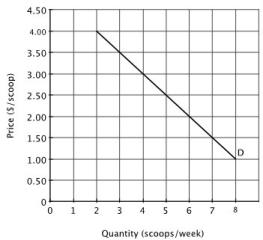 The student union sells a total of 7,200 scoops of ice cream each week at a price of $2.00 per scoop. If every student who buys ice cream has the demand curve shown above, then there must be ________ students purchasing ice cream each week.
 (Multiple Choice)
5.0/5 (84)
(84) Suppose a cup of tea costs $0.60 and a scone costs $1.20. If Edith spends all of her income on these two goods, and at her current level of consumption, she receives a marginal utility of 6 utils from the last cup of tea she buys and a marginal utility of 24 utils from the last scone she buys, then Edith should:
(Multiple Choice)
4.9/5 (72)
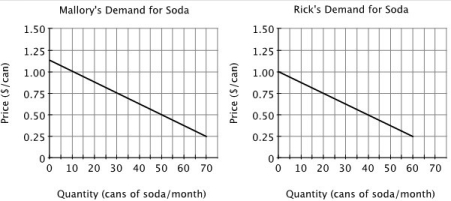
(72) Refer to the accompanying figures. If the price of soda is $1.25 per can, then the quantity of soda demanded in the market each month is:
(Multiple Choice)
4.9/5 (80)
(80) Jamie's marginal utility from muffins and from doughnuts (in utils)is shown in the accompanying table. Jamie spends a total of $8 on muffins and/or doughnuts every morning. The price of each muffin is $2 and the price of each doughnut is $1. Mufins Per Day Marginnl Utility Per Muftin Deughnuts Per Day Marginal Utility Per Deughnut 1 40 2 20 2 30 4 15 3 20 5 10 What is Jamie's optimal combination of muffins and doughnuts each day?
(Multiple Choice)
4.7/5 (85)
(85) Refer to the accompanying figure. What is total consumer surplus at the market equilibrium? 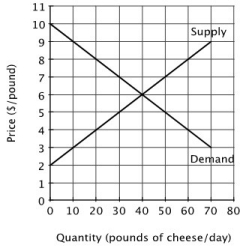
(Multiple Choice)
4.8/5 (87)
(87) Taylor's marginal utility from watching movies and from eating out (in utils)is shown in the accompanying table. Taylor spends exactly $100 every month on these two forms of entertainment; the price of each movie is $10 and the price of each dinner is $20. Mavies Per Manth Mar ginal Utility Per Movie Dingers Out Per Month Marginal Utility Per Dinner 1 60 1 150 2 50 2 140 3 20 3 120 4 5 4 100
If Taylor eats out 3 times a month, Taylor will watch ________ movies, and have marginal utility per dollar of ________ from eating out and a marginal utility per dollar of ________ from going to the movies.
(Multiple Choice)
5.0/5 (82)
(82) Refer to the accompanying figure.
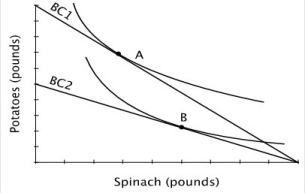 From the figure, we can infer that James' marginal rate of substitution is:
 (Multiple Choice)
4.7/5 (79)
(79) Refer to the accompanying table. If the price of Good A is $5 and the price of Good B is $4, then the rational spending rule is satisfied when the consumer purchases ________ units of Good A and ________ units of Good B. 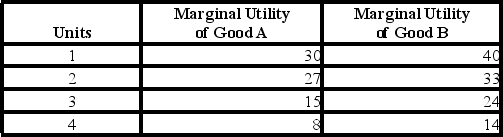
(Multiple Choice)
4.9/5 (86)
(86) 
Filters
- Essay(0)
- Multiple Choice(0)
- Short Answer(0)
- True False(0)
- Matching(0)