



 Chat with AI
Exam 14: Principles of Disease and Epidemiology

Exam 1: The Microbial World and You65 Questions
Exam 2: Chemical Principles65 Questions
Exam 3: Observing Microorganisms Through a Microscope65 Questions
Exam 4: Functional Anatomy of Prokaryotic and Eukaryotic65 Questions
Exam 5: Microbial Metabolism67 Questions
Exam 6: Microbial Growth65 Questions
Exam 7: The Control of Microbial Growth67 Questions
Exam 8: Microbial Genetics65 Questions
Exam 9: Biotechnology and Dna Technology64 Questions
Exam 10: Classification of Microorganisms65 Questions
Exam 11: The Prokaryotes: Domains Bacteria and Archaea60 Questions
Exam 12: The Eukaryotes: Fungi, algae, protozoa, and Helminths65 Questions
Exam 13: Viruses,viroids,and Prions66 Questions
Exam 14: Principles of Disease and Epidemiology65 Questions
Exam 15: Microbial Mechanisms of Pathogenicity63 Questions
Exam 16: Innate Immunity: Nonspecific Defenses of the Host65 Questions
Exam 17: Adaptive Immunity: Specific Defenses of the Host65 Questions
Exam 18: Practical Applications of Immunology65 Questions
Exam 19: Disorders Associated With the Immune System67 Questions
Exam 20: Antimicrobial Drugs65 Questions
Exam 21: Microbial Diseases of the Skin and Eyes65 Questions
Exam 22: Microbial Diseases of the Nervous System65 Questions
Exam 23: Microbial Diseases of the Cardiovascular and Lymphatic Systems65 Questions
Exam 24: Microbial Diseases of the Respiratory System65 Questions
Exam 25: Microbial Diseases of the Digestive System66 Questions
Exam 26: Microbial Diseases of the Urinary and Reproductive Systems65 Questions
Exam 27: Environmental Microbiology65 Questions
Exam 28: Applied and Industrial Microbiology65 Questions
Select questions type


Zika virus infection,a zoonotic disease,produced somewhat sizable outbreaks recently in certain areas of Central America,but not in the U.S (although there were some infected individuals uncovered in the U.S.).Provide two plausible explanations for this dichotomy,and explain.
(Essay)
4.9/5  (82)
(82) A disease in which the causative agent remains inactive for a time before producing symptoms is referred to as
(Multiple Choice)
4.9/5 (78)
(78) Pseudomonas bacteria colonized the bile duct of a patient following his liver transplant surgery.This is an example of a
(Multiple Choice)
4.9/5 (89)
(89) In which of the following patterns of disease does the patient experience no signs or symptoms?
(Multiple Choice)
4.9/5 (96)
(96) Situation 14.1
During a six-month period, 239 cases of pneumonia occurred in a town of 300 people. A clinical case was defined as fever ≥ 39°C lasting >2 days with three or more symptoms (i.e., chills, sweats, severe headache, cough, aching muscles/joints, fatigue, or feeling ill). A laboratory-confirmed case was defined as a positive result for antibodies against Coxiella burnetii. Before the outbreak, 2000 sheep were kept northwest of the town. Of the 20 sheep tested from the flock, 15 were positive for C. burnetii antibodies. Wind blew from the northwest, and rainfall was 0.5 cm compared with 7 to 10 cm during each of the previous three years.
-The etiologic agent of the disease in Situation 14.1 is
(Multiple Choice)
4.8/5 (80)
(80) A healthcare-associated infection (traditionally known as a nosocomial infection)is
(Multiple Choice)
4.8/5 (68)
(68) Which of the following is NOT a verified exception in the use of Koch's postulates?
(Multiple Choice)
5.0/5 (77)
(77) Which of the following diseases is NOT spread by droplet infection?
(Multiple Choice)
4.9/5 (76)
(76) Situation 14.1
During a six-month period, 239 cases of pneumonia occurred in a town of 300 people. A clinical case was defined as fever ≥ 39°C lasting >2 days with three or more symptoms (i.e., chills, sweats, severe headache, cough, aching muscles/joints, fatigue, or feeling ill). A laboratory-confirmed case was defined as a positive result for antibodies against Coxiella burnetii. Before the outbreak, 2000 sheep were kept northwest of the town. Of the 20 sheep tested from the flock, 15 were positive for C. burnetii antibodies. Wind blew from the northwest, and rainfall was 0.5 cm compared with 7 to 10 cm during each of the previous three years.
-Situation 14.1 is an example of
(Multiple Choice)
4.9/5 (83)
(83) Emergence of infectious diseases can be attributed to all of the following EXCEPT
(Multiple Choice)
4.8/5 (85)
(85) Refer to Figure 14.3 for the next several questions.
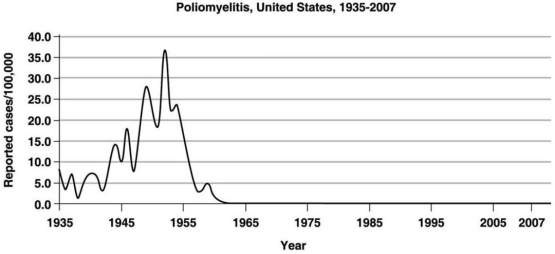 -The graph in Figure 14.3 shows the incidence of polio in the United States.The period between 1945 and 1955 indicates a(n)
 (Multiple Choice)
4.9/5 (85)
(85) Which of the following statements about healthcare-associated infections is FALSE?
(Multiple Choice)
4.7/5 (67)
(67) Bloodstream infections are the least common forms of nosocomial infections.
(True/False)
4.9/5 (83)
(83) Which of the following can contribute to postoperative infections?
(Multiple Choice)
4.8/5 (78)
(78) 
Filters
- Essay(0)
- Multiple Choice(0)
- Short Answer(0)
- True False(0)
- Matching(0)