



 Chat with AI
Exam 19: Labor and Entrepreneurship: the Human Inputs

Exam 1: What Is Economics232 Questions
Exam 2: The Economy: Myth and Reality155 Questions
Exam 3: The Fundamental Economic Problem: Scarcity and Choice255 Questions
Exam 4: Supply and Demand: an Initial Look313 Questions
Exam 5: Consumer Choice: Individual and Market Demand206 Questions
Exam 6: Demand and Elasticity214 Questions
Exam 7: Production, Inputs, and Cost: Building Blocks for Supply Analysis221 Questions
Exam 8: Output, Price, and Profit: the Importance of Marginal Analysis194 Questions
Exam 9: Securities: Business Finance and the Economy: the Tail That Wags the Dog203 Questions
Exam 10: The Firm and the Industry Under Perfect Competition212 Questions
Exam 11: Monopoly208 Questions
Exam 12: Between Competition and Monopoly230 Questions
Exam 13: Limiting Market Power: Regulation and Antitrust155 Questions
Exam 14: The Case for Free Markets: the Price System225 Questions
Exam 15: The Shortcomings of Free Markets219 Questions
Exam 16: Externalities, the Environment, and Natural Resources222 Questions
Exam 17: Taxation and Resource Allocation221 Questions
Exam 18: Pricing the Factors of Production233 Questions
Exam 19: Labor and Entrepreneurship: the Human Inputs271 Questions
Exam 20: Poverty, Inequality, and Discrimination172 Questions
Exam 21: Is Useconomic Leadership Threatened75 Questions
Exam 22: An Introduction to Macroeconomics216 Questions
Exam 23: The Goals of Macroeconomic Policy212 Questions
Exam 24: Economic Growth: Theory and Policy228 Questions
Exam 25: Aggregate Demand and the Powerful Consumer219 Questions
Exam 26: Demand-Side Equilibrium: Unemployment or Inflation216 Questions
Exam 27: Bringing in the Supply Side: Unemployment and Inflation228 Questions
Exam 28: Managing Aggregate Demand: Fiscal Policy210 Questions
Exam 29: Money and the Banking System224 Questions
Exam 30: Monetary Policy: Conventional and Unconventional210 Questions
Exam 31: He Financial Crisis and the Great Recession66 Questions
Exam 32: The Debate Over Monetary and Fiscal Policy219 Questions
Exam 33: Budget Deficits in the Short and Long Run215 Questions
Exam 34: The Trade-Off Between Inflation and Unemployment219 Questions
Exam 35: International Trade and Comparative Advantage223 Questions
Exam 36: The International Monetary System: Order or Disorder218 Questions
Exam 37: Exchange Rates and the Macroeconomy219 Questions
Select questions type


One of the most significant developments in labor supply in recent times is the increase in the labor force participation of married women.
(True/False)
4.8/5  (77)
(77) Explain how productivity growth has led to labor market realignment in the United States.
(Essay)
4.9/5 (93)
(93) What is the term used for the process by which an entrepreneur creates or recognizes a new and better product, acquires it, and brings it to market, making older substitutes obsolete?
(Multiple Choice)
4.9/5 (79)
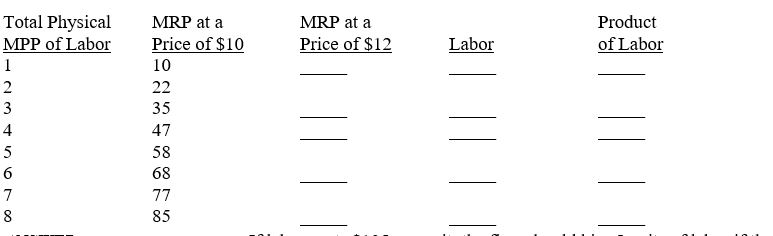
(79) The following table shows the total physical product of labor.Compute the marginal physical product of labor and the marginal revenue product of labor at output prices of $10 per unit and $12 per unit.If labor costs $105 per unit, how much should the firm hire at each price of output?
(Essay)
4.8/5 (75)
(75) Those who view education as a sorting mechanism emphasize that employers value
(Multiple Choice)
4.9/5 (87)
(87) Theoretically, the price of a field hand on the New Orleans slave market would have
(Multiple Choice)
4.9/5 (72)
(72) During the twentieth century, the real income of the average American grew by a factor of more than seven.
(True/False)
4.8/5 (81)
(81) Now, about ____ percent of American married-couple families have two or more wage earners.
(Multiple Choice)
4.7/5 (86)
(86) When unions and management fail to reach agreement and the public interest is compromised, the government may require the union and management to undertake mediation.
(True/False)
4.9/5 (77)
(77) More goods are available to the average American today than two hundred years ago, but today an American has to work more hours to earn the money to purchase most items.
(True/False)
4.7/5 (99)
(99) A minimum wage law might increase wages without reducing employment if the hiring firm is
(Multiple Choice)
4.9/5 (72)
(72) Average hours worked per week have ____ since the early 1900s.
(Multiple Choice)
4.8/5 (85)
(85) Figure 20-3
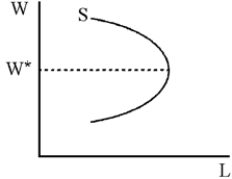 -Figure 20-3 shows a worker's backward-bending supply curve of labor.Which of the following statements is correct?
 (Multiple Choice)
4.8/5 (71)
(71) The United Automobile Workers union can select the most favorable point on the demand curve for labor and the auto manufacturing companies can do nothing in response.
(True/False)
4.7/5 (81)
(81) A monopsony is a market situation in which there is only one seller.
(True/False)
4.9/5 (74)
(74) 
Filters
- Essay(0)
- Multiple Choice(0)
- Short Answer(0)
- True False(0)
- Matching(0)