



 Chat with AI
Exam 19: Labor and Entrepreneurship: the Human Inputs

Exam 1: What Is Economics232 Questions
Exam 2: The Economy: Myth and Reality155 Questions
Exam 3: The Fundamental Economic Problem: Scarcity and Choice255 Questions
Exam 4: Supply and Demand: an Initial Look313 Questions
Exam 5: Consumer Choice: Individual and Market Demand206 Questions
Exam 6: Demand and Elasticity214 Questions
Exam 7: Production, Inputs, and Cost: Building Blocks for Supply Analysis221 Questions
Exam 8: Output, Price, and Profit: the Importance of Marginal Analysis194 Questions
Exam 9: Securities: Business Finance and the Economy: the Tail That Wags the Dog203 Questions
Exam 10: The Firm and the Industry Under Perfect Competition212 Questions
Exam 11: Monopoly208 Questions
Exam 12: Between Competition and Monopoly230 Questions
Exam 13: Limiting Market Power: Regulation and Antitrust155 Questions
Exam 14: The Case for Free Markets: the Price System225 Questions
Exam 15: The Shortcomings of Free Markets219 Questions
Exam 16: Externalities, the Environment, and Natural Resources222 Questions
Exam 17: Taxation and Resource Allocation221 Questions
Exam 18: Pricing the Factors of Production233 Questions
Exam 19: Labor and Entrepreneurship: the Human Inputs271 Questions
Exam 20: Poverty, Inequality, and Discrimination172 Questions
Exam 21: Is Useconomic Leadership Threatened75 Questions
Exam 22: An Introduction to Macroeconomics216 Questions
Exam 23: The Goals of Macroeconomic Policy212 Questions
Exam 24: Economic Growth: Theory and Policy228 Questions
Exam 25: Aggregate Demand and the Powerful Consumer219 Questions
Exam 26: Demand-Side Equilibrium: Unemployment or Inflation216 Questions
Exam 27: Bringing in the Supply Side: Unemployment and Inflation228 Questions
Exam 28: Managing Aggregate Demand: Fiscal Policy210 Questions
Exam 29: Money and the Banking System224 Questions
Exam 30: Monetary Policy: Conventional and Unconventional210 Questions
Exam 31: He Financial Crisis and the Great Recession66 Questions
Exam 32: The Debate Over Monetary and Fiscal Policy219 Questions
Exam 33: Budget Deficits in the Short and Long Run215 Questions
Exam 34: The Trade-Off Between Inflation and Unemployment219 Questions
Exam 35: International Trade and Comparative Advantage223 Questions
Exam 36: The International Monetary System: Order or Disorder218 Questions
Exam 37: Exchange Rates and the Macroeconomy219 Questions
Select questions type


The relationship between professional basketball players and the owners' association is an example of a bilateral monopoly.
(True/False)
4.9/5  (68)
(68) Give some explanations for the decline in union membership in the United States.
(Essay)
4.9/5 (85)
(85) Figure 20-1
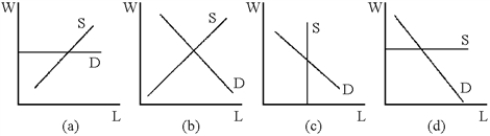 -Which of the diagrams in Figure 20-1 shows the situation of an individual firm that hires labor in a perfectly competitive market?
 (Multiple Choice)
4.8/5 (79)
(79) One of the reasons for the growth performance of free market economies is firms' use of innovation to compete with one another.
(True/False)
4.8/5 (85)
(85) If an individual possesses an ability that others cannot acquire, payment to that individual is
(Multiple Choice)
4.8/5 (69)
(69) The American Bar Association administers the bar examinations that prospective lawyers must pass before being allowed to practice law.The exam system thus allows the ABA to act like a
(Multiple Choice)
4.9/5 (83)
(83) The consensus among researchers is that union workers earn 15 percent more than otherwise identical nonunion workers.This means unions have probably raised wages
(Multiple Choice)
4.9/5 (83)
(83) When large oligopolistic firms negotiate with the unions of their employees, the resulting bargaining process closely resembles
(Multiple Choice)
4.8/5 (76)
(76) Currently, college graduates are earning about ____ more than high school grads over the course of their careers.
(Multiple Choice)
4.8/5 (72)
(72) Describe the profit-maximizing firm's decision about how much to spend on innovation.
(Essay)
4.8/5 (84)
(84) The income effect is thought to offset the substitution effect among very high wage earners.
(True/False)
4.8/5 (82)
(82) The United States suffers more from strikes than Japan but fewer strikes than Canada.
(True/False)
4.8/5 (72)
(72) In the view of human capital theorists, educational institutions are factories that take less productive workers as their raw materials and create more productive workers as output.
(True/False)
4.9/5 (79)
(79) Governmental rules that significantly promoted entrepreneurship first became prominent during the
(Multiple Choice)
4.9/5 (82)
(82) The supply curve of truck drivers is upward sloping and demand curve is downward sloping.A reduction in the price of hauling freight by truck relative to the price of hauling freight by rail will ____ the equilibrium wage of truck drivers and ____ the number of drivers employed.
(Multiple Choice)
4.8/5 (82)
(82) 
Filters
- Essay(0)
- Multiple Choice(0)
- Short Answer(0)
- True False(0)
- Matching(0)