



 Chat with AI
Exam 19: Labor and Entrepreneurship: the Human Inputs

Exam 1: What Is Economics232 Questions
Exam 2: The Economy: Myth and Reality155 Questions
Exam 3: The Fundamental Economic Problem: Scarcity and Choice255 Questions
Exam 4: Supply and Demand: an Initial Look313 Questions
Exam 5: Consumer Choice: Individual and Market Demand206 Questions
Exam 6: Demand and Elasticity214 Questions
Exam 7: Production, Inputs, and Cost: Building Blocks for Supply Analysis221 Questions
Exam 8: Output, Price, and Profit: the Importance of Marginal Analysis194 Questions
Exam 9: Securities: Business Finance and the Economy: the Tail That Wags the Dog203 Questions
Exam 10: The Firm and the Industry Under Perfect Competition212 Questions
Exam 11: Monopoly208 Questions
Exam 12: Between Competition and Monopoly230 Questions
Exam 13: Limiting Market Power: Regulation and Antitrust155 Questions
Exam 14: The Case for Free Markets: the Price System225 Questions
Exam 15: The Shortcomings of Free Markets219 Questions
Exam 16: Externalities, the Environment, and Natural Resources222 Questions
Exam 17: Taxation and Resource Allocation221 Questions
Exam 18: Pricing the Factors of Production233 Questions
Exam 19: Labor and Entrepreneurship: the Human Inputs271 Questions
Exam 20: Poverty, Inequality, and Discrimination172 Questions
Exam 21: Is Useconomic Leadership Threatened75 Questions
Exam 22: An Introduction to Macroeconomics216 Questions
Exam 23: The Goals of Macroeconomic Policy212 Questions
Exam 24: Economic Growth: Theory and Policy228 Questions
Exam 25: Aggregate Demand and the Powerful Consumer219 Questions
Exam 26: Demand-Side Equilibrium: Unemployment or Inflation216 Questions
Exam 27: Bringing in the Supply Side: Unemployment and Inflation228 Questions
Exam 28: Managing Aggregate Demand: Fiscal Policy210 Questions
Exam 29: Money and the Banking System224 Questions
Exam 30: Monetary Policy: Conventional and Unconventional210 Questions
Exam 31: He Financial Crisis and the Great Recession66 Questions
Exam 32: The Debate Over Monetary and Fiscal Policy219 Questions
Exam 33: Budget Deficits in the Short and Long Run215 Questions
Exam 34: The Trade-Off Between Inflation and Unemployment219 Questions
Exam 35: International Trade and Comparative Advantage223 Questions
Exam 36: The International Monetary System: Order or Disorder218 Questions
Exam 37: Exchange Rates and the Macroeconomy219 Questions
Select questions type


There is only a small difference in wages between college graduates and workers who did not attend college.
(True/False)
4.8/5  (83)
(83) The United States has had a long history of work time lost due to worker strikes.This trend has
(Multiple Choice)
4.9/5 (84)
(84) Explain the concept of 'creative destruction' by innovation.Does it ensure positive economic profits in the long run?
(Essay)
4.9/5 (90)
(90) What type of cost is not relevant to the process of research and development or invention in general?
(Multiple Choice)
4.8/5 (89)
(89) Which of the following makes invention and entrepreneurship more likely in today's economy?
(Multiple Choice)
4.8/5 (71)
(71) Statistical studies in the United States have reached the conclusion that for low-income workers
(Multiple Choice)
4.8/5 (78)
(78) The proliferation of new products that we are used to today has been occurring since the advent of the Industrial Revolution.
(True/False)
4.7/5 (92)
(92) Regarding new inventions, which of the following statements is not true?
(Multiple Choice)
4.8/5 (69)
(69) The initial stage of the procedure in which a union and an employer negotiate over a contract is known as
(Multiple Choice)
4.8/5 (88)
(88) The salary of an athlete like Peyton Manning is in part a reward for his unique ability-something economists call economic rent.
(True/False)
4.9/5 (62)
(62) Expenditures for attending college can be viewed as an investment in human capital.
(True/False)
4.9/5 (79)
(79) Explain what is meant when it is said that the demand for labor is a derived demand.
(Essay)
4.8/5 (89)
(89) Which of the following affects the marginal physical product of labor?
(Multiple Choice)
5.0/5 (82)
(82) Figure 20-2
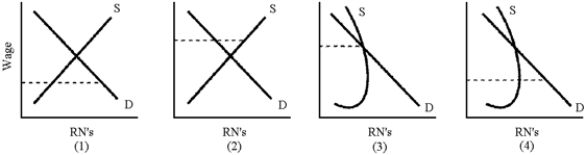 -At existing wage rates, hospitals face a shortage of registered nurses.Some studies have suggested that an increase in RN wages will actually reduce the hours supplied by existing RNs, making it more difficult for hospitals to find RNs.Which panel in Figure 20-2, where the broken line indicates the existing wage rate, illustrates this case?
 (Multiple Choice)
4.8/5 (72)
(72) Recent data and analysis confirms that minimum wage laws have significantly increased teenage unemployment.
(True/False)
5.0/5 (70)
(70) Average real wages have not risen significantly since approximately 1973.
(True/False)
4.8/5 (76)
(76) Since women earn less on average than men, we would expect that the substitution effect of a wage change would be more likely to dominate for women and the income effect would be more likely to dominate for men.
(True/False)
5.0/5 (76)
(76) 
Filters
- Essay(0)
- Multiple Choice(0)
- Short Answer(0)
- True False(0)
- Matching(0)