



 Chat with AI
Exam 19: Labor and Entrepreneurship: the Human Inputs

Exam 1: What Is Economics232 Questions
Exam 2: The Economy: Myth and Reality155 Questions
Exam 3: The Fundamental Economic Problem: Scarcity and Choice255 Questions
Exam 4: Supply and Demand: an Initial Look313 Questions
Exam 5: Consumer Choice: Individual and Market Demand206 Questions
Exam 6: Demand and Elasticity214 Questions
Exam 7: Production, Inputs, and Cost: Building Blocks for Supply Analysis221 Questions
Exam 8: Output, Price, and Profit: the Importance of Marginal Analysis194 Questions
Exam 9: Securities: Business Finance and the Economy: the Tail That Wags the Dog203 Questions
Exam 10: The Firm and the Industry Under Perfect Competition212 Questions
Exam 11: Monopoly208 Questions
Exam 12: Between Competition and Monopoly230 Questions
Exam 13: Limiting Market Power: Regulation and Antitrust155 Questions
Exam 14: The Case for Free Markets: the Price System225 Questions
Exam 15: The Shortcomings of Free Markets219 Questions
Exam 16: Externalities, the Environment, and Natural Resources222 Questions
Exam 17: Taxation and Resource Allocation221 Questions
Exam 18: Pricing the Factors of Production233 Questions
Exam 19: Labor and Entrepreneurship: the Human Inputs271 Questions
Exam 20: Poverty, Inequality, and Discrimination172 Questions
Exam 21: Is Useconomic Leadership Threatened75 Questions
Exam 22: An Introduction to Macroeconomics216 Questions
Exam 23: The Goals of Macroeconomic Policy212 Questions
Exam 24: Economic Growth: Theory and Policy228 Questions
Exam 25: Aggregate Demand and the Powerful Consumer219 Questions
Exam 26: Demand-Side Equilibrium: Unemployment or Inflation216 Questions
Exam 27: Bringing in the Supply Side: Unemployment and Inflation228 Questions
Exam 28: Managing Aggregate Demand: Fiscal Policy210 Questions
Exam 29: Money and the Banking System224 Questions
Exam 30: Monetary Policy: Conventional and Unconventional210 Questions
Exam 31: He Financial Crisis and the Great Recession66 Questions
Exam 32: The Debate Over Monetary and Fiscal Policy219 Questions
Exam 33: Budget Deficits in the Short and Long Run215 Questions
Exam 34: The Trade-Off Between Inflation and Unemployment219 Questions
Exam 35: International Trade and Comparative Advantage223 Questions
Exam 36: The International Monetary System: Order or Disorder218 Questions
Exam 37: Exchange Rates and the Macroeconomy219 Questions
Select questions type


After Hurricane Katrina, construction wages in New Orleans rose partly because of the loss of a working population.
(True/False)
4.9/5  (85)
(85) Figure 20-4
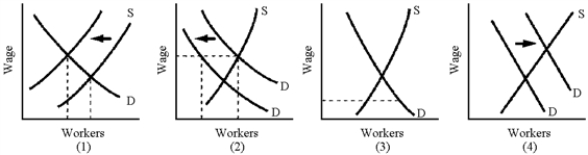 -In Figure 20-4, which panel shows the impact of union efforts to have goods produced in Asia excluded from the U.S.market?
 (Multiple Choice)
4.9/5 (68)
(68) When workers purchase more leisure and work less at higher wages, the supply curve
(Multiple Choice)
4.9/5 (84)
(84) What is the most probable reason why garbage men have higher wages than nurses?
(Multiple Choice)
4.8/5 (68)
(68) There is strong evidence that entrepreneurs are characteristically:
(Multiple Choice)
4.9/5 (77)
(77) Rising labor productivity means that less labor is needed to produce the same level of output.
(True/False)
4.8/5 (78)
(78) Explain the circumstances under which some component of labor income is economic rent.
(Essay)
4.9/5 (90)
(90) An investment in yourself is an investment in what economists call human capital.
(True/False)
4.8/5 (81)
(81) Since a union represents individuals rather than firms, it cannot be considered a monopoly.
(True/False)
4.9/5 (79)
(79) The primary reason unionization in the United States has been declining is the shift of the U.S.labor force into service industries and out of manufacturing.
(True/False)
4.9/5 (83)
(83) Which economist created the theory of creative destruction?
(Multiple Choice)
4.8/5 (74)
(74) The job market for which group always seems to have higher unemployment than the labor force as a whole?
Why?
(Essay)
4.9/5 (72)
(72) In 1972, a very controversial study asserted that income differences among individuals did not depend on genetic differences in reasoning ability, or differences between schools, or family background.Moreover, the effects of level of schooling are much less than previously understood.After controlling for all of these background variables, much of the variation in earnings appeared to be random.From this analysis, one might reach the very controversial conclusion that earnings depended to a very great extent on
(Multiple Choice)
4.8/5 (98)
(98) P = MC is a recipe for financial loss in an innovative firm established by an innovative entrepreneur.Explain.
(Essay)
4.9/5 (83)
(83) Suppose a study showed that as the income of doctors increased, doctors spent more time on the golf course and less in the office.What would such a conclusion say about the relative sizes of substitution and income effects?
(Essay)
4.8/5 (70)
(70) 
Filters
- Essay(0)
- Multiple Choice(0)
- Short Answer(0)
- True False(0)
- Matching(0)