



 Chat with AI
Exam 95: Hydraulic Valves and Switches

Exam 1: Automotive Background and Overview32 Questions
Exam 2: Careers in the Automotive Service Industry30 Questions
Exam 3: Starting a Career in the Automotive Industry30 Questions
Exam 4: Working As a Professional Service Technician31 Questions
Exam 5: Technician Certification28 Questions
Exam 6: Shop Safety31 Questions
Exam 7: Environmental and Hazardous Materials24 Questions
Exam 8: Fasteners and Thread Repair34 Questions
Exam 9: Hand Tools25 Questions
Exam 10: Power Tools and Shop Equipment30 Questions
Exam 11: Vehicle Lifting and Hoisting24 Questions
Exam 12: Measuring Systems and Tools30 Questions
Exam 13: Scientific Principles and Materials31 Questions
Exam 14: Math, Charts, and Calculations30 Questions
Exam 15: Service Information28 Questions
Exam 16: Vehicle Identification and Emission Ratings28 Questions
Exam 17: Preventative Maintenance and Service Procedures30 Questions
Exam 18: Gasoline Engine Operation, Parts, and Specifications10 Questions
Exam 19: Diesel Engine Operation and Diagnosis30 Questions
Exam 20: Coolant22 Questions
Exam 21: Cooling System Operation and Diagnosis24 Questions
Exam 22: Engine Oil24 Questions
Exam 23: Lubrication System Operation and Diagnosis21 Questions
Exam 24: Intake and Exhaust Systems20 Questions
Exam 25: Turbocharging and Supercharging22 Questions
Exam 26: Engine Condition Diagnosis15 Questions
Exam 27: In-Vehicle Engine Service2 Questions
Exam 28: Engine Removal and Disassembly22 Questions
Exam 29: Engine Cleaning and Crack Detection22 Questions
Exam 30: Cylinder Head and Valve Guide Service22 Questions
Exam 31: Valve and Seat Service22 Questions
Exam 32: Camshafts and Valve Trains27 Questions
Exam 33: Pistons, Rings, and Connecting Rods22 Questions
Exam 34: Engine Blocks24 Questions
Exam 35: Crankshafts, Balance Shafts, and Bearings25 Questions
Exam 36: Gaskets and Sealants20 Questions
Exam 37: Engine Assembly and Dynamometer Testing33 Questions
Exam 38: Engine Installation and Break-In20 Questions
Exam 39: Electrical Fundamentals24 Questions
Exam 40: Electrical Circuits and Ohms Law20 Questions
Exam 41: Series, Parallel, and Series-Parallel Circuits29 Questions
Exam 42: Circuit Testers and Digital Meters2 Questions
Exam 44: Automotive Wiring and Wire Repair26 Questions
Exam 45: Wiring Schematics and Circuit Testing19 Questions
Exam 46: Capacitance and Capacitors10 Questions
Exam 47: Magnetism and Electromagnetism10 Questions
Exam 48: Electronic Fundamentals4 Questions
Exam 49: Can and Network Communications4 Questions
Exam 50: Batteries13 Questions
Exam 51: Battery Testing and Service13 Questions
Exam 52: Cranking System12 Questions
Exam 53: Cranking System Diagnosis and Service14 Questions
Exam 54: Charging System16 Questions
Exam 55: Charging System Diagnosis and Service9 Questions
Exam 56: Lighting and Signaling Circuits15 Questions
Exam 57: Driver Information and Navigation Systems20 Questions
Exam 58: Horn, Wiper, and Blower Motor Circuits12 Questions
Exam 59: Accessory Circuits14 Questions
Exam 60: Airbags and Pretensioner Circuits14 Questions
Exam 61: Audio System Operation and Diagnosis17 Questions
Exam 62: Heating and Air-Conditioning Components and Operation29 Questions
Exam 63: Automatic Air-Conditioning System Operation22 Questions
Exam 64: Heating and Air-Conditioning System Diagnosis25 Questions
Exam 65: Heating and Air-Conditioning System Service25 Questions
Exam 66: Gasoline15 Questions
Exam 67: Alternative Fuels17 Questions
Exam 68: Diesel and Biodiesel Fuels27 Questions
Exam 69: Ignition System Components and Operation25 Questions
Exam 70: Ignition System Diagnosis and Service18 Questions
Exam 71: Computer Fundamentals12 Questions
Exam 72: Temperature Sensors6 Questions
Exam 73: Throttle Position Tp Sensors10 Questions
Exam 74: Mapbaro Sensors6 Questions
Exam 75: Mass Air Flow Sensors12 Questions
Exam 76: Oxygen Sensors6 Questions
Exam 77: Fuel Pumps, Lines, and Filters6 Questions
Exam 78: Fuel-Injection Components and Operation5 Questions
Exam 79: Gasoline Direct-Injection Systems2 Questions
Exam 80: Electronic Throttle Control System3 Questions
Exam 81: Fuel-Injection System Diagnosis and Service8 Questions
Exam 82: Vehicle Emission Standards and Testing6 Questions
Exam 83: Evaporative Emission Control Systems18 Questions
Exam 84: Exhaust Gas Recirculation Systems15 Questions
Exam 85: Positive Crankcase Ventilation and Secondary Air-Injection Systems12 Questions
Exam 86: Catalytic Converters17 Questions
Exam 87: Onboard Diagnosis1 Questions
Exam 88: Scan Tools and Engine Performance Diagnosis5 Questions
Exam 89: Introduction to Hybrid Vehicles22 Questions
Exam 90: Hybrid Safety and Service Procedures21 Questions
Exam 91: Fuel Cells and Advanced Technologies22 Questions
Exam 92: Braking System Components and Performance Standards26 Questions
Exam 93: Braking System Principles27 Questions
Exam 94: Brake Hydraulic Systems31 Questions
Exam 95: Hydraulic Valves and Switches30 Questions
Exam 96: Brake Fluid and Lines28 Questions
Exam 97: Brake Bleeding Methods and Procedures28 Questions
Exam 98: Wheel Bearings and Service26 Questions
Exam 99: Drum Brakes37 Questions
Exam 100: Drum Brake Diagnosis and Service30 Questions
Exam 101: Disc Brakes32 Questions
Exam 102: Disc Brakes Diagnosis and Service28 Questions
Exam 103: Parking Brake Operation, Diagnosis, and Service25 Questions
Exam 104: Machining Brake Drums and Rotors25 Questions
Exam 105: Power Brake Unit Operation, Diagnosis, and Service25 Questions
Exam 106: Abs Components and Operation24 Questions
Exam 107: Abs Diagnosis and Service21 Questions
Exam 108: Electronic Stability Control Systems20 Questions
Exam 109: Tires and Wheels32 Questions
Exam 110: Tire Pressure Monitoring Systems21 Questions
Exam 111: Tire and Wheel Service30 Questions
Exam 112: Suspension System Principles and Components31 Questions
Exam 113: Front Suspensions and Service32 Questions
Exam 114: Rear Suspensions and Service30 Questions
Exam 115: Electronic Suspension Systems30 Questions
Exam 116: Steering Columns and Gears29 Questions
Exam 117: Steering Linkage and Service28 Questions
Exam 118: Power-Assisted Steering Operation and Service30 Questions
Exam 119: Wheel Alignment Principles35 Questions
Exam 120: Alignment Diagnosis and Service30 Questions
Exam 121: Clutches30 Questions
Exam 122: Manual Transmissions/Transaxles22 Questions
Exam 123: Drive Axle Shafts and Cv Joints30 Questions
Exam 124: Drive Shafts and Cv Joint Service28 Questions
Exam 125: Drive Axles and Differentials22 Questions
Exam 126: Four-Wheel-Drive and All-Wheel Drive24 Questions
Exam 127: Automatic Transmissiontransaxle Principles22 Questions
Exam 128: Hydraulic Components and Control Systems22 Questions
Exam 129: Automatic Transmissiontransaxle Diagnosis and In-Vehicle Service19 Questions
Exam 130: Automatic Transmissiontransaxle Unit Repair21 Questions
Select questions type


The button on the ________ valve should be held when pressure bleeding the brakes.

Free
(Multiple Choice)
4.8/5  (79)
(79) Correct Answer: Verified
A
Technician A says that the height-sensing proportioning valve changes its split point by means of a rotating cam. Technician B says that levers are used in conjunction with the height-sensing proportioning valve. Which technician is correct?
Free
(Multiple Choice)
4.7/5 (75)
(75) Correct Answer:Verified
VerifiedC
Dual braking systems sometimes use a fluid level switch in place of a pressure differential switch.
Free
(True/False)
4.9/5 (79)
(79) Correct Answer:Verified
VerifiedTrue
When the brakes are applied lightly at low speeds on slippery pavement, which type of valve keeps the front brakes from locking?
(Multiple Choice)
4.9/5 (81)
(81) Technician A says installation of aftermarket air shocks may cause height-sensitive proportioning valves to function improperly. Technician B says vehicles equipped with ABS systems using electronic brake proportioning (EBP) do not need proportioning valves. Which technician is correct?
(Multiple Choice)
4.9/5 (92)
(92) 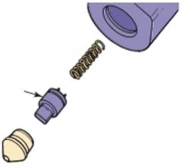
Two technicians are discussing the metering valve in a front-disc, rear-drum braking system. Technician A says that the metering valve delays application of the front brakes. Technician B says that the metering valve delays the application of the rear brakes. Which technician is correct?
(Multiple Choice)
4.8/5 (78)
(78) The ratio of front to rear hydraulic system pressure supplied to the rear brakes by the proportioning valve is called ________.
(Multiple Choice)
4.9/5 (66)
(66) Technician A says a pull to the right during braking could be caused by a defective metering valve.Technician B says a pull to the left could be caused by a defective proportioning valve. Which technician is correct?
(Multiple Choice)
4.8/5 (74)
(74) The rear brakes lock up during a regular brake application. Technician A says the metering valve could be the cause. Technician B says that stuck front disc brake calipers could be the cause. Which technician is correct?
(Multiple Choice)
4.9/5 (83)
(83) Technician A says that some proportioning valves are one part and used to control both rear brakes.Technician B says that some proportioning valves are two parts; one for each rear wheel. Which technician is correct?
(Multiple Choice)
4.9/5 (76)
(76) Technician a says that the red brake warning light can be turned on if a difference in pressure is detected by the pressure differential switch. Technician B says that the red brake warning light can be turned on if the brake fluid level sensor detected low brake fluid level. Which technician is correct?
(Multiple Choice)
5.0/5 (73)
(73) A visual inspection of the metering valve includes ________.
(Multiple Choice)
4.9/5 (74)
(74) When the brakes are applied in a panic situation, the rear brakes have a tendency to skid. The most likely cause is ________.
(Multiple Choice)
4.7/5 (82)
(82) The rear wheels lock up during hard braking. Technician A says that a defective metering valve could be the cause. Technician B says that a defective proportioning valve could be the cause. Which technician is correct?
(Multiple Choice)
4.8/5 (67)
(67) 
Filters
- Essay(0)
- Multiple Choice(0)
- Short Answer(0)
- True False(0)
- Matching(0)