



 Chat with AI
Exam 14: Firms in Competitive Markets

Exam 1: Ten Principles of Economics237 Questions
Exam 2: Thinking Like an Economist267 Questions
Exam 3: Interdependence and the Gains From Trade217 Questions
Exam 4: The Market Forces of Supply and Demand303 Questions
Exam 5: Elasticity and Its Applications282 Questions
Exam 6: Supply, demand, and Government Policies252 Questions
Exam 7: Consumers, producers, and the Efficiency of Markets248 Questions
Exam 8: Application: the Costs of Taxation245 Questions
Exam 9: Application: International Trade245 Questions
Exam 10: Externalities288 Questions
Exam 11: Public Goods and Common Resources258 Questions
Exam 12: The Design of the Tax System328 Questions
Exam 13: The Costs of Production303 Questions
Exam 14: Firms in Competitive Markets271 Questions
Exam 15: Monopoly306 Questions
Exam 16: Oligopoly291 Questions
Exam 17: Monopolistic Competition257 Questions
Exam 18: The Markets for the Factors of Production284 Questions
Exam 19: Earnings and Discrimination286 Questions
Exam 20: Income Inequality and Poverty247 Questions
Exam 21: The Theory of Consumer Choice238 Questions
Exam 22: Frontiers of Microeconomics199 Questions
Exam 23: Measuring a Nations Income215 Questions
Exam 24: Measuring the Cost of Living208 Questions
Exam 25: Production and Growth240 Questions
Exam 26: Saving, investment, and the Financial System282 Questions
Exam 27: The Basic Tools of Finance249 Questions
Exam 28: Unemployment242 Questions
Exam 29: The Monetary System277 Questions
Exam 30: Money Growth and Inflation224 Questions
Exam 31: Open-Economy Macroeconomics: Basic Concepts256 Questions
Exam 32: A Macroeconomic Theory of the Open Economy217 Questions
Exam 33: Aggregate Demand and Aggregate Supply302 Questions
Exam 34: The Influence of Monetary and Fiscal Policy on Aggregate Demand249 Questions
Exam 35: The Short Run Trade Off Between Inflation and Unemployment246 Questions
Exam 36: Five Debates Over Macroeconomic Policy140 Questions
Select questions type


Table 14-3
Use the information for a competitive firm in the table below to answer the following questions.
 -Refer to Table 14-3.At a production level of 4 units which of the following is true?
 (Multiple Choice)
4.9/5  (72)
(72) A firm in a competitive market has the following cost structure: 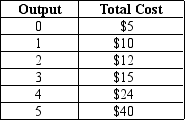 If the market price is $4,this firm will
 (Multiple Choice)
4.9/5 (80)
(80) When an individual firm in a competitive market increases its production,it is likely that the market price will fall.
(True/False)
4.8/5 (79)
(79) Refer to Figure 14-6.If at a market price of $1.75,52,500 units of output are supplied to this market,how many identical firms are participating in this market?
(Multiple Choice)
4.8/5 (89)
(89) Table 14-3
Use the information for a competitive firm in the table below to answer the following questions.
-Refer to Table 14-3.The maximum profit available to this firm is
-Refer to Table 14-3.The maximum profit available to this firm is (Multiple Choice)
4.8/5 (85)
(85) The Wheeler Wheat Farm sells wheat to a grain broker in Seattle,Washington.Since the market for wheat is generally considered to be competitive,the Wheeler Farm does not
(Multiple Choice)
4.7/5 (63)
(63) For a firm in a competitive market,marginal revenue is always equal to average revenue.
(True/False)
4.9/5 (86)
(86) The assumption of a fixed number of firms is appropriate for analysis of
(Multiple Choice)
4.8/5 (85)
(85) Of the following characteristics of competitive markets,which are necessary for firms to be price takers? (i) There are many sellers.
(ii) Firms can freely enter or exit the market.
(iii) Goods offered for sale are largely the same.
(Multiple Choice)
5.0/5 (87)
(87) Figure 14-4
The figure below depicts the cost structure of a firm in a competitive market.
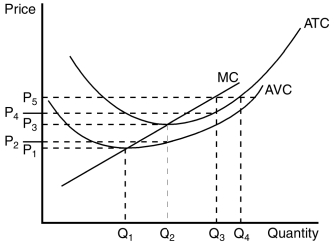 -Refer to Figure 14-4.When market price is P₅,a profit-maximizing firm's profits can be represented by the area
 (Multiple Choice)
4.8/5 (65)
(65) Table 14-4
The following table presents cost and revenue information for John's Vineyard.
 -Refer to Table 14-4.What is John's Vineyard's economic profit at its profit-maximizing output level?
 (Multiple Choice)
4.8/5 (90)
(90) When firms are neither entering nor exiting a perfectly competitive market,
(Multiple Choice)
4.8/5 (73)
(73) Table 14-4
The following table presents cost and revenue information for John's Vineyard.
-Refer to Table 14-4.At what quantity does John's Vineyard maximize profits?
-Refer to Table 14-4.At what quantity does John's Vineyard maximize profits? (Multiple Choice)
4.9/5 (70)
(70) Assume a firm is producing 800 units of output,and it sells each unit for $6.Its average total cost is $4.Its profit is
(Multiple Choice)
4.9/5 (74)
(74) In a particular market,there are 500 firms.Each firm has a marginal cost of $30 when it produces 200 units of output.One point on the market supply curve is
(Multiple Choice)
4.9/5 (76)
(76) Table 14-3
Use the information for a competitive firm in the table below to answer the following questions.
-Refer to Table 14-3.At which quantity of output is marginal revenue equal to marginal cost?
-Refer to Table 14-3.At which quantity of output is marginal revenue equal to marginal cost? (Multiple Choice)
4.8/5 (75)
(75) Tommy's Tires operates in a perfectly competitive market.If tires sell for $50 each and average total cost per tire is $40 at the profit-maximizing output level,then in the long run
(Multiple Choice)
4.8/5 (76)
(76) Which of the following statements regarding a competitive market is false?
(Multiple Choice)
4.9/5 (80)
(80) By comparing marginal revenue and marginal cost,a firm in a competitive market is able to adjust production to the level that achieves its objective,which we assume to be
(Multiple Choice)
4.8/5 (63)
(63) Starting from a situation in which a firm in a competitive market produces and sells 500 doorknobs for a price of $10 per doorknob,which of the following events would decrease the firm's average revenue?
(Multiple Choice)
4.8/5 (82)
(82) 
Filters
- Essay(0)
- Multiple Choice(0)
- Short Answer(0)
- True False(0)
- Matching(0)