



 Chat with AI
Exam 14: Firms in Competitive Markets

Exam 1: Ten Principles of Economics237 Questions
Exam 2: Thinking Like an Economist267 Questions
Exam 3: Interdependence and the Gains From Trade217 Questions
Exam 4: The Market Forces of Supply and Demand303 Questions
Exam 5: Elasticity and Its Applications282 Questions
Exam 6: Supply, demand, and Government Policies252 Questions
Exam 7: Consumers, producers, and the Efficiency of Markets248 Questions
Exam 8: Application: the Costs of Taxation245 Questions
Exam 9: Application: International Trade245 Questions
Exam 10: Externalities288 Questions
Exam 11: Public Goods and Common Resources258 Questions
Exam 12: The Design of the Tax System328 Questions
Exam 13: The Costs of Production303 Questions
Exam 14: Firms in Competitive Markets271 Questions
Exam 15: Monopoly306 Questions
Exam 16: Oligopoly291 Questions
Exam 17: Monopolistic Competition257 Questions
Exam 18: The Markets for the Factors of Production284 Questions
Exam 19: Earnings and Discrimination286 Questions
Exam 20: Income Inequality and Poverty247 Questions
Exam 21: The Theory of Consumer Choice238 Questions
Exam 22: Frontiers of Microeconomics199 Questions
Exam 23: Measuring a Nations Income215 Questions
Exam 24: Measuring the Cost of Living208 Questions
Exam 25: Production and Growth240 Questions
Exam 26: Saving, investment, and the Financial System282 Questions
Exam 27: The Basic Tools of Finance249 Questions
Exam 28: Unemployment242 Questions
Exam 29: The Monetary System277 Questions
Exam 30: Money Growth and Inflation224 Questions
Exam 31: Open-Economy Macroeconomics: Basic Concepts256 Questions
Exam 32: A Macroeconomic Theory of the Open Economy217 Questions
Exam 33: Aggregate Demand and Aggregate Supply302 Questions
Exam 34: The Influence of Monetary and Fiscal Policy on Aggregate Demand249 Questions
Exam 35: The Short Run Trade Off Between Inflation and Unemployment246 Questions
Exam 36: Five Debates Over Macroeconomic Policy140 Questions
Select questions type


When a profit-maximizing firm in a competitive market experiences rising prices,it will respond with an increase in production.
(True/False)
4.8/5  (89)
(89) Consider a competitive market with 50 identical firms.Suppose the market demand is given by the equation Qᴰ = 200 - 10P and the market supply is given by the equation Qˢ = 10P.In addition,suppose the following table shows the marginal cost of production for various levels of output for firms in this market. 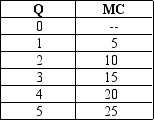 How many units should a firm in this market produce to maximize profit?
 (Multiple Choice)
5.0/5 (70)
(70) In the long run,all of a firm's costs are variable.In this case the exit criterion for a profit-maximizing firm is to
(Multiple Choice)
4.9/5 (67)
(67) When a profit-maximizing competitive firm finds itself minimizing losses because it is unable to earn a positive profit,this task is accomplished by producing the quantity at which price is equal to
(Multiple Choice)
4.9/5 (85)
(85) Comparison of marginal revenue to marginal cost (i) reveals the contribution of the last unit of production to total profit.
(ii) is helpful in making profit-maximizing production decisions.
(iii) tells a firm whether its fixed costs are too high.
(Multiple Choice)
4.8/5 (83)
(83) A profit-maximizing firm will shut down in the short run when
(Multiple Choice)
4.9/5 (74)
(74) Consider a competitive market with a large number of identical firms.The firms in this market do not use any resources that are available only in limited quantities.In long-run equilibrium,market price
(Multiple Choice)
4.9/5 (75)
(75) The Wheeler Wheat Farm sells wheat to a grain broker in Seattle,Washington.Since the market for wheat is generally considered to be competitive,the Wheeler Wheat Farm maximizes its profit by choosing
(Multiple Choice)
4.8/5 (74)
(74) When determining whether to shutdown in the short run,a competitive firm should
(Multiple Choice)
5.0/5 (73)
(73) Which of the following represents the firm's short-run condition for shutting down?
(Multiple Choice)
4.7/5 (81)
(81) When a restaurant stays open for lunch service even though few customers patronize the restaurant for lunch,which of the following principles is (are)best demonstrated? (i) Fixed costs are sunk in the short run.
(ii) In the short run,only fixed costs are important to the decision to stay open for lunch.
(iii) If revenue exceeds variable cost,the restaurant owner is making a profitable strategic decision to remain open for lunch.
(Multiple Choice)
4.7/5 (96)
(96) Scenario 14-2
Assume a certain firm is producing Q = 1,000 units of output. At Q = 1,000, the firm's marginal cost equals $15 and its average total cost equals $11. The firm sells its output for $12 per unit.
-Refer to Scenario 14-2.At Q = 999,the firm's profit amounts to
(Multiple Choice)
4.8/5 (75)
(75) Table 14-3
Use the information for a competitive firm in the table below to answer the following questions.
 -Refer to Table 14-3.If the firm finds that its marginal cost is $11,it should
 (Multiple Choice)
4.9/5 (72)
(72) A competitive firm's marginal cost curve is regarded as its supply curve because
(Multiple Choice)
4.9/5 (94)
(94) Table 14-1
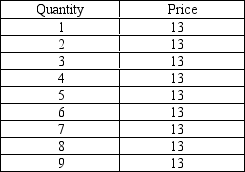 -Refer to Table 14-1.The price and quantity relationship in the table is most likely that faced by a firm in a
 (Multiple Choice)
4.8/5 (90)
(90) When buyers in a competitive market take the selling price as given,they are said to be
(Multiple Choice)
4.9/5 (75)
(75) Table 14-4
The following table presents cost and revenue information for John's Vineyard.
 -Refer to Table 14-4.What is the marginal revenue from selling the 5th unit?
 (Multiple Choice)
4.7/5 (83)
(83) If a firm in a perfectly competitive market triples the number of units of output sold,then total revenue will
(Multiple Choice)
4.9/5 (83)
(83) 
Filters
- Essay(0)
- Multiple Choice(0)
- Short Answer(0)
- True False(0)
- Matching(0)