



 Chat with AI
Exam 14: Firms in Competitive Markets

Exam 1: Ten Principles of Economics237 Questions
Exam 2: Thinking Like an Economist267 Questions
Exam 3: Interdependence and the Gains From Trade217 Questions
Exam 4: The Market Forces of Supply and Demand303 Questions
Exam 5: Elasticity and Its Applications282 Questions
Exam 6: Supply, demand, and Government Policies252 Questions
Exam 7: Consumers, producers, and the Efficiency of Markets248 Questions
Exam 8: Application: the Costs of Taxation245 Questions
Exam 9: Application: International Trade245 Questions
Exam 10: Externalities288 Questions
Exam 11: Public Goods and Common Resources258 Questions
Exam 12: The Design of the Tax System328 Questions
Exam 13: The Costs of Production303 Questions
Exam 14: Firms in Competitive Markets271 Questions
Exam 15: Monopoly306 Questions
Exam 16: Oligopoly291 Questions
Exam 17: Monopolistic Competition257 Questions
Exam 18: The Markets for the Factors of Production284 Questions
Exam 19: Earnings and Discrimination286 Questions
Exam 20: Income Inequality and Poverty247 Questions
Exam 21: The Theory of Consumer Choice238 Questions
Exam 22: Frontiers of Microeconomics199 Questions
Exam 23: Measuring a Nations Income215 Questions
Exam 24: Measuring the Cost of Living208 Questions
Exam 25: Production and Growth240 Questions
Exam 26: Saving, investment, and the Financial System282 Questions
Exam 27: The Basic Tools of Finance249 Questions
Exam 28: Unemployment242 Questions
Exam 29: The Monetary System277 Questions
Exam 30: Money Growth and Inflation224 Questions
Exam 31: Open-Economy Macroeconomics: Basic Concepts256 Questions
Exam 32: A Macroeconomic Theory of the Open Economy217 Questions
Exam 33: Aggregate Demand and Aggregate Supply302 Questions
Exam 34: The Influence of Monetary and Fiscal Policy on Aggregate Demand249 Questions
Exam 35: The Short Run Trade Off Between Inflation and Unemployment246 Questions
Exam 36: Five Debates Over Macroeconomic Policy140 Questions
Select questions type


When managers of firms in a competitive market observe falling profits,they are likely to infer that the market is characterized by
(Multiple Choice)
4.8/5  (78)
(78) Suppose a profit-maximizing firm in a competitive market produces rubber bands.When the market price for rubber bands falls below the minimum of its average total cost,but still lies above the minimum of average variable cost,the firm
(Multiple Choice)
4.8/5 (72)
(72) In competitive markets,firms that raise their prices are typically rewarded with larger profits.
(True/False)
4.8/5 (88)
(88) Scenario 14-2
Assume a certain firm is producing Q = 1,000 units of output. At Q = 1,000, the firm's marginal cost equals $15 and its average total cost equals $11. The firm sells its output for $12 per unit.
-Refer to Scenario 14-2.At Q = 999,the firm's total cost amounts to
(Multiple Choice)
4.8/5 (76)
(76) When a firm has little ability to influence market prices it is said to be in
(Multiple Choice)
5.0/5 (90)
(90) Which of the following firms is the closest to being a perfectly competitive firm?
(Multiple Choice)
5.0/5 (73)
(73) Figure 14-2
The figure below depicts the cost structure of a profit-maximizing firm in a competitive market.
 -Refer to Figure 14-2.If the firm is in a short-run position where P < AVC,it is most likely to be on what segment of its supply curve?
 (Multiple Choice)
4.7/5 (82)
(82) When market conditions in a competitive industry are such that firms cannot cover their production costs,then
(Multiple Choice)
4.7/5 (73)
(73) Scenario 14-1
As part of an estate settlement Mary received $1 million. She decided to use the money to purchase a small business in Anywhere, USA. If Mary would have invested the $1 million in a risk-free bond fund she could have made $100,000 each year. She also quit her job with Lucky.Com Inc. to devote all of her time to her new business; her salary at Lucky.Com Inc. was $75,000 per year.
-Refer to Scenario 14-1.At the end of the first year of operating her new business,Mary's accountant reported an accounting profit of $150,000.What was Mary's economic profit?
(Multiple Choice)
4.8/5 (82)
(82) If a competitive firm is currently producing a level of output at which marginal cost exceeds marginal revenue,then
(Multiple Choice)
4.9/5 (87)
(87) Table 14-3
Use the information for a competitive firm in the table below to answer the following questions.
 -Refer to Table 14-3.If the firm finds that its marginal cost is $5,it should
 (Multiple Choice)
4.9/5 (83)
(83) Shrimp Galore,a shrimp harvesting business in the Pacific Northwest,has a 30-year loan on its shrimp harvesting boat.The annual loan payment is $25,000 and the boat has a market (salvage)value that exceeds its outstanding loan balance.Prior to the 2001 shrimp harvesting season,Shrimp Galore's accountant predicted that at expected market prices for shrimp,Shrimp Galore would have a net loss of $75,000 dollars after paying all 2001 expenses (including the annual loan payment).In this case,Shrimp Galore should
(Multiple Choice)
4.9/5 (77)
(77) When some resources used in production are only available in limited quantities,it is likely that the long-run supply curve in a competitive market is
(Multiple Choice)
5.0/5 (80)
(80) Table 14-2
The following table presents cost and revenue information for Soper's Port Vineyard.
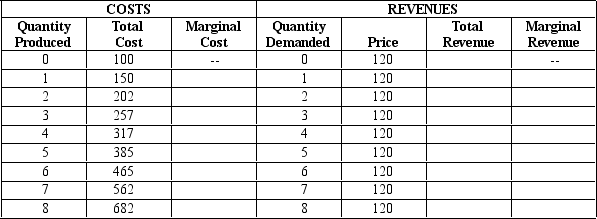 -Refer to Table 14-2.Consumers are willing to pay $120 per unit of port wine.What is the marginal revenue from selling the 3rd unit?
 (Multiple Choice)
4.9/5 (88)
(88) Competitive firms that earn a loss in the short run should
(Multiple Choice)
4.8/5 (78)
(78) Figure 14-1
The graph below depicts the cost structure for a firm in a competitive market.
 -Refer to Figure 14-1.When price rises from P₃ to P₄,the firm finds that
 (Multiple Choice)
4.9/5 (87)
(87) 
Filters
- Essay(0)
- Multiple Choice(0)
- Short Answer(0)
- True False(0)
- Matching(0)