



 Chat with AI
Exam 14: Firms in Competitive Markets

Exam 1: Ten Principles of Economics237 Questions
Exam 2: Thinking Like an Economist267 Questions
Exam 3: Interdependence and the Gains From Trade217 Questions
Exam 4: The Market Forces of Supply and Demand303 Questions
Exam 5: Elasticity and Its Applications282 Questions
Exam 6: Supply, demand, and Government Policies252 Questions
Exam 7: Consumers, producers, and the Efficiency of Markets248 Questions
Exam 8: Application: the Costs of Taxation245 Questions
Exam 9: Application: International Trade245 Questions
Exam 10: Externalities288 Questions
Exam 11: Public Goods and Common Resources258 Questions
Exam 12: The Design of the Tax System328 Questions
Exam 13: The Costs of Production303 Questions
Exam 14: Firms in Competitive Markets271 Questions
Exam 15: Monopoly306 Questions
Exam 16: Oligopoly291 Questions
Exam 17: Monopolistic Competition257 Questions
Exam 18: The Markets for the Factors of Production284 Questions
Exam 19: Earnings and Discrimination286 Questions
Exam 20: Income Inequality and Poverty247 Questions
Exam 21: The Theory of Consumer Choice238 Questions
Exam 22: Frontiers of Microeconomics199 Questions
Exam 23: Measuring a Nations Income215 Questions
Exam 24: Measuring the Cost of Living208 Questions
Exam 25: Production and Growth240 Questions
Exam 26: Saving, investment, and the Financial System282 Questions
Exam 27: The Basic Tools of Finance249 Questions
Exam 28: Unemployment242 Questions
Exam 29: The Monetary System277 Questions
Exam 30: Money Growth and Inflation224 Questions
Exam 31: Open-Economy Macroeconomics: Basic Concepts256 Questions
Exam 32: A Macroeconomic Theory of the Open Economy217 Questions
Exam 33: Aggregate Demand and Aggregate Supply302 Questions
Exam 34: The Influence of Monetary and Fiscal Policy on Aggregate Demand249 Questions
Exam 35: The Short Run Trade Off Between Inflation and Unemployment246 Questions
Exam 36: Five Debates Over Macroeconomic Policy140 Questions
Select questions type


A competitive firm might choose to set its price below the market price,because
(Multiple Choice)
4.9/5  (70)
(70) A competitive firm has been selling its output for $10 per unit and has been maximizing its profit.Then,the price rises to $14 and the firm makes whatever adjustments are necessary to maximize its profit at the now-higher price.Once the firm has adjusted,which of the following statements is correct?
(Multiple Choice)
4.9/5 (86)
(86) Figure 14-3
The figure below depicts the cost structure of a profit-maximizing firm in a competitive market.
 -Refer to Figure 14-3.This firm will exit the market for any price on the line segment
 (Multiple Choice)
4.9/5 (70)
(70) Susan quit her job as a teacher,which paid her $36,000 per year,in order to start her own catering business.She spent $12,000 of her savings,which had been earning 10 percent interest per year,on equipment for her business.She also borrowed $12,000 from her bank at 10 percent interest,which she also spent on equipment.For the past several months she has spent $1,000 per month on ingredients and other variable costs.Also for the past several months she has taken in $3,500 in monthly revenue.
(Multiple Choice)
4.9/5 (83)
(83) Scenario 14-1
As part of an estate settlement Mary received $1 million. She decided to use the money to purchase a small business in Anywhere, USA. If Mary would have invested the $1 million in a risk-free bond fund she could have made $100,000 each year. She also quit her job with Lucky.Com Inc. to devote all of her time to her new business; her salary at Lucky.Com Inc. was $75,000 per year.
-Refer to Scenario 14-1.What are Mary's opportunity costs of operating her new business?
(Multiple Choice)
4.9/5 (82)
(82) Suppose a firm operates in the short run at a price above its average total cost of production.In the long run the firm should expect
(Multiple Choice)
4.8/5 (85)
(85) Figure 14-3
The figure below depicts the cost structure of a profit-maximizing firm in a competitive market.
-Refer to Figure 14-3.Which line segment best reflects the long-run supply curve for this firm?
-Refer to Figure 14-3.Which line segment best reflects the long-run supply curve for this firm? (Multiple Choice)
4.9/5 (77)
(77) Because the goods offered for sale in a competitive market are largely the same,
(Multiple Choice)
4.9/5 (62)
(62) A profit-maximizing firm in a competitive market will always make marginal adjustments to production as long as
(Multiple Choice)
4.8/5 (81)
(81) When firms in a perfectly competitive market face the same costs,in the long run they must be operating
(Multiple Choice)
5.0/5 (85)
(85) Figure 14-7
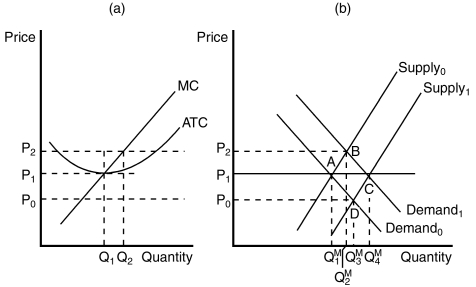 -Refer to Figure 14-7.Assume that the market starts in equilibrium at point A in panel (b).An increase in demand from Demand₀ to Demand₁ will result in
 (Multiple Choice)
4.8/5 (75)
(75) Changes in the output of a perfectly competitive firm,without any change in the price of the product,will change the firm's
(Multiple Choice)
4.9/5 (70)
(70) Table 14-1
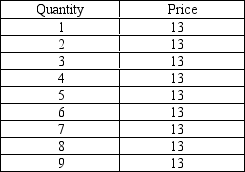 -Refer to Table 14-1.If the firm doubles its output from 3 to 6 units,total revenue will
 (Multiple Choice)
4.8/5 (84)
(84) When fixed costs are ignored because they are irrelevant to a business's production decision,they are called
(Multiple Choice)
4.7/5 (88)
(88) If a competitive firm is (i)selling 1,000 units of its product at a price of $9 per unit and (ii)earning a positive profit,then
(Multiple Choice)
4.7/5 (76)
(76) Which of the following statements is correct regarding a firm's decision-making?
(Multiple Choice)
4.8/5 (90)
(90) Which of the following could be used to calculate the profit for a firm?
(Multiple Choice)
4.8/5 (76)
(76) Table 14-2
The following table presents cost and revenue information for Soper's Port Vineyard.
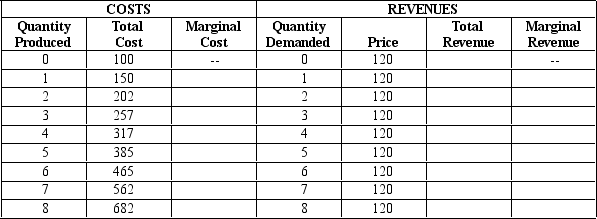 -Refer to Table 14-2.Consumers are willing to pay $120 per unit of port wine.What is the total revenue from selling 4 units?
 (Multiple Choice)
4.9/5 (86)
(86) Table 14-4
The following table presents cost and revenue information for John's Vineyard.
 -Refer to Table 14-4.What is the marginal revenue from selling the 1st unit?
 (Multiple Choice)
4.9/5 (81)
(81) If all firms have the same costs of production,then in long-run equilibrium,
(Multiple Choice)
4.9/5 (83)
(83) 
Filters
- Essay(0)
- Multiple Choice(0)
- Short Answer(0)
- True False(0)
- Matching(0)