



 Chat with AI
Exam 7: Consumers, producers, and the Efficiency of Markets

Exam 1: Ten Principles of Economics237 Questions
Exam 2: Thinking Like an Economist267 Questions
Exam 3: Interdependence and the Gains From Trade217 Questions
Exam 4: The Market Forces of Supply and Demand303 Questions
Exam 5: Elasticity and Its Applications282 Questions
Exam 6: Supply, demand, and Government Policies252 Questions
Exam 7: Consumers, producers, and the Efficiency of Markets248 Questions
Exam 8: Application: the Costs of Taxation245 Questions
Exam 9: Application: International Trade245 Questions
Exam 10: Externalities288 Questions
Exam 11: Public Goods and Common Resources258 Questions
Exam 12: The Design of the Tax System328 Questions
Exam 13: The Costs of Production303 Questions
Exam 14: Firms in Competitive Markets271 Questions
Exam 15: Monopoly306 Questions
Exam 16: Oligopoly291 Questions
Exam 17: Monopolistic Competition257 Questions
Exam 18: The Markets for the Factors of Production284 Questions
Exam 19: Earnings and Discrimination286 Questions
Exam 20: Income Inequality and Poverty247 Questions
Exam 21: The Theory of Consumer Choice238 Questions
Exam 22: Frontiers of Microeconomics199 Questions
Exam 23: Measuring a Nations Income215 Questions
Exam 24: Measuring the Cost of Living208 Questions
Exam 25: Production and Growth240 Questions
Exam 26: Saving, investment, and the Financial System282 Questions
Exam 27: The Basic Tools of Finance249 Questions
Exam 28: Unemployment242 Questions
Exam 29: The Monetary System277 Questions
Exam 30: Money Growth and Inflation224 Questions
Exam 31: Open-Economy Macroeconomics: Basic Concepts256 Questions
Exam 32: A Macroeconomic Theory of the Open Economy217 Questions
Exam 33: Aggregate Demand and Aggregate Supply302 Questions
Exam 34: The Influence of Monetary and Fiscal Policy on Aggregate Demand249 Questions
Exam 35: The Short Run Trade Off Between Inflation and Unemployment246 Questions
Exam 36: Five Debates Over Macroeconomic Policy140 Questions
Select questions type


A technological advance in the production of computers will
(Multiple Choice)
5.0/5  (76)
(76) At present,the maximum legal price for a human kidney is $0.The price of $0 maximizes
(Multiple Choice)
4.9/5 (102)
(102) Figure 7-8
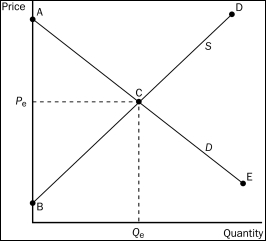 -Refer to Figure 7-8.Sellers whose costs are greater than price are represented by segment
 (Multiple Choice)
4.8/5 (71)
(71) Figure 7-1
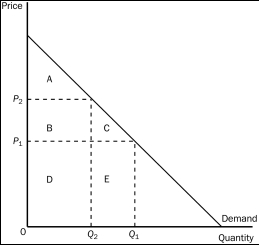 -Refer to Figure 7-1.When the price is P₂,consumer surplus is
 (Multiple Choice)
4.8/5 (96)
(96) Table 7-3
For each of three potential buyers of oranges, the table displays the willingness to pay for the first three oranges of the day. Assume Alex, Barb, and Carlos are the only three buyers of oranges, and only three oranges can be supplied per day.
 -Refer to Table 7-3.If the market price of an orange is $0.40,
 (Multiple Choice)
4.8/5 (81)
(81) Total surplus in a market is consumer surplus minus producer surplus.
(True/False)
4.7/5 (77)
(77) Figure 7-11. On the graph below, Q represents the quantity of the good and P represents the good's price.
 -Refer to Figure 7-11.At the equilibrium,producer surplus amounts to
 (Multiple Choice)
4.9/5 (79)
(79) Figure 7-6
 -Refer to Figure 7-6.When the price is P₂,producer surplus is
 (Multiple Choice)
4.9/5 (78)
(78) Economists argue that restrictions against ticket scalping actually drive up the cost of many tickets.
(True/False)
4.9/5 (80)
(80) Suppose Larry,Moe and Curly are bidding in an auction for a mint-condition video of Charlie Chaplin's first movie.Each has in mind a maximum amount that he will bid.This maximum is called
(Multiple Choice)
4.8/5 (97)
(97) In which of the following circumstances would a buyer be indifferent about buying a good?
(Multiple Choice)
4.8/5 (94)
(94) Figure 7-10
 -Refer to Figure 7-10.At the market-clearing equilibrium,total producer surplus is represented by the area
 (Multiple Choice)
4.9/5 (75)
(75) Efficiency is related to the size of the economic pie,whereas equity is related to how the pie gets sliced and distributed.
(True/False)
4.8/5 (71)
(71) Unless markets are perfectly competitive,they mail fail to maximize the total benefits to buyers and sellers.
(True/False)
5.0/5 (81)
(81) Figure 7-2
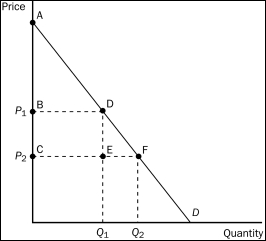 -Refer to Figure 7-2.Which area represents consumer surplus at a price of P₂?
 (Multiple Choice)
4.8/5 (91)
(91) Figure 7-6
-Refer to Figure 7-6.When the price is P₁,producer surplus is
-Refer to Figure 7-6.When the price is P₁,producer surplus is (Multiple Choice)
4.8/5 (72)
(72) Ivana produces cookies.Her production cost is $6 per dozen.She sells the cookies for $8 per dozen.Her producer surplus per dozen cookies is
(Multiple Choice)
4.9/5 (88)
(88) Suppose Katie,Kendra,and Kristen each purchase a particular type of cell phone at a price of $80.Katie's willingness to pay was $100,Kendras's willingness to pay was $95,and Kristen's willingness to pay was $80.Which of the following statements is correct?
(Multiple Choice)
4.9/5 (74)
(74) 
Filters
- Essay(0)
- Multiple Choice(0)
- Short Answer(0)
- True False(0)
- Matching(0)