



 Chat with AI
Exam 7: Consumers, producers, and the Efficiency of Markets

Exam 1: Ten Principles of Economics237 Questions
Exam 2: Thinking Like an Economist267 Questions
Exam 3: Interdependence and the Gains From Trade217 Questions
Exam 4: The Market Forces of Supply and Demand303 Questions
Exam 5: Elasticity and Its Applications282 Questions
Exam 6: Supply, demand, and Government Policies252 Questions
Exam 7: Consumers, producers, and the Efficiency of Markets248 Questions
Exam 8: Application: the Costs of Taxation245 Questions
Exam 9: Application: International Trade245 Questions
Exam 10: Externalities288 Questions
Exam 11: Public Goods and Common Resources258 Questions
Exam 12: The Design of the Tax System328 Questions
Exam 13: The Costs of Production303 Questions
Exam 14: Firms in Competitive Markets271 Questions
Exam 15: Monopoly306 Questions
Exam 16: Oligopoly291 Questions
Exam 17: Monopolistic Competition257 Questions
Exam 18: The Markets for the Factors of Production284 Questions
Exam 19: Earnings and Discrimination286 Questions
Exam 20: Income Inequality and Poverty247 Questions
Exam 21: The Theory of Consumer Choice238 Questions
Exam 22: Frontiers of Microeconomics199 Questions
Exam 23: Measuring a Nations Income215 Questions
Exam 24: Measuring the Cost of Living208 Questions
Exam 25: Production and Growth240 Questions
Exam 26: Saving, investment, and the Financial System282 Questions
Exam 27: The Basic Tools of Finance249 Questions
Exam 28: Unemployment242 Questions
Exam 29: The Monetary System277 Questions
Exam 30: Money Growth and Inflation224 Questions
Exam 31: Open-Economy Macroeconomics: Basic Concepts256 Questions
Exam 32: A Macroeconomic Theory of the Open Economy217 Questions
Exam 33: Aggregate Demand and Aggregate Supply302 Questions
Exam 34: The Influence of Monetary and Fiscal Policy on Aggregate Demand249 Questions
Exam 35: The Short Run Trade Off Between Inflation and Unemployment246 Questions
Exam 36: Five Debates Over Macroeconomic Policy140 Questions
Select questions type


The following table represents the costs of five possible sellers.
Table 7-4
 -Refer to Table 7-4.If the market price is $1,000,the producer surplus in the market is
 (Multiple Choice)
4.8/5  (87)
(87) At Nick's Bakery,the cost to make homemade chocolate cake is $3 per cake.As a result of selling three cakes,Nick experiences a producer surplus in the amount of $19.50.Nick must be selling his cakes for
(Multiple Choice)
4.8/5 (76)
(76) Figure 7-4
 -Refer to Figure 7-4.Which area represents producer surplus when the price is P₁?
 (Multiple Choice)
4.9/5 (75)
(75) Even though participants in the economy are motivated by self-interest,the "invisible hand" of the marketplace guides this self-interest into promoting general economic well-being.
(True/False)
4.9/5 (78)
(78) Free markets allocate (a)the supply of goods to the buyers who value them most highly and (b)the demand for goods to the sellers who can produce them at least cost.
(True/False)
4.9/5 (72)
(72) Figure 7-9
 -Refer to Figure 7-9.If 40 units of the good are being bought and sold,then
 (Multiple Choice)
4.7/5 (73)
(73) Figure 7-3.
On the graph below, Q represents the quantity of the good and P represents the good's price.
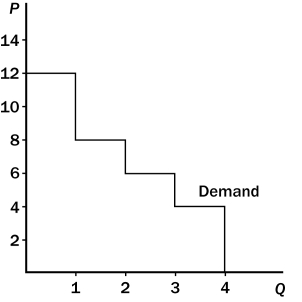 -Refer to Figure 7-3.If the price of the good is $6,then consumer surplus is
 (Multiple Choice)
4.9/5 (68)
(68) The study of how the allocation of resources affects economic well-being is called
(Multiple Choice)
4.8/5 (73)
(73) Table 7-1
 -Refer to Table 7-1.If the table represents the willingness to pay of four buyers and the price of the product is $15,then who would be willing to purchase the product?
 (Multiple Choice)
5.0/5 (84)
(84) Market Supply and Demand for Pepperoni Pizza
Table 7-5
 -Refer to Table 7-5.As the table suggests,the demand curve is a straight line and so is the supply curve.Take this into account and suppose the price is $8,with only 4 pizzas being bought and sold.Producer surplus amounts to
 (Multiple Choice)
4.7/5 (79)
(79) When there is a technological advance in the ice cream industry,consumer surplus in that market will
(Multiple Choice)
4.7/5 (69)
(69) Market Supply and Demand for Pepperoni Pizza
Table 7-5
-Refer to Table 7-5.The equilibrium or market-clearing price is
-Refer to Table 7-5.The equilibrium or market-clearing price is (Multiple Choice)
4.8/5 (75)
(75) Kristi and Rebecca sell lemonade on the corner.It costs them 7 cents to make each cup.On a certain day,they sell 40 cups,and their producer surplus for that day amounts to $15.20.Kristi and Rebecca sold each cup for
(Multiple Choice)
4.9/5 (83)
(83) Denise values a stainless steel dishwasher for her new house at $500,but she succeeds in buying one for $350.Denise's willingness to pay is
(Multiple Choice)
4.9/5 (84)
(84) 
Filters
- Essay(0)
- Multiple Choice(0)
- Short Answer(0)
- True False(0)
- Matching(0)