



 Chat with AI
Exam 7: Consumers, producers, and the Efficiency of Markets

Exam 1: Ten Principles of Economics237 Questions
Exam 2: Thinking Like an Economist267 Questions
Exam 3: Interdependence and the Gains From Trade217 Questions
Exam 4: The Market Forces of Supply and Demand303 Questions
Exam 5: Elasticity and Its Applications282 Questions
Exam 6: Supply, demand, and Government Policies252 Questions
Exam 7: Consumers, producers, and the Efficiency of Markets248 Questions
Exam 8: Application: the Costs of Taxation245 Questions
Exam 9: Application: International Trade245 Questions
Exam 10: Externalities288 Questions
Exam 11: Public Goods and Common Resources258 Questions
Exam 12: The Design of the Tax System328 Questions
Exam 13: The Costs of Production303 Questions
Exam 14: Firms in Competitive Markets271 Questions
Exam 15: Monopoly306 Questions
Exam 16: Oligopoly291 Questions
Exam 17: Monopolistic Competition257 Questions
Exam 18: The Markets for the Factors of Production284 Questions
Exam 19: Earnings and Discrimination286 Questions
Exam 20: Income Inequality and Poverty247 Questions
Exam 21: The Theory of Consumer Choice238 Questions
Exam 22: Frontiers of Microeconomics199 Questions
Exam 23: Measuring a Nations Income215 Questions
Exam 24: Measuring the Cost of Living208 Questions
Exam 25: Production and Growth240 Questions
Exam 26: Saving, investment, and the Financial System282 Questions
Exam 27: The Basic Tools of Finance249 Questions
Exam 28: Unemployment242 Questions
Exam 29: The Monetary System277 Questions
Exam 30: Money Growth and Inflation224 Questions
Exam 31: Open-Economy Macroeconomics: Basic Concepts256 Questions
Exam 32: A Macroeconomic Theory of the Open Economy217 Questions
Exam 33: Aggregate Demand and Aggregate Supply302 Questions
Exam 34: The Influence of Monetary and Fiscal Policy on Aggregate Demand249 Questions
Exam 35: The Short Run Trade Off Between Inflation and Unemployment246 Questions
Exam 36: Five Debates Over Macroeconomic Policy140 Questions
Select questions type


Figure 7-4
 -Refer to Figure 7-4.Which area represents producer surplus when the price is P₂?
 (Multiple Choice)
5.0/5  (79)
(79) Dallas buys strawberries,and he would be willing to pay more than he now pays.Suppose that Dallas has a change in his tastes such that he values strawberries more than before.If the market price is the same as before,then
(Multiple Choice)
4.8/5 (80)
(80) Consumer surplus measures the benefit to buyers of participating in a market.
(True/False)
4.8/5 (82)
(82) Figure 7-5. On the graph below, Q represents the quantity of the good and P represents the good's price.
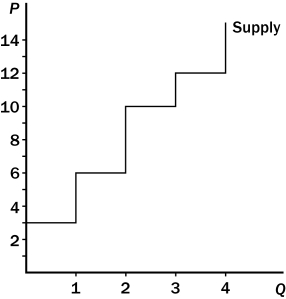 -Refer to Figure 7-5.If the price of the good is $8.50,then producer surplus is
 (Multiple Choice)
4.8/5 (95)
(95) Denise values a stainless steel dishwasher for her new house at $500.The actual price of the dishwasher is $650.Denise
(Multiple Choice)
4.8/5 (80)
(80) Laissez-faire is a French expression which literally means
(Multiple Choice)
4.8/5 (78)
(78) Suppose there is an early freeze in California that reduces the size of the lemon crop.What happens to consumer surplus in the market for lemons?
(Multiple Choice)
4.9/5 (91)
(91) Figure 7-11. On the graph below, Q represents the quantity of the good and P represents the good's price.
 -Refer to Figure 7-11.At the equilibrium,producer surplus is measured by the area
 (Multiple Choice)
4.8/5 (72)
(72) Suppose televisions are a normal good and buyers of televisions experience a decrease in income.As a result,consumer surplus in the television market
(Multiple Choice)
4.9/5 (70)
(70) Figure 7-10
 -Refer to Figure 7-10.The efficient price-quantity combination is
 (Multiple Choice)
4.9/5 (78)
(78) Figure 7-9
 -Refer to Figure 7-9.If 110 units of the good are being bought and sold,then
 (Multiple Choice)
4.8/5 (68)
(68) The decisions of buyers and sellers that affect people who are not participants in the market create
(Multiple Choice)
4.9/5 (83)
(83) Figure 7-11. On the graph below, Q represents the quantity of the good and P represents the good's price.
-Refer to Figure 7-11.At the equilibrium,consumer surplus is measured by the area
-Refer to Figure 7-11.At the equilibrium,consumer surplus is measured by the area (Multiple Choice)
4.8/5 (72)
(72) At the equilibrium price of a good,the good will be purchased by those buyers who
(Multiple Choice)
4.8/5 (81)
(81) Figure 7-9
-Refer to Figure 7-9.At the equilibrium price,consumer surplus is
-Refer to Figure 7-9.At the equilibrium price,consumer surplus is (Multiple Choice)
4.9/5 (64)
(64) When market price increases,producer surplus increases because (1)producer surplus received by existing sellers increases,and (2)new sellers enter the market.
(True/False)
4.9/5 (87)
(87) Figure 7-2
 -Refer to Figure 7-2.When the price falls from P₁ to P₂,which area represents the increase in consumer surplus to existing buyers?
 (Multiple Choice)
4.9/5 (73)
(73) 
Filters
- Essay(0)
- Multiple Choice(0)
- Short Answer(0)
- True False(0)
- Matching(0)