



 Chat with AI
Exam 7: Consumers, producers, and the Efficiency of Markets

Exam 1: Ten Principles of Economics237 Questions
Exam 2: Thinking Like an Economist267 Questions
Exam 3: Interdependence and the Gains From Trade217 Questions
Exam 4: The Market Forces of Supply and Demand303 Questions
Exam 5: Elasticity and Its Applications282 Questions
Exam 6: Supply, demand, and Government Policies252 Questions
Exam 7: Consumers, producers, and the Efficiency of Markets248 Questions
Exam 8: Application: the Costs of Taxation245 Questions
Exam 9: Application: International Trade245 Questions
Exam 10: Externalities288 Questions
Exam 11: Public Goods and Common Resources258 Questions
Exam 12: The Design of the Tax System328 Questions
Exam 13: The Costs of Production303 Questions
Exam 14: Firms in Competitive Markets271 Questions
Exam 15: Monopoly306 Questions
Exam 16: Oligopoly291 Questions
Exam 17: Monopolistic Competition257 Questions
Exam 18: The Markets for the Factors of Production284 Questions
Exam 19: Earnings and Discrimination286 Questions
Exam 20: Income Inequality and Poverty247 Questions
Exam 21: The Theory of Consumer Choice238 Questions
Exam 22: Frontiers of Microeconomics199 Questions
Exam 23: Measuring a Nations Income215 Questions
Exam 24: Measuring the Cost of Living208 Questions
Exam 25: Production and Growth240 Questions
Exam 26: Saving, investment, and the Financial System282 Questions
Exam 27: The Basic Tools of Finance249 Questions
Exam 28: Unemployment242 Questions
Exam 29: The Monetary System277 Questions
Exam 30: Money Growth and Inflation224 Questions
Exam 31: Open-Economy Macroeconomics: Basic Concepts256 Questions
Exam 32: A Macroeconomic Theory of the Open Economy217 Questions
Exam 33: Aggregate Demand and Aggregate Supply302 Questions
Exam 34: The Influence of Monetary and Fiscal Policy on Aggregate Demand249 Questions
Exam 35: The Short Run Trade Off Between Inflation and Unemployment246 Questions
Exam 36: Five Debates Over Macroeconomic Policy140 Questions
Select questions type


This table refers to five possible buyers' willingness to pay for a case of Vanilla Coke.
Table 7-2
 -Refer to Table 7-2.If the price of Vanilla Coke is $6.90,who will purchase the good?
 (Multiple Choice)
4.8/5  (76)
(76) If the demand for a good or service decreases,producer surplus
(Multiple Choice)
4.9/5 (86)
(86) Figure 7-7
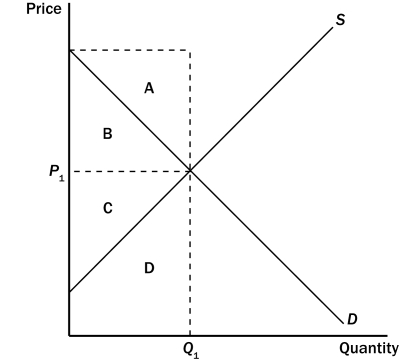 -Refer to Figure 7-7.Which area represents consumer surplus when the price is P₁?
 (Multiple Choice)
4.9/5 (74)
(74) According to many economists,government restrictions on ticket scalping do all of the following except
(Multiple Choice)
5.0/5 (70)
(70) If a market is allowed to move freely to its equilibrium price and quantity,then an increase in supply will
(Multiple Choice)
4.9/5 (69)
(69) Producer surplus is the amount a seller is paid minus the cost of production.
(True/False)
4.9/5 (88)
(88) Shannon buys a new CD player for her car for $135.She receives consumer surplus of $25 on her purchase if her willingness to pay is
(Multiple Choice)
4.7/5 (79)
(79) Ray buys a new tractor for $118,000.He receives consumer surplus of $13,000 on his purchase.Ray's willingness to pay is
(Multiple Choice)
4.8/5 (77)
(77) Suppose your own demand curve for tomatoes slopes downward.Suppose also that,for the last tomato you bought this week,you paid a price exactly equal to your willingness to pay.Then
(Multiple Choice)
4.8/5 (84)
(84) Suppose the market demand curve for a good passes through the point (quantity demanded = 100,price = $25).If there are five buyers in the market,then
(Multiple Choice)
4.7/5 (83)
(83) Figure 7-11. On the graph below, Q represents the quantity of the good and P represents the good's price.
 -Refer to Figure 7-11.At the equilibrium,total surplus is measured by the area
 (Multiple Choice)
4.9/5 (89)
(89) Figure 7-5. On the graph below, Q represents the quantity of the good and P represents the good's price.
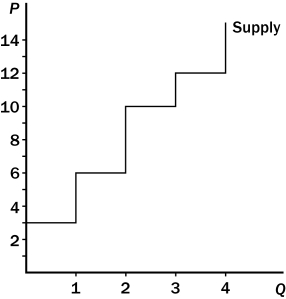 -Refer to Figure 7-5.If the price of the good is $14,then producer surplus is
 (Multiple Choice)
4.8/5 (86)
(86) The area below the price and above the supply curve measures the producer surplus in a market.
(True/False)
4.8/5 (76)
(76) If a market is allowed to adjust freely to its equilibrium price and quantity,then an increase in demand will
(Multiple Choice)
4.9/5 (79)
(79) Sally sharpens knives in her spare time for extra income.Buyers of her service are willing to pay $2.50 per knife for as many knives as Sally is willing to sharpen.On a particular day,she is willing to sharpen the first knife for $1.75,the second knife for $2.25,the third knife for $2.75,and the fourth knife for $3.25.Assume Sally is rational in deciding how many knives to sharpen.Her producer surplus is
(Multiple Choice)
4.7/5 (79)
(79) What happens to consumer surplus if the price of a good increases?
(Multiple Choice)
4.8/5 (88)
(88) Table 7-3
For each of three potential buyers of oranges, the table displays the willingness to pay for the first three oranges of the day. Assume Alex, Barb, and Carlos are the only three buyers of oranges, and only three oranges can be supplied per day.
 -Refer to Table 7-3.If the market price of an orange is $1.20,the market quantity of oranges demanded per day is
 (Multiple Choice)
4.8/5 (90)
(90) Figure 7-2
 -Refer to Figure 7-2.Which area represents the increase in consumer surplus when the price falls from P₁ to P₂?
 (Multiple Choice)
4.9/5 (82)
(82) 
Filters
- Essay(0)
- Multiple Choice(0)
- Short Answer(0)
- True False(0)
- Matching(0)