



 Chat with AI
Exam 7: Consumers, producers, and the Efficiency of Markets

Exam 1: Ten Principles of Economics237 Questions
Exam 2: Thinking Like an Economist267 Questions
Exam 3: Interdependence and the Gains From Trade217 Questions
Exam 4: The Market Forces of Supply and Demand303 Questions
Exam 5: Elasticity and Its Applications282 Questions
Exam 6: Supply, demand, and Government Policies252 Questions
Exam 7: Consumers, producers, and the Efficiency of Markets248 Questions
Exam 8: Application: the Costs of Taxation245 Questions
Exam 9: Application: International Trade245 Questions
Exam 10: Externalities288 Questions
Exam 11: Public Goods and Common Resources258 Questions
Exam 12: The Design of the Tax System328 Questions
Exam 13: The Costs of Production303 Questions
Exam 14: Firms in Competitive Markets271 Questions
Exam 15: Monopoly306 Questions
Exam 16: Oligopoly291 Questions
Exam 17: Monopolistic Competition257 Questions
Exam 18: The Markets for the Factors of Production284 Questions
Exam 19: Earnings and Discrimination286 Questions
Exam 20: Income Inequality and Poverty247 Questions
Exam 21: The Theory of Consumer Choice238 Questions
Exam 22: Frontiers of Microeconomics199 Questions
Exam 23: Measuring a Nations Income215 Questions
Exam 24: Measuring the Cost of Living208 Questions
Exam 25: Production and Growth240 Questions
Exam 26: Saving, investment, and the Financial System282 Questions
Exam 27: The Basic Tools of Finance249 Questions
Exam 28: Unemployment242 Questions
Exam 29: The Monetary System277 Questions
Exam 30: Money Growth and Inflation224 Questions
Exam 31: Open-Economy Macroeconomics: Basic Concepts256 Questions
Exam 32: A Macroeconomic Theory of the Open Economy217 Questions
Exam 33: Aggregate Demand and Aggregate Supply302 Questions
Exam 34: The Influence of Monetary and Fiscal Policy on Aggregate Demand249 Questions
Exam 35: The Short Run Trade Off Between Inflation and Unemployment246 Questions
Exam 36: Five Debates Over Macroeconomic Policy140 Questions
Select questions type


Figure 7-4
 -Refer to Figure 7-4.Which area represents the increase in producer surplus when the price rises from P₁ to P₂ due to new producers entering the market?
 (Multiple Choice)
4.8/5  (68)
(68) Which of the Ten Principles of Economics does welfare economics explain more fully?
(Multiple Choice)
4.8/5 (82)
(82) The French expression used by free-market advocates,which literally translates as "allow them to do," is
(Multiple Choice)
4.9/5 (84)
(84) Figure 7-6
 -Refer to Figure 7-6.When the price falls from P₂ to P₁,which of the following would not be true?
 (Multiple Choice)
4.8/5 (76)
(76) Efficiency refers to whether a market outcome is fair,while equity refers to whether the maximum amount of output was produced from a given number of inputs.
(True/False)
4.8/5 (92)
(92) The willingness to pay is the maximum amount that a buyer will pay for a good and measures how much the buyer values the good.
(True/False)
4.9/5 (81)
(81) Figure 7-11. On the graph below, Q represents the quantity of the good and P represents the good's price.
 -Refer to Figure 7-11.The equilibrium allocation of resources is
 (Multiple Choice)
4.9/5 (90)
(90) Ally mows lawns for a living.Ally's out-of-pocket expenses (for equipment,gasoline,and so on)plus the value that she places on her own time amount to her
(Multiple Choice)
4.8/5 (87)
(87) Figure 7-9
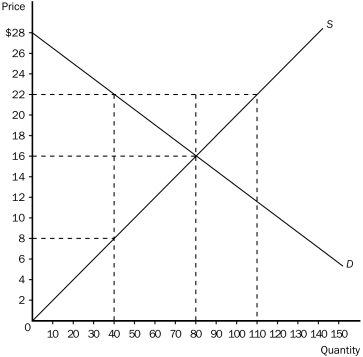 -Refer to Figure 7-9.Assume demand increases and as a result,equilibrium price increases to $22 and equilibrium quantity increases to 110.The increase in producer surplus is equal to
 (Multiple Choice)
5.0/5 (81)
(81) Figure 7-9
-Refer to Figure 7-9.Assume demand increases and as a result,equilibrium price increases to $22 and equilibrium quantity increases to 110.The increase in producer surplus to producers already in the market would be equal to
-Refer to Figure 7-9.Assume demand increases and as a result,equilibrium price increases to $22 and equilibrium quantity increases to 110.The increase in producer surplus to producers already in the market would be equal to (Multiple Choice)
4.8/5 (81)
(81) Suppose Bart,Benjamin,and Brent each purchase a particular type of electric pencil sharpener at a price of $20.Bart's willingness to pay was $22,Benjamin's willingness to pay was $25,and Brent's willingness to pay was $30.Which of the following statements is correct?
(Multiple Choice)
4.8/5 (73)
(73) Motor oil and gasoline are complements.If the price of motor oil increases,consumer surplus in the gasoline market
(Multiple Choice)
4.9/5 (73)
(73) When the demand for a good increases and the supply of the good remains unchanged,consumer surplus
(Multiple Choice)
4.8/5 (77)
(77) Suppose that the equilibrium price in the market for widgets is $5.If a law increased the minimum legal price for widgets to $6,
(Multiple Choice)
4.8/5 (83)
(83) Which of the following events would increase producer surplus?
(Multiple Choice)
4.8/5 (89)
(89) Table 7-3
For each of three potential buyers of oranges, the table displays the willingness to pay for the first three oranges of the day. Assume Alex, Barb, and Carlos are the only three buyers of oranges, and only three oranges can be supplied per day.
 -Refer to Table 7-3.Who experiences the largest loss of consumer surplus when the price of an orange increases from $0.70 to $1.40?
 (Multiple Choice)
4.9/5 (84)
(84) Total surplus in a market is represented by the total area
(Multiple Choice)
4.8/5 (79)
(79) 
Filters
- Essay(0)
- Multiple Choice(0)
- Short Answer(0)
- True False(0)
- Matching(0)